Tampilkan postingan dengan label VLDL. Tampilkan semua postingan

Jumat, 19 Februari 2016

High Dose Stevia Turns Weight Gain into Loss, Lowers Lipid and Glucose Levels not Only When Used to Replace Sugar - Effects are Mediated by Reduced Energy Intake & Utilization

There's very little "natural" about the natural sweetener stevia when it ends up in your food in form of purified and decolorized steviosids.
As a SuppVersity reader you'll know that "natural" does not equate "healthy". This, the proven anti-microbial effects stevia exerts in your gut and the fact that the currently available steviosid-based stevia products undergo more processing steps than than the dreaded aspartame warrant the question whether (a) stevia is safe and (b) as effective as other sweeteners when it comes to weight loss promotion.

Since the optimal dosage of stevia to achieve meaningful effects is also not known, yet, scientists from the Alexandria University in Egypt investigated the safety ad efficacy of different amounts of stevia sweeteners (25, 250, 500 and 1000 mg/kg body weight per day) as a substitute for sucrose on weight gain or the weight loss and weight management of female rats on an ad-libitum diet.
You can learn more about sweeteners at the SuppVersity

Aspartame & Your Microbiome - Not a Problem?

Will Artificial Sweeteners Spike Insulin?

Sweeteners & the Gut Microbiome Each is Diff.

Chronic Sweeten-er Intake Won't Effect Microbiome

Stevia, the Healthy Sweetener?

Sweeteners In- crease Sweet- ness Threshold
Sixty adult female Wistar strain rats (average weight 203 ± 6 g) were used in the present experiment. Animals were obtained from Faculty of Medicine, Alexandria University, Egypt. Animals were caged in groups of 6 and given distilled water and a standard diet that meets their requirements for growing ad libitum. The diet consisted of  44% soybean cake; 12% berseem clover hay, 13.5% fat, 9.8% yellow maize, 13.2% starch, 5% minerals; 2% lime stone and 0.5% vitamins mixture. After two weks of acclimatization, animals were divided into six equal groups:
  • The first group was drank distilled water (Negative control), and positive control was given a dose of sucrose dissolved in drinking water at 500 mg/kg/day. This dose of sucrose used in this experiment was predicted to dose of stevia sweeteners equivalent concentration estimated by JECFA as control. 
  • "On the other hand, groups 3, 4, 5 and 6 were given a different doses of stevia sweeteners which were dissolved in drinking water at a dose level of 25 mg/kg/day (human equivalent dosage, HED = 4 mg/kg/day) according to JECFA (G1), 250 mg/kg/day (G2: HED = 41 mg//kg/day), 500 mg/kg/day (G3: HED = 81 mg/kg/day) and 1000 mg/kg/day (G4: HED = 162 mg/kg/day ), respectively" (Elnaga. 2016)
To assess how much stevia the animals actually consumed, the scientists recorded the animals fluid intake daily. To ensure constant intakes in all groups, they adjusted the solution concentrations weekly based on the average weight of the animals and their current fluid consumption.
At the end of the experimental period (12 weeks), body weights of animals were recorded and calculated of body weights gain (%) and feed efficiency ratio (FER) according to the method of Chapman et al. (1959).
Figure 1: Body weight of rats treated with administration of sucrose (S) and stevia sweetener different dosages (25, 250, 500 and 1000 mg/kg) for 12 weeks compared with control (Elnaga. 2016).
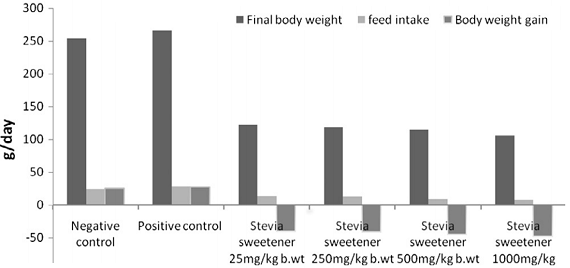
You probably expected that the replacement of sugar with stevia would lead to significant reductions in body weight gain, right? Well, if you scrutinize the data in Figure 1, you will notice that the effect went far beyond a reduction in weight gain. In fact, all stevia supplemented animals lost weight - dose-dependently 40.29%-48.29%.
Figure 2: Organ weights relative to body weight of female rats treated with stevia sweetener at doses of 25, 250, 500 and 1000 mg/kg b. wt and sucrose compared with control (Elnaga. 2016).
This certainly sounds like bad news, but the data in Figure 2 tells you that the weight of all important organs (liver, heart, brain, kidney, lung, pancreas and spleen) remained stable. Unfortunately, the scientists did not measure muscle and fatpad weight.
Figure 3: Final body weight, feed intake and body weight gain % in rats treated with administration of stevia sweetener in different dosages (25, 250, 500 and 1000 mg/kg) after 12 weeks on ad-libitum diet (Elnaga. 2016).
In view of the significantly reduced feed intake (>50%) and the even more reduced feed efficiency ratio (FER), of which the scientists say that it was the lowest at a dose 1000 mg/kg b.wt stevia ( -6.14) and increased with decreasing stevia intakes (-5.21, -3.22 FER and -2.91 FER), it would yet be unreasonable to assume that the weight difference was a results of fat loss, alone.
What about human studies? And what's the mechanism? Comparable human studies haven't been done and the fact that a 2005 study by Chang et al. suggests that the body weight loss of rats receiving 5.0 mg/kg stevioside was due to the poor palatability of the food because of the high amount of stevioside. It is thus questionable if stevia would work the same magic in humans. Ok, in the study at hand, the sweetener was gavaged in the drinking water, but the food intake still decreased significantly. Significantly enough to trigger profound weight loss even in the absence of the reduced feed efficacy (see Figure 3); and even the reductions in blood lipids and glucose could eventually be a function of weight loss - even though, studies appear to suggest that stevia has insulinotropic, glucagonostatic, antihyperglycemic, and blood-pressure-lowering effects all of which would suggest that it could be more than a sugar replacement (Gregersen. 2004; Hony. 2006).
Aside from the questionable weight loss, the three groups of rats treated with stevia sweetener showed improvement in lipid profile levels comparing with negative or positive control group. More specifically,
  • ... the total lipid levels of the rodents decreased by 11.96%, 19.89%, 25.03% and 37.07% when rats were given stevia sweetener at doses of 25, 250, 500 and 1000 mg/kg/b. wt, respectively compared to negative control,
  • ... the LDL values in rat serum lipids decreased with increasing the doses of stevia sweetener; rats given stevia sweetener at dose 1000 mg/kg b. wt showed the highest decrease in the LDL (26.50%) followed by those given dose 500 mg/kg (24.36%), dose 250 mg/kg (19.90%) and finally dose 25 mg/kg (15.01%), and 
  • ... the VLDL levels were decreased 3.13%, 11.18%, 19.87% and 26.08% in rats given stevia sweetener at doses of 25, 250, 500 and 1000 mg/kg.
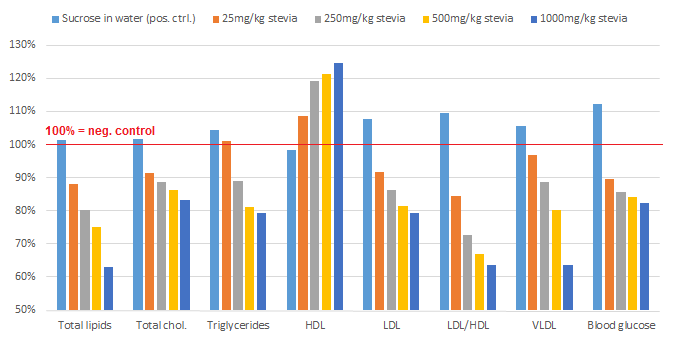
The decreases in total, LDL and VLDL cholesterol stand in contrast to significant increase in HDL and corresponding decreases of the LDL/HDL ratio from 3.43 and 3.76 in the negative and positive control group to 2.90, 2.49, 2.30 and 2.18 in the 25mg/kg, 250mg/kg, 500mg/kg and 1000mg/kg groups, respectively.
Figure 4: Blood lipids and glucose levels after 12 weeks on high sucrose water with different amounts of stevia replacing the sucrose in the water; data expressed relative to negative (=water) control (Elnaga. 2016).
Ill effects on markers of liver health or general blood parameters were not observed and the significant decrease in blood glucose levels, I added to the relative changes in lipid levels in Figure 4, is certainly nothing to be concerned about.
Bottom line: Just as the scientists put it, "the stevia sweetener treated groups showed significantly improvement and ameliorated reduction in bodyweight, BWG % and lesser intake of feed" (Elnaga. 2016). In conjunction with the "decreasing [...] levels of blood glucose, total lipids, total cholesterol, triglycerides and low-density lipoprotein concentrations, and increasing [...] high-density lipoprotein" (ibid.) concentrations the study at hand appears to suggest that stevia was a wonder-drug.

Study indicates stevia kills healthy gut bacteria. So, how bad is it? Are the effects significant, will they have an impact on your overall health and does this mean you must not use stevia any longer? Learn more in this SV Classic
Two things you must not forget, though, are that (a) the health benefits were most pronounced in comparison to the "positive control", i.e. the sucrose guzzling rats that represent the average sugar-sweetened beverage junkie and that (b) the >40% of weight the rodents lost certainly didn't come from body fat, exclusively.

In view of the contemporary lack of data that would confirm the beneficial effects of several grams of stevia (the dose equivalents for an adult are  ~0.2, ~1.6, ~3.2, ~6.5g per day, respectively) on the body composition and lipid levels of human beings, I must caution against being too euphoric about the results of this study, anyways. | Comment!
References:
  • Chang, J. C., et al. "Increase of insulin sensitivity by stevioside in fructose-rich chow-fed rats." Hormone and metabolic research= Hormon-und Stoffwechselforschung= Hormones et metabolisme 37.10 (2005): 610-616.
  • Elnaga, NIE Abo, et al. "Effect of stevia sweetener consumption as non-caloric sweetening on body weight gain and biochemical’s parameters in overweight female rats." Annals of Agricultural Sciences (2016).
  • Gregersen, Søren, et al. "Antihyperglycemic effects of stevioside in type 2 diabetic subjects." Metabolism 53.1 (2004): 73-76.
  • Hong, Jing, et al. "Stevioside counteracts the α-cell hypersecretion caused by long-term palmitate exposure." American Journal of Physiology-Endocrinology and Metabolism 290.3 (2006): E416-E422.

Jumat, 23 Oktober 2015

Silicon-Powered Anti-Heart Disease Sausages / High Protein Breakfast, High Satiety, No Change in Food Intake / 49% Higher Chance of Healthy Aging Depends on Moderation

Can you pump them up w/ silicon and to negate their atherosclerotic effects!? 
In today's installment of the Nutrition Research Update in the Short News, I am going to tackle three studies that deal with the surprisingly pronounced, yet practically potentially irrelevant benefits of eating a high protein breakfast, silicon... not in breasts, but sausages as a means to protect you from heart disease and the fact that calories count so much that even on a "healthy diet" only those who eat in moderation will age healthily.

That sounds interesting? Fine! I am not going to waste any more time and will fast forward to the first study...
Read more short news on various topics here at the SuppVersity

Exercise Research Uptake Nov '14 1/2

Exercise Research Uptake Nov '14 2/2

Nutrition and (Anti-)Aging News Special

Exercise Supplementation Quickie

Exercise Research Uptake Jan 12, 2015

Read the Latest Ex. Science Update
  • Breakfasts Higher in Protein Increase Postprandial Energy Expenditure, Increase Fat Oxidation, and Reduce Hunger in Overweight Children from 8 to 12 Years of Age - In the eponymous study, Baum et al. determined whether consumption of a protein-based breakfast (PRO) increases postprandial energy metabolism and substrate oxidation, reduces hunger, and reduces food intake at lunch compared with a carbohydrate-based breakfast (CHO) in normal weight (NW) vs. overweight/obese (OW) children. Both, the normal and over-weight children participated in the same randomized, crossover protocol that arranged for all participants to be served a
    • high PRO [344 kcal, 21% protein (18 g), 52% carbohydrate, and 27% fat] or 
    • high CHO [327 kcal, 4% protein (3 g), 67% carbohydrate, and 29% fat]
    breakfast, after which the energy expenditure (EE), substrate oxidation, appetite, and blood glucose were measured over a 4 h period. To access whether the high protein intake would also affect the participants appetite, the subjects had free access to a lunch buffet and food intake was recorded.
    Figure 1: Energy expenditure, fat and carbohydrate oxidation in the 4h post breakfast (Blum. 2015).
    The results were unambiguous: After breakfast, OW children in the PRO group had higher (P < 0.0001) EEs and fat oxidation over the 4 h period than did the NW children in the CHO and PRO groups. Of these, the increase in energy expenditure was transient and didn't last for the full 4h period. The increase in fat oxidation in response to the high protein intake, on the other hand, lasted for the full 4 h period (+16%; P < 0.05) and went hand in hand with a surprisingly pronounced 32% increase in carbohydrate oxidation in the PRO vs. CHO (P < 0.01) trial.
    Table 1: Despite decreased hunger and increased fullness, the protein breakfast did not reduce the total energy intake or modify the macronutrient ratio of the foods the kids selected at the lunch buffet (Baum. 2015).
    Now, all this sounds great, but even though the subjects experienced decreased feelings of hunger (−14%; P < 0.01) and increased fullness (+32%; P < 0.05) after the PRO than the CHO breakfast, the lack of effect on the intake at the subsequent ad-libitum lunch is disappointing to say the least. This and the lack of long-term data make it very difficult to predict if a similar increase in protein during breakfast only would actually help the subjects lose weight.  
  • Silicon ... not breasts, but enhanced meat may protect older individuals against atherosclerosis - That's at least what a recent rodent study by Garcimartin et al. (2015) suggests.
    "Research has shown that silicon can play an important role in protecting against degenerative diseases. Restructuring pork by partially disassembling meat would permit the incorporation of active components with potential functional effects. However, there has been no research to date on the impact that silicon, as a functional ingredient in restructured pork (RP), has on lipoprotein composition, metabolism, and oxidation" (Garcimartin. 2015).
    In order to find out whether the addition of silicon would actually have a meaningful effect, the scientists added 1.3g/kg silicon to sausages that were then fed to one group of old rodents while the rest received regular, non-enriched sausages as part of regular and pro-atherogenic cholesterol-enriched diets.

    The results were quite astonishing, as is partially normalized the changes induced by the high cholesterol diet. Compared with the rodents who received the regular sausages, those on the silicon sausages had lower VLDL compound concentrations (P < 0.001; e.g., 75% less VLDL cholesterol) and a significantly reduced VLDL oxidation (65% less conjugated dienes and 85% less TBARS) that went hand in hand with an increase in LDL-receptor expression (200% more).
    Figure 1: The silicon in the sausages increased the LDL receptor density to (almost) normal, the amount of cholesterol protecting AE in the blood and liver, as well as its ratio to the amount of cholesterol. The result is obvious: With as little oxidized VLDL in the blood as the control, we can safely assume that the rodents that consumed the silicon enriched sausages have a sign. lower atherosclerosis risk (Garcimartin. 2015).
    In spite of the fact that there are differences in the susceptibility of mouse and man to the pro-atherogenic diets of the results do - just as the authors point out - still suggest that silicon added to restructure pork can strongly counterbalanced the negative effect of high-cholesterol-ingestion and, as I would like to add, the negative effects of endogenous cholestrol (by increasing its uptake by LDL receptors and decreasing its susceptibility to oxidation) thus "functioning as an active hypocholesterolemic, hypolipemic, and antioxidant dietary ingredient" (Garcimartin. 2015).
  • Healthy eating requires a controlled (not restricting) energy intake to increase one's chance of "aging healthily" by almost 50% - If you question if eating "healthy" and not eating everything in sight is even worth it, you will like the results of a recent study from the Sorbonne in Paris (Essmann. 2015).

    In her latest study Karen E Essmann and her colleagues analyzed the diets of a subgroup of 2769 participants of the SU.VI.MAX (SUpplémentation en Vitamines et Minéraux AntioXydants) trial. They identified subjects consuming "healthy" and those on the "standard Western diet", adjusted the data for a large number of potential confounders and the influence of high(er) and low(er) energy intakes.
    Table 2: Overview of the criteria the scientists applied to identify "healthy eating" - CES-D, Center for Epidemiologic Studies–Depression Scale; DKTMT, Delis-Kaplan version of the Trail Making Test; IADL, instrumental activities of daily living; MMSE, Mini-Mental State Examination; RI-48, 48-item cued recall test; SF-36, Medical Outcome Study Short Form 36; SPPB, Short Physical Performance Battery.
    In that, the scientists found that the association between "healthy eating" and "healthy aging" was mediated by low(er) energy intakes. Only in subjects with median or lower energy intakes, the association between "healthy eating" and "healthy aging" reached statistical significance, so that the non-gluttonous "healthy eaters" were 49% more likely to age healthily.

    Since we are already talking "healthy eating", let's briefly mention that scientists from the University of Eastern Finland just confirmed the obvious (Haapala. 2015): A poorer diet quality is associated with worse cognition in children. What is a bit surprising, though, is that the relationship was stronger in boys than in girls.
In contrast to Blum's study, a previous study with high fat breakfasts showed sign. reduced 24h food intakes | more
Bottom Line: So what did we learn today? I guess if you want to find a general bottom line it is as simple as "when it comes to nutrition, things are never as straight forward as it is often portrayed in the mainstream media". High protein breakfasts, for example will help you to control your energy intake (by increasing satiety and fullness) and increase your energy expenditure, but they (certainly) won't make you lose weight in a scenario where you simply eat whatever is in sight. The same goes for the link between "eating healthy" and "aging healthy" which is significant (+49%) only in those who don't overeat on their healthy diets (note: a median intake is enough, you don't have to fast!).

And if that was not complex enough, take a look at the silicon sausage study. With the right additives even something as junk-foody as sausages can have almost "medical" effects. Whether silicon supplements have the same effects in men and women, though, would require future (long-term) studies | Comment on Facebook!
References:
  • Assmann, et al. "A Healthy Dietary Pattern at Midlife, Combined with a Regulated Energy Intake, Is Related to Increased Odds for Healthy Aging." J. Nutr. first published on 5 August 2015 doi:10.3945/jn.115.210740
  • Baum, et al. "Breakfasts Higher in Protein Increase Postprandial Energy Expenditure, Increase Fat Oxidation, and Reduce Hunger in Overweight Children from 8 to 12 Years of Age." J. Nutr. first published on 12 August 2015 doi:10.3945/jn.115.214551
  • Garcimartín, et al. "Silicon-Enriched Restructured Pork Affects the Lipoprotein Profile, VLDL Oxidation, and LDL Receptor Gene Expression in Aged Rats Fed an Atherogenic Diet." J. Nutr. first published on 5 August 2015 doi:10.3945/jn.115.213934
  • Haapala, et al. "Associations of diet quality with cognition in children – the Physical Activity and Nutrition in Children Study." British Journal of Nutrition (2015): FirstView Article.