Tampilkan postingan dengan label fat burner. Tampilkan semua postingan

Minggu, 20 Maret 2016

2-aminoisoheptane aka DMHA or Octadrine, a Legit DMAA Successor? Structure, Effects & Sides Suggest: "Maybe"

DMHA is rather a stim than a fat burner. But I guess it will be marketed as both.
If you are following the supplement market closely, you will have seen the first products with a new stimulant on the shelves. 2-aminoisoheptane or DMHA - a supposedly worthy successor to DMAA aka "geranamine" (the stuff in the old Jacked3D) with unquestionable structural similarities to the original banned stimulant and a questionable efficacy and safety profile. With two other non-OTC agents that have been (ab)used to lose body fat for decades, namely ephedrine and clenbuterol, DMHA, which is also called octadrine and correctly labeled "2-amino-6-methylheptane" shares a history as an asthma agent (Monroe. 1947).
DMHA will be banned, when this article is a SV Classic and caffeine again the stim of choice

For Caffeine, Timing Matters! 45 Min or More?

Coffee - The Good, Bad & Interesting

Three Cups of Coffee Keep Insulin At Bay

Caffeine's Effect on Testosterone, Estrogen & SHBG

The Coffee³ Ad- vantage: Fat loss, Appetite & Mood

Caffeine Resis- tance - Does It Even Exist?
Aside from the previously cited study by Monroe et al., a study that showed weak, but existing cytoxic effects in cancer cells by Craciunesco et al. from the early 1980s and an old safety study in rodents and guinea pigs by Fellows (1947), which allows us to estimate the "safety range" of the agent at a human equivalent roughly < 400mg (in rodents, the equivalent dose will already trigger tremors and sign. increases in activity), there's unfortunately no scientific evidence to prove that the agent is (a) safe for human consumption and/or (b) even works as it is supposed to.

Whether the active substance in Eskay Oralator inhalants from the 1940s is a legitimate successor to DMAA can thus only be answered based on speculation and information from the first users, as well as the fact that the agent ended up on Rasmussen et al's recently published list of "novel stimulants in supplements" that are supposed ot "substitute for recently successful products based on ephedrine and amphetamine" (Rasmussen. 2015 | see Table 1 #8).
Table 1: Trivial and chemical names of the compounds supplement companies have dug up in articles from the 1940-50s to replace banned substances in their products (Rasmussen. 2015).
So let's look at what we have: The obviously unreliable user feedback is positive and in line with the implications of the fact that DMHA shares the same structural characteristics which allowed DMAA to interact with the trace amine associated receptor 1 and modulate dopamine and norepinephrine by increasing their production and reducing their reuptake.

Figure 1: It is not difficult to see the structural ressamblance of "geranium" or "geranamine" aka "DMAA" (found for ex. in the old "Jack3D") and "octadrine" aka "DMHA" (as it is found in supps like "InfraRed") when you compare the two.
The structural resemblance to DMAA (see Figure 1) is yet not the only thing the two agents with similar acronyms have in common. Another one is the lack of compelling scientific evidence of their efficacy and safety: Just like DMHA now, DMAA had no no real scientific backup when it first appeared on the radar of the average supplement junkie and it still blew many away - in the positive sense of being happy w/ the results,... at least until the stimulant effects wore off and the crash turned the positive into similarly negative feelings.
Remember the craze about tainted charges of DS Craze with more than just dendobrium | read more
Speaking of supplement junkies... in view of the facts that corresponding products are already on the market, we are certainly going to learn relatively soon about the efficacy and safety of this compound from hundreds if not thousand of human guinea pigs on "the boards" (fitness forums).

Don't be one of those guinea pigs that use an untested product of which I am sure it's going to be banned soon based on hearsay only - regardless of what you hear about purported α-2 receptor activity (like yohimbine) or the fact that it supposedly has similar effects as high dose caffeine or DMAA, but without the crash, by the way | Comment!
References:
  • Craciunescu, D. G., et al. "Structure-antitumour activity relationships for new platinum complexes." Chemico-biological interactions 42.2 (1982): 153-164.
  • Fellows, Edwin J. "The pharmacology of 2-amino-6-methylheptane." Journal of Pharmacology and Experimental Therapeutics 90.4 (1947): 351-358.
  • Monroe, Russell R., and Hyman J. Drell. "Oral use of stimulants obtained from inhalers." Journal of the American Medical Association 135.14 (1947): 909-915.
  • Rasmussen, Nicolas, and Peter HJ Keizers. "History full circle:‘Novel’sympathomimetics in supplements." Drug Testing and Analysis (2015).
  • Thompson, W.F. - Memo, ‘Low CNS Inhaler’, 22 December 1941; R.S. Fox memo, ‘Disposal of Certain Patent Cases’, 22 March 1942; M.T. Rabbitt to Thompson re ‘Chronologic Report on the Study of Normal-Amylmethyl Carbinamine Sulfate’, 7 June 1945. All in the archives of the California Institute of Technology, Gordon Alles papers, box 15, unlabelled folder.

Kamis, 03 Maret 2016

Non-Stimulant, Non-Effective?! Can Non-Stimulant Dietary Herbal Supplements Boost Your Resting Metabolic Rate?

There are two types of alleged fat burners: Type I are the stimulants with proven beneficial effects on you resting metabolic rate and beneficial "side effects" on energy levels and (reduced) appetite. Type II are non-stimulant "fat burners". Two of those have been tested in a recent study ... learn what the study says.
Amanda J. Salacinski, Steven M. Howell, Danielle L. Hill, & Steven M. Mauk, researchers from the Department of Kinesiology and Physical Education at the Nothern Illinois University didn't miss that weight loss supplements are becoming increasingly popular - even in people with with chronic diseases (usually as a consequence of obesity).

Even in healthy individuals, the list of side effects that have been reported for the various fat burners is long (Salacinski et al. highlight G.I. distress, and liver inflammation, which may accompany weight loss resulting from chronic supplementa-tion, in particular)... and while it is long, very long, in fact, it is hardly science based, because evidence controlled treatment trials in healthy and diseased patients are rare, insufficient or simply lacking. That's bad news. After all, for most currently marketed OTC weight loss agents' kitchen-sink approach to fat loss, there's no evidence that they even work.
If you're looking for a true fat burner, try coffee ;-)

For Caffeine, Timing Matters! 45 Min or More?

Coffee - The Good, Bad & Interesting

Three Cups of Coffee Keep Insulin At Bay

Caffeine's Effect on Testosterone, Estrogen & SHBG

The Coffee³ Ad- vantage: Fat loss, Appetite & Mood

Caffeine Resis- tance - Does It Even Exist?
One example the scientists mention are raspberry ketones which have, as the scientists point out, "been widely promoted as a ‘weight loss miracle’ [even though there's more than just] limited research [...] on humans" (Salacinski. 2016); and still, raspberry ketones are at least an ingredient of which you know that it could be working... to some degree. That is in contrast to what the scientists say is true for the majority of products on the US market, which "have inconclusive labels or contain a ‘metabolic activator blend’ which includes no details on the ingredients for weight loss" (Salacinski. 2016). Furthermore, ...
Figure 1: There's no doubt that there was an effective fat burner on the market. The com-bination of ephedrine and caffeine (data from Greenway et al. 2004) did what pharma-cological bogus like "Alli" will never do: burn fat and protect muscle (e.g. Molnar. 2000)
"[...t]he Dietary Supplement Health and Education Act (1994) allows for the marketing of supplements without prior approval of their efficacy and safety by the Food and Drug Administration (FDA). Therefore, the safety profiles for many of these products are unknown, thus leading to variations in their composition and allows for the inclusion of inferior products (Stickel et al., 2005). Moreover, the majority of the research conducted within this area has primarily focused on the use of caffeine, chromium, and ephedra for weight loss, which contributes to increase user confusion and product uncertainty (Anderson, 1998; Greenway et al., 2004; Urbina et al., 2012)" (Salacinski. 2016).
As a more recent study by Urbina et al. (2012) appears to suggest, it doesn't necessarily take ephedrine, though, to elicit significant increases in metabolic rate. The ephedrine-free caffeine + green tea based successor to the ephedrine-based fat burner DymaBurn(TM) may not be as effective, but can still elevate the resting metabolic rate of  6 male and 6 female subjects (N = 12, 22 ± 9.5 yrs, 171 ± 11.2 cm, 76.9 ± 11.2 kg, 22.7 ± 9.5), who consumed either a 2 capsule serving of Dyma-Burn Xtreme (DBX) or placebo (PLC), significantly (see Figure 2):
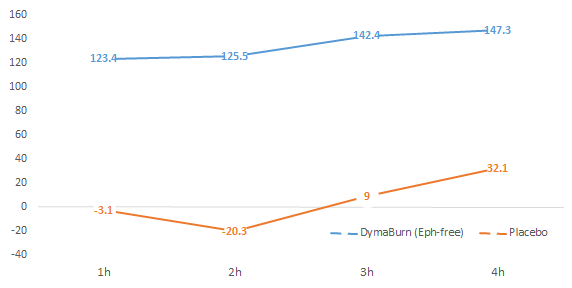
Figure 2: Effects of the ephedrine-free version of DymaBurn (caffeine, green tea extract, raspberry ketones and L-carnitine) fat burner and placebo on resting metabolic rate at 1h, 2h, 3h and 4h after ingestion; values in kcal / day (Urbina. 2012).
The same goes for the desired "side effects", namely an improved state of mood state that involves increased focus, alertness, and energy (Urbina. 2012)... all three effects are characteristic of stimulants, though, and thus exactly those fat burner ingredients of which Salacinski et al. wanted to determine whether they could be replaced with non-stimulant herbal supplements.
Citrus aurantium is not the valid successor to ephedra marketing campaigns tell you. In fact, Bent et al. found only one reliable placebo-controlled study which yielded the disappointing results you see above (Colker. 1999)
No fat burner "burns fat": Among those agents that won't possibly kill you in no time, none will actively burn fat - not even those that have been proven to trigger significant increases in fat oxidation, like caffeine or green tea. They may help you to shift the weight loss towards body fat, but the <125kcal/day increase in resting metabolic rate from the caffeine + GTE combination I plotted for you in Figure 2 is not going to get you ripped without the help of concomitant dieting efforts.

Fat burners are no magic weight loss pills and still, they can help you lose weight - especially the stim-based ones - because they may reduce appetite, increase energy and thus your ability to adhere to an energy restricted diet with or without concomitant exercise.
Supplements like the kitchen-sink blend CelluCor CLK or the previously mentioned raspberry ketones. Two agents Salacinski et al. administered to 10 healthy female and 16 male participants (mean age 23.7 ± 3.9 years; mean weight 79.2 ± 18.2 kg) in a complex experiment. The latter involved three trials on separate days during the morning hours (0600–1100) during a 2-week interval.
Figure 3: Changes in RMR after the administration of raspberry ketones or CelluCor CLK; p  > 0.05 for both (Salacinski. 2016).
"As recommended by Compher and colleagues (2006), subjects were instructed to refrain from exercising for 24 hours and from consuming food for 12 hours prior to testing. The participant ingested a placebo (an empty digestible capsule) or a dose of one of two supplements; CelluCor CLK or raspberry ketones (R) and CelluCor T7 or the metabolic activator blend (MAB) with water, upon awakening on the morning of each measurement session. The three softgel and two softgel tablets were considered to be a single dose of R and MAB, respectively, as recommended by the manufacturer.

R was composed of 1.7 g of conjugated linoleic acid, 500 mg of l-carnitine tartrate, 100 mg of R, and 100 mg of 7-ketodehydroepiandrosterone. The MAB product consisted of 494 mg of MAB with an ingredient list of white willow bark, cayenne, 3-iodotyrosine, 3, 5-diiodotyrosine, 200 mg of zinc arginate chelate, 150 mg of sea weed extract. 66 mg of niacinamide, 66 mg of griffonia seed extract, and 0.2 mg of selenium" (Salacinski. 2016).
The placebo (control trial) was always ingested on the morning of the first measurement session two hours prior to measurements. The supplement (R or MAB) taken upon awakening prior to the second and third measurement session was randomly determined by a coin toss, again two hours before the data collection. Whichever supplement was not taken prior to the second measurement trial was taken prior to the third measurement trial. At least 24 hours separated the first session (control) with the second session; and at least 48 hours separated the second session from the third session to minimize interference from the previous supplement.

The results of this recent rel. small scale (N=26, no dropouts) study are plotted in Figure 3. Data from two participants were excluded from the statistical analysis because the data could not be adjusted to meet the acceptable criteria recommended by Compher et al. (2007) and Frankenfield et al. (2003). Despite the two exclusions, it should be obvious that the non-significant 0.111% increase due to raspberry ketones and the even lower increase due to CelluCor CLK are meaningless.
Onakpoya, et al. conducted a comprehensive meta-analysis on the weight loss effects of CLA. The analysis shows a non-significant trend for increased weight loss with increasing dosages of conjugated linoleic acid, but overall, their results do "not convincingly show that CLA intake generates any clinically relevant effects on body composition on the long term" (Onakpoya. 2012).
Bottom line: In view of the fact that the study at hand is an acute response study, I have to admit that it is remotely possible that any of the supplements tested could still trigger long-term fat loss, Salacinski et al. rightly point out that their study refutes the often-heard claim that non-thermogenic herbal supplements would be a fit and safe alternative to stimulants. A replacement that would facilitate similar increases in RMR as nowadays mostly caffeine-based thermogenics without side effects.

Irrespective of any methodological gaps, the study at hand suggests shows one thing with a decent certainty: if raspberry ketones alone or RK blends like CelluCor CLK, which contains hydrolysates of Blue Whiting, L-Carnitine Tartrate, CLA (Conjugated Linoleic Acid) and Razberi-K®, a proprietary raspberry extract marketed as "the original ketone ingredient behind this movement", work at all - it is not by increasing your REE | Comment!
References:
  • Anderson, Richard A. "Chromium, glucose intolerance and diabetes." Journal of the American College of Nutrition 17.6 (1998): 548-555.
  • Bent, Stephen, Amy Padula, and John Neuhaus. "Safety and efficacy of citrus aurantium for weight loss." The American journal of cardiology 94.10 (2004): 1359-1361.
  • Colker, Carlon M., et al. "Effects of Citrus aurantium extract, caffeine, and St. John's wort on body fat loss, lipid levels, and mood states in overweight healthy adults." Current Therapeutic Research 60.3 (1999): 145-153.
  • Greenway, Frank L., et al. "Effect of a Dietary Herbal Supplement Containing Caffeine and Ephedra on Weight, Metabolic Rate, and Body Composition*." Obesity research 12.7 (2004): 1152-1157.
  • Molnar, D., et al. "Safety and efficacy of treatment with an ephedrine/caffeine mixture. The first double-blind placebo-controlled pilot study in adolescents." International Journal of Obesity 24.12 (2000): 1573-1578.
  • Onakpoya, Igho J., et al. "The efficacy of long-term conjugated linoleic acid (CLA) supplementation on body composition in overweight and obese individuals: a systematic review and meta-analysis of randomized clinical trials." European journal of nutrition 51.2 (2012): 127-134.
  • Salacinski, Amanda J., et al. "The Acute Effects of Nonstimulant Over-the-Counter Dietary Herbal Supplements on Resting Metabolic Rate." Journal of dietary supplements (2015): 1-10.
  • Stickel, Felix, Eleonora Patsenker, and Detlef Schuppan. "Herbal hepatotoxicity." Journal of hepatology 43.5 (2005): 901-910.
  • Urbina, Stacie, et al. "Effects of ingesting Dyma-Burn Xtreme, a thermogenic dietary supplement on metabolic rate and subjective measures of mood state." JISSN 9.Suppl 1 (2012): P31.

Rabu, 13 Januari 2016

Phosphorus, an Anti-Obesity Agent? 3x375 mg With Each Meal Strip Almost 4 cm Off Obese Waists in Only 12 Weeks

You knew that all these fat burning high protein foods are high in phosphorus?!
1 cm per week? What sounds like an advertisement for the next best useless fat burner, is in fact the rate at which the 47 obese, but otherwise "healthy" subjects in a recent study from the American University of Beirut had to tighten their belts (Ayoub. 2015)... Ok, I know that this is not DNP-like earth-shatteringly fast, but in view of the fact that the placebo group had to loosen their belts to accommodate for an additional 0.36 cm increase in waist circumference, it is still quite amazing. I mean, would you have expected that the amount of phosphorus of ca. 300 g salmon would have such an effect if there's no other difference in diet or physical activity between the two groups of overweight participants?
If you're looking for a true fat burner, try coffee ;-)

For Caffeine, Timing Matters! 45 Min or More?

Coffee - The Good, Bad & Interesting

Three Cups of Coffee Keep Insulin At Bay

Caffeine's Effect on Testosterone, Estrogen & SHBG

The Coffee³ Ad- vantage: Fat loss, Appetite & Mood

Caffeine Resis- tance - Does It Even Exist?
Speaking of which,... there were 47 participants (placebo group n = 21; phosphorus group n = 26), 16 men and 31 women, who completed the intervention over the course of all subjects were requested to take three tablets that contained either 375 mg phosphorus or a placebo (Nutricap Labs, Farmingdale, NY, USA) with each main meal (breakfast, lunch and dinner) for 12 weeks (there were no detectable differences in size or weight between intervention and control envelopes | see Table 1).
Table 1: Overview of the baseline characteristics of the subjects in the placebo and phosphorus group (Ayoub. 2015).
Otherwise, the subjects had to maintain their regular dietary and (sedentary) physical activity habits. Whether this was actually the case, however, was unfortunately not monitored by the scientists -- I know that's a bummer, but it is (a) very unlikely that the subjects suddenly started to work out, when they were asked not to, and (b) unrealistic to assume that any effects on the diet that would not be a consequence of the phosphorus supplementation would occur only in the treatment, but not in the active treatment group. Changes in dietary intake that may have occurred in response to the phosphorus treatment, on the other hand, must be expected to occur in the real world as well and would thus only add to the practical relevance of the study at hand compared to a study, where the diet was standardized and potential effects on appetite intake could not have been measured, anyway (as we are going to see further down, this is actually an important fact, even though it would still be nice if we had at least data from food logs).
Figure 1: Weight, waist circumference and serum phosphorus levels expressed rel. to baseline (Ayoub. 2015).
If you look at the selected study outcomes in Figure 1 (please note the non-existing effects on serum phosphorus!), it is still sad that Ayoub et al didn't at least tell their subjects to run food logs, because now everything we have as a basis to speculate about the mechanism that triggered the 'weight and waist loss' are the highly unreliable appetite scores in Table 2; and the latter clearly suggest, but certainly don't prove that the effect was the result of a mere reduction in energy intake.
Table 2: Changes in subjective appetite scores from baseline to 12 weeks (Ayoub. 2015).
Since we don't have those food logs, though, we will have to rely on older studies and a few assumptions to make sense of the results. Well, then...
  • there's firstly the evidence from observational studies linking high protein, high dairy and high whole grains intakes to reduced risk of overweight and metabolic syndrome - since a high intake of all three of these food groups is also associated with an increased intake of phosphorus, that's the first line of evidence which supports a mechanistic role of increased phosphorus intakes in weight management,
  • there's secondly epidemiological evidence showing an inverse association between an individuals phosphorus status and his or her body weight and waist circumference, and 
  • there's thirdly the well-known effect of phosphorus on ATP production, especially in the liver, of which previous studies suggest that it regulates afferent neural signals to the central nervous system which will result in a reduction in food intake (Friedman. 2007).
If we take all three lines of evidence into consideration, we are yet back to square one: the most likely, but unproven mechanism by which the addition of phosphorus to the diet helped the obese subjects in the study at hand lose weight is a reduction in energy intake.
Figure 2: In a previous study the addition of 500mg of phosphorus to a non-caloric or caloric pre-load has already been shown to significantly reduce the food intake during ad-libitum (pizza) lunch (Obeid. 2012).
The latter, by the way, is not just in line with the subjective appetite ratings of Ayoub's study participants, but also with the results of a previous study by Obeid et al (2012), in which the addition of phosphorus to a water, sucrose, fructose + glucose, or pure glucose preload that was administered before an ad-libitum meal lead to an additional attenuation of food intake (see Figure 3). Against that background it is actually very reasonable to assume that the same effect, i.e. a mere reduction in energy intake, is responsible for the 'weight and waist loss' in the study at hand, too.
If you're a loyal SuppVersity, you will probably remember that phosphorus supplements have also been shown to ameliorate the decrease of the active thyroid hormone T3 dieters experience as they progressively reduce their food intake | learn more
Disappointed that it all comes back to eating less, once again? I know the mechanism, a reduction in food intake, is not exactly exciting. It means, after all, that you can still not eat as much junkfood as you want and stay lean if you only supplement with enough phosphorus (in view of the potential diarrhea you may get from very high doses, I suspect you could eat as much as you want... but you certainly don't want to ;-).

With the previously reported beneficial effects of phosphate supplements against the metabolic slow down in response to significantly reduced energy intake, the study at hand does yet contribute another line of evidence that suggests that our diet may eventually not really be so much too high in phosphorus / -phates as we believe it was | Comment!
References:
  • Ayoub et al. "Effect of phosphorus supplementation on weight gain and waist circumference of overweight/obese adults: a randomized clinical trial." Nutrition & Diabetes (2015) 5, e189; doi:10.1038/nutd.2015.38.
  • Friedman, Mark I. "Obesity and the hepatic control of feeding behavior." Drug News Perspect 20.9 (2007): 573-8.
  • Obeid, O. A., S. Dimachkie, and S. Hlais. "Increased phosphorus content of preload suppresses ad libitum energy intake at subsequent meal." International Journal of Obesity 34.9 (2010): 1446-1448.

Kamis, 03 Desember 2015

Caffeine + Green Tea = Plus 10% Fat Oxidation & Energy Expenditure at Rest and During Sprint Interval Exercise

From a health perspective it may be good that green tea does not contain all-too much caffeine. From a fat loss perspective, it clearly lacks caffeine.
When it comes to dietary supplements, people like to pay tons of money for unproven ingredients with funky names and dubious or non-existent safety profiles; agents that have been scientifically proven to work, are safe and cheap, on the other hand, are non-sellers or at least considered to be non-effective.

Obviously, I cannot really explain why that is the case (I suspect it is because people effect drug-like effects without drug-like side-effects from supps and are thus always on the lookout for the "next big"... hoax), I can tell you, though, that a recent study that is going to be published in one of the upcoming issues of the Journal of Strength and Conditioning Research (Jo. 2015) shows that caffeine and green tea, two supplements that belong to the previously described category, are everything but useless.
You can learn more about coffee at the SuppVersity

For Caffeine, Timing Matters! 45 Min or More?

Coffee - The Good, Bad & Interesting

Three Cups of Coffee Keep Insulin At Bay

Caffeine's Effect on Testosterone, Estrogen & SHBG

The Coffee³ Ad- vantage: Fat loss, Appetite & Mood

Caffeine Resis- tance - Does It Even Exist?
In said study, Edward Jo and colleagues investigated the effects of a caffeine + green tea polyphenol mix (250mg caffeine + 400mg of a green tea extract with 50% EGCG and 5mg of caffeine per serving) on (a) metabolic rate and fat oxidation at rest, as well as following a bout of sprint interval exercise (SIE) and (b) the performance during a standardized sprint-interval test.

The study was a double-blind, randomized, placebo-controlled, crossover study that involvd 12 subjects (male: n=11; female:1 n=1) whose antroprometric data, i.e "body mass=76.1±2.2 kg; height= 169.8±1.6 cm; BMI= 22.7±3.0 kg/m2; body fat %= 21.6±2.0% [DXA data]" (Jo. 2015), already tell you that they were healthy recreationally active, but not necessarily athletic (it may be worth mentioning that they were relatively stim-naive with an intake of < 201mg of caffeine per day).
Figure 1: Energy expenditure (kcal/h) and fat oxidation (g/day) measure before (at rest) and during (during SIE) the sprint interval exercise 10 and 55 minutes after the ingestion of caffeine + GTE or placebo (Jo. 2015).
During the two testing sessions at the Human Performance Research Laboratory of the California State Polytechnic University, the subjects' resting energy expenditure (REE) was measured for 45 minutes starting 10 minutes after the ingestion of the aforementioned caffeine + polyphenol mix - a mix that was consumed on an empty stomach after an 8-h overnight fast (don't be fooled by the way the scientists report their data in "g/day" and kcal/day - I changed the latter, already but the values for fat in g would have become to small - we are talking about 45 + 30 min and a 24h measurement here).
Don't confuse increases in fat oxidation w/ fat loss: I guess we have to credit the supplement industry for propagating the myth that the ratio of fat to glucose you were burning was in anyway directly related to losing body fat. I am not sure how often I've written this on this blog or told someone in the gym: that is not the case. You can burn 20% more fat and still store more body fat if you increase your energy intake from exactly enough to already too much. The connection between fatty acid oxidation which would actually be a better term for the phenomenon we are talking about is complicated and a decreasing respiratory exchange ratio, i.e. a reduction of the ratio of glucose to fat that's used to fuel your metabolism is not a reliable predictor of fat loss.
After the initial 45-minutes, during which the subjects' resting energy expenditure had been measured, the subjects were placed on a computer-integrated cycle ergometer on which they performed a standardized 30 minute sprint interval exercise (SIE) protocol., the scientists describe as follows:
"Sprint-Interval Exercise Protocol. The SIE protocol was performed on the Velotron DynaFit Pro cycle ergometer and comprised of four 30-second maximal effort intervals each separated by 5 minutes of low-intensity, constant workload cycling (Figure 2). First, the ergometer was properly adjusted for the subject. Adjustment specifications for each subject was recorded during their familiarization visit and repeated for all experimental trials. Subjects initiated the SIE protocol with a 5-minute interval of low-intensity cycling at a constant workload of 75W. Immediately after, subjects cycled with maximal effort for 30 seconds against an added resistance that is 7.5% of BW for males and 7.2% for females. These two intervals were repeated three additional times. After the last 30-second sprint interval, the subjects performed an additional low-intensity 75W interval plus an extra 3 minutes of cool-down at a constant workload of 30W. The total duration of the SIE protocol was 30 minutes" (Jo. 2015).
A workout that had little effect on the effect of the caffeine + green tea combo which did, as you can see, when you compare the "at rest" and "during SIE" values in Figure 1, increase the energy at rest and during sprint interval training to a similar extent. More specifically, the increase in energy expenditure and fat oxidation was - within the margin of inter-individual variability - in the range of +10% during both conditions.

Figure 2: Illustration of the sprint interval exercise test performed 55 min after ingesting the supplement (Jo. 2015).
In view of the fact that we may safely assume that this effect should last for at least 2-3h this can be a practically relevant effect if it is complemented by a reduced energy intake and a caloric deficit. If the latter is not present, even the extremest increases in fat oxidation and energy expenditure will fizzle out and be as irrelevant as the effect of the caffeine + green tea combination on exercise average and peak power (W) during the sprint training, Jo et al. observed in their study... and "Yes!", that is disappointing, but in view of the low dose of caffeine and the non-existent effects of green tea on performance during a test like this not really surprising.
Did you know this SuppVersity Calssic? "Post-Workout Coffee Boosts Glycogen Repletion by Up to 30% and May Even Have Sign. Glucose Partitioning Effects | learn more!
Bottom line: I admit, they certainly sound less exciting as the latest exotic herb from the rain-forest or a substance that is listed only under its funky chemical name on the label, but unlike your average "innovative breakthrough metabolic activator" caffeine and green tea will deliver. The 10% increase in metabolic rate and the accompanying increase in fat oxidation won't make you lose slabs of body fat, but the effects are pronounced enough to expect a measurable effect on the success of your next diet / cut. A cut, by the way, that will still require a significant reduction in energy intake, even if your energy expenditure and fat oxidation. So, don't be a fool and confuse a 10% increase in fat oxidation w/ a 10% increase in fat loss that occurs in the absence of dieting on an ad-libitum diet | Comment!
References:
  • Jo et al. "Dietary Caffeine And Polyphenol Supplementation Enhances Overall Metabolic Rate And Lipid Oxidation At Rest And After A Bout Of Sprint Interval Exercise." Journal of Strength & Conditioning Research: Post Acceptance: November 23, 2015. doi: 10.1519/JSC.0000000000001277

Minggu, 01 November 2015

Is »BAIBA« the Next Big Thing in Fat Loss Supplements? 24% Reduction in Fat Gain is an Impressive Number, But...

Could BIBA be the active ingredient in a pill that solves your weight problems once and for all? Or is that too good be true?
Beta-aminoisobutyric acid, aka BAIBA, is a natural catabolite of thymine. As with many other purported "next big things in fat loss supplements", early rodent studies suggest that it can significantly reduce body fatness through a mechanism that appears to involve increases in fatty acid oxidation (FAO) and reductions in de novo lipogenesis - in particular in the liver (Maisonneuve. 2003 & 2004; Begriche. 2008).

As Karima Begrich et al. point out in a more recent review of the literature, "experimental evidence [... also] suggested that BAIBA could reduce body adiposity through increased leptin expression and secretion" (Begriche. 2010).
Some people say that caffeine is the last real "fat burner" left on the market

Remember: With Coffee More Won't Help More

Coffee - The Good, Bad & Interesting

Three Cups of Coffee Keep Insulin At Bay

Caffeine's Effect on Testosterone, Estrogen & SHBG

The Coffee³ Ad- vantage: Fat loss, Appetite & Mood

Caffeine Resis- tance - Does It Even Exist?
Against that background, it is only logical to ask whether we have overlooked a potent natural fat burner with a mechanism of cation that may be beneficial for both losing fat (increase in fat oxidation and decrease in fat storage) and keeping it off (modulation of leptin expression and secretion).

Unfortunately, it does not take long to find the first evidence that blows a hole into the neat "BAIBA could solve the diabesity epidemic"-theory. It comes right from one of the previously cited studies.
In their 2008 study, Begriche et al. were able to confirm that the provision of 100mg/kg per day (for humans that would be ~8mg/kg per day) of Beta-aminoisobutyric acid triggers significant reductions in body fat gain in lean mice (Figure 1, left).
Figure 1: 100mg/kg/day BAIBA may be an anti-weight gain supplement The data from obese rodents (rights) does yet suggest that it is not a weight loss supplement (Maisonneuve. 2004) | Anti-obesity, but not weight loss effects were also observed in obesity prone rodents in a 2008 study by Begrich et al. at the same dosage of BAIBA.
What the same amount of BAIBA did not do, though, was to prevent the weight gain in already obese mice (Figure 1, right). In view of the fact that the same discrepancies were observed for liver fat and total body weight (not shown in Figure 1), the currently available evidence clearly doesn't support the use of BAIBA as a classic "fat burner".
In obesity prone mice, BAIBA (100mg/kg) did not just ameliorate the body fat gain, it also reduced (c,d) the number of fibrotic leasons (a,b) of the liver that occured when the ob +/+ mice got fat (Begrich. 2008).
Is BAIBA even safe? In the absence of human studies that's difficult to say, but in rodents it had no ill effects on mtDNA replication (Mainonneuve. 2004) and displays a generally low toxicity. As Begrich et al. point out, their "further investigations are [still] requested to determine whether BAIBA could induce deleterious effects," even though, "it seems that this endogenous derivative could have a favourable safety profile that might be attractive for pharmacological usage" (Begrich. 2010). Deteriorations of the lipid or glucose metabolism, were not observed in any of the currently published studies and at a dosage of 100mg/kg BAIBA reduced the fibrotic leasons in the livers of obesity prone mice and improved the level of lactate dehydrogenase, a potential marker of liver problems (Begrich. 2008).
Overall, it does thus appear as if Begrich's own conclusion that BAIBA supplements "may be indeed an attractive pharmacological strategy in order to prevent (and/or treat) obesity" (Begrich. 2010) is only partly warranted:
  • While BAIBA may be useful to ameliorate the body fat gain in lean individuals and would thus in fact be an "attractive pharmacological strategy in order to prevent [...] obesity" (ibid.) in an obesogenic environment,
  • it appears to be more than just 'a little too early' to assume that BAIBA supplements could also be used to "treat" (ibid.) obesity in individuals who are already carrying >50% more body fat on their frame than the average lean person.
It is however more than the fact that many of you are probably (still) lean that keeps BAIBA in the game: If you look at the data in Figure 2, it becomes obvious that BAIBA may do more than to prevent the body fat gain in people who have always been lean: its effect on leptin, in particular, could be of even greater use for people who have lost a significant amount of body fat and are now struggling with the nasty yoyo effect.
Figure 2: The increase in adipocyte (=fat cell) leptin and adiponectin production that was observed in the petri dish is particularly interesting for people who have already lost a significant amount of body fat (Begrich. 2010). If it translates into in vivo human studies, it may help those people to stay lean and reverse "metabolic damage".
As you can see in Figure 2, in vitro data shows that the direct exposure of fat cells (adipocytes) of mice, which are at a particularly high risk of becoming obese, will trigger a significant increase in leptin and adiponectin production. Why's that important? Well, of these...
  • Metabolic Damage, Energy Intake & the Human "Energy Thermostat" - An Update Based on Recent Studies | read it!
    the increase in adiponectin that is produced by one's fat cells has been linked to important health markers, like increased insulin sensitivity and improved markers of lipid management.
  • the increase in leptin production, however, may be of greater importance, because the diet- or rather fat-loss induced remodelling of the adipose tissue (many small empty fat cells) will reduce the production of the "you're fat enough" signal leptin and thus increase the risk of formerly obese individuals to regain every pound (or even more) of body fat they have painfully lost over months of hard dieting.
With that being said, the possibility that BAIBA may be able to reverse a potential cause of something that is often referred to as "metabolic damage" of which it appears as if it was at least partly triggered by a reduction in relative leptin production (i.e. the amount of leptin that is produced at a certain level of body fat) brings BAIBA back into the game. 
Bottom line: Whether an increase in leptin production is, as Figure 3 from Begrich's previously cited review suggests, the only (or at least the most important) mechanism of the beta-aminoisobutyric acid induced anti-obesity effect will yet have to be confirmed in future studies.

Figure 3: If Begrich et al. (2010) are right, the beneficial effects of BAIBA are mediated mostly, if not exclusively by leptin. Due to a lack of human data, BAIBA must - as of now - still be classified as "promising, but unproven" anti-obesity supplement.
Of even greater importance than investigations into what I would like to call the "leptin hypothesis of BAIBA's anti-obesity effects", though, is the simple confirmation of its effects in independent human studies. I mean, rodents are (often) a good model of human metabolism, but there are instances where slight metabolic differences between man and mouse can have a huge impact on several practically relevant research outcomes. It is thus well possible that unexpected human-specific "side effects" like an extreme increase in appetite and energy intake could reduce or blunt the purported anti-obesity prowess of BAIBA. Before the aforementioned human studies have not been conducted, peer-reviewed and published, I recommend to stay skeptical about BAIBA being the "next big thing in fat loss supplements." | Comment on Facebook!
References:
  • Begriche, Karima, et al. "β‐Aminoisobutyric Acid Prevents Diet‐induced Obesity in Mice With Partial Leptin Deficiency." Obesity 16.9 (2008): 2053-2067.
  • Begriche, Karima, Julie Massart, and Bernard Fromenty. "Effects of β‐aminoisobutyric acid on leptin production and lipid homeostasis: mechanisms and possible relevance for the prevention of obesity." Fundamental & clinical pharmacology 24.3 (2010): 269-282.
  • Maisonneuve, Caroline, et al. "Mitochondrial and metabolic effects of nucleoside reverse transcriptase inhibitors (NRTIs) in mice receiving one of five single-and three dual-NRTI treatments." Antimicrobial agents and chemotherapy 47.11 (2003): 3384-3392.
  • Maisonneuve, Caroline, et al. "Effects of zidovudine, stavudine and beta-aminoisobutyric acid on lipid homeostasis in mice: possible role in human fat wasting." Antiviral therapy 9.5 (2004): 801-810.