Tampilkan postingan dengan label sweetener. Tampilkan semua postingan

Rabu, 22 Juni 2016

Can Stevia Help You Ward Off Type II Diabetes? A Review

Unfortunately, it is not even clear if you need the "white stuff", i.e. pure steviosides, whole leaves of leaf-extracts to maximize the anti-diabetic effects of stevia. What is clear, though, is that there's still a lot of research to be done.
"Can Stevia Help You Ward Off Type II Diabetes?" That's not just the title of today's SuppVersity article, it is also the research question of a recent paper by Esteves A.F. dos Santos from Farmácia Progresso (dos Santos. 2016). An interesting question with an obvious answer: if you replace sugar in your diet with stevia, it will help.

Now, you know that this would not be worth discussing in a SuppVersity article of its own. What is worth discussing, though, is that stevia contains "compounds and other substance obtained from stevioside hydrolyses" (dos Santos. 2016) such as isoteviol of which studies show that they can be used as 'active' diabetes treatments - meaning: they help, even if you take them on top of sugar / your regular diet.
You can learn more about sweeteners at the SuppVersity

Aspartame & Your Microbiome - Not a Problem?

Will Artificial Sweeteners Spike Insulin?

Sweeteners & the Gut Microbiome Each is Diff.

Chronic Sweeten-er Intake Won't Effect Microbiome

Stevia, the Healthy Sweetener?

Sweeteners In- crease Sweet- ness Threshold
To understand how stevia may help you to ward off diabetes, you will first have to understand how the latter actually develops. In the previously references review, dos Santos writes about the consequences of life-style induced weight gain and concomitant increases in body fat and insulin resistance (IR):
Figure 1: Illustration of the etiology of type II diabetes from a secondary source (in dos Santos. 2016)
"After an initial increase of insulin production as a response to IR in peripheral tissue, pancreatic β cells no longer have the ability to control glucose homeostasis, leading to endocrine sys-tem imbalances. Under glucagon influ-ence, the liver contributes significantly in glucose homeostasis because liver makes the balance between capture / storage of glucose, via glycogenesis, and the release of glucose by glycogenolysis and gluconeogenesis. 
Constant, prolonged state of hypergly-cemia enables the formation of Advanced Glycation End-Products (AGEs). AGEs are responsible for the onset of diabetic complications, such as neurological and kidney complications (diabetic nephropathy), aging and cardiovascular complications: dyslipidemia, hyperten-sion, [etc.]" (dos Santos. 2016).
The previously referenced AGEs and the significant increase of reactive oxygen specimen (ROS), which leads to decreased levels of antioxidants enzymes, increase lipid peroxidation, will increase the risk for cardiovascular diseases and exacerbate the state of the disease, which has - at this point - started to self-propel its own progression.

If using stevia could break this vicious cycle, this would obviously be awesome!

Initial evidence that suggests that stevia could do what the subheading suggests, and decrease blood glucose levels comes from ... you guessed it: rodents. In a 4 week supplementation study, rats who were fed Stevia rebaudiana extract - combined with high-carbohydrate and high-fat diets - exhibited a sign. lower increase in glucose and worsening of their glucose tolerance in an oral glucose tolerance test (OGTT) - a result that was soon confirmed in human beings who ingested an infusion of 5 Stevia rebaudiana leaves for 3 days, every 6 hours (see Figure 2):
Figure 2: Effect of stevia leaf extract (5g) blood glucose of 16 healthy subjects on oral glucose tolerance test (Curi. 1986).
Similar results have been observed by Anton et al. (2010) who compared the effect of preloads of stevia with preloads of other sweeteners, such as aspartame or sucrose in obese and normal subjects. As the data in Figure 3 shows, these preloads, which were consumed by study participants 20 minutes before their test lunch and dinner meals, decreased postprandial insulin significantly.
Figure 3: Blood glucose response in man with preloads of either sucrose, aspartame or stevia (Anton. 2010)
Now, the obvious question we have to answer is: how did that work? There are different speculative and proven mechanisms that could contribute to the anti-diabetic effects of stevia:

  • one study showed that Stevia rebaudiana will inhibit the pancreatic enzyme alpha-amylase and alpha-glucosidase and thus the breakdown of carbs in the intestine (Adisakwattana. 2010),
  • Figure 4: Effects of Stevia extracts on glucose transport activity compared to the effect of insulin. SH-SY5Y (a) and HL-60 (b) cells were treated with steviol glycosides (1 mg/mL), with 100 nM insulin (I), with steviol glycosides and insulin simultaneously, or 1 mM standard compounds (StReb, StStev | Rizzo. 2013).
    stevia rebaudiana extracts may also act similar to insulin and are equally effective in increasing glucose uptake,because the co-treatment with insulin and stevia extracts increase glucose uptake significantly higher than the increase due to insulin alone (Rizzo. 2013), , similar results were reported by Akbarzadeh et al. (2015) in STZ-induced diabetic rats
  • various studies provide evidence for the anti-oxidant effects of stevia and respective extracts, which will - in view of the inflammatory nature of type II diabetes - obviously contribute to its anti-diabetic effects
  • at least one study shows that isostevial, one of the stevia glycosides, appears to work part of its magic via activating the PPAR receptor alpha (Xu. 2012)
Whether there is one specific agent that is responsible for the previously listed effects is still debated. Among the "suspects" are primarily steviol glycosides for which anti-hyperglycemic effect has been observed in doses ranging from 5 mg / kg to 200mg/kg (González. 2014)
Is stevia even safe? You will be surprised to hear that, but the safety of the chronic consumption of stevia, the "natural sweetener", cannot be guaranteed (see possible ill effects on fertility). While studies in adult hypertensive patients show that it is "likely safe" when taken orally (250-500mg stevioside) thrice daily for up to two years, scientists argue that it could be "possibly unsafe, [...w]hen taken [by] children, or pregnant or lactating women or for periods longer than two years, due to insufficient available evidence" (Ulbricht. 2010). The same goes for its use by patients with hypotension, hypocalcemia, hypoglycemia, or impaired kidney function. In view of what we know about the possibility of allergy/hypersensitivity to other members the daisy family (Asteraceae/ Compositae), one may also suspect that allergic reactions, which have not been reported in the literature, yet, are not likely.
More specifically, these compounds have been observed to offset "the glucagon hypersecretion by pancreas α cells that's usually caused by prolonged exposure to fatty acids, and changed genes expression responsible for the metabolism of fatty acids" (dos Santos. 2016). They have also been shown to increase the glucose uptake of pancreatic cells, thus rendering them more sensitive to (small) changes in blood glucose levels; and Gonzalez et al. found them to be capable of increasing proinsulin mRNA concentration and insulin in pancreas INS-1 cells - with the result being a sign. increase the content of insulin in cells.
Figure 5: Glucose (left) and lipid (right) levels in rodents after 14 days on a high fat diet w/ different amounts of isosteviol in the diet - the effects are sign., but the effect size is small (Xu. 2012)
Of the various steviosides, dos Santos highlights isosteviol, a stevioside hydrolyzate, in particular, because it has been shown to have especially pronounced influence on glucose metabolism (Xu. 2012) in a 14-day rodent study in which the animals were fed high-fat chow and the oral administration of  isosteviol orally administrated at doses from 1 to 5 mg/kg/day led to a statistically significant decrease in insulin levels, accelerated glucose clearance and improved insulin sensitivity while simultaneously lowering total and LDL cholesterol and increasing HDL - not bad even if the effect size is relatively small, right?
"The mechanism underlying these effects may be related to the expression of PPARα, since this has changed in the treatment with isosteviol. Furthermore, the pretreatment with isoteviol improves antiapoptosis factor Bcl-2 expression and inhibits the NF-kB expression, and increases SOD and GSH-PX activity. Isosteviol has anti-inflammatory effects, which may possibly be related to hypoglycemic effect and the ability to change lipid profile" (dos Santos. 2016).
Unfortunately, the results Xu et al. presented 4 years ago still await confirmation in human studies. The same goes for the first stevia based anti-diabetes "drugs" which seek to increase the bioavailability (in serum) of steviosides by bioconjugating them on biodegradable Pluronic-F-68 copolymer based PLA nanoparticles by the means of nanoprecipitation (Barwal. 2013). These studies exist, like a recent study by Kassi et al. who introduced low glycemic load snacks based on Stevia to a low calorie diet in patients with metabolic syndrome and found this to be a safe and highly efficient means to "further reduc[e] BP [blood pressure], fasting glucose, ox[idized] LDL and leptin compared to a hypocaloric diet alone, decreasing, thus, further the risk of atherosclerosis and DMT2" (Kassi. 2016) - as part of a regular diet and in place of high sugar foods, stevia is thus the most effective.
Figure 6: One of the few long(er) term studies in (diabetic) humans found no effect of 1g rebaudioside on glycemia (Maki. 2008) - so, don't get too excited about stevia being the new metformin.
So what's the verdict then? Well, I guess you won't be happy if I say that more research is, as usually, necessary. Dos Santos is yet right that "Stevia rebaudiana is a good option to be included in the group of nutraceuticals", in view of its "action and its main compounds (stevioside and rebaudioside A) concerning glycaemia control, diabetes consequences, and early development of IR" (dos Sanots. 2016).

In as much as it can be considered a "medicinal herb," though, its safety of and necessity of higher dosages, as well as the exact mechanism of action require further investigation. Whether it makes sense to develop sustained released, high bioavailability 'stevia drugs' does yet appear questionable to me. - in particularly, because isosteviol "is not subject to intestinal hydrolysis and has shown results as therapeutic agent for type 2 diabetes and its consequences" (dos Santos. 2016), without being chemically / molecularly altered - using "regular" stevia and that to replace sugar does therefore still appear to be the best 'anti-diabetic' use for this sweetener which is up to 150 times sweeter than sugar, heat- and pH-stable, and not fermentable | Comment on Facebook!
References:
  • Adisakwattana, Sirichai, et al. "Evaluation of α-glucosidase, α-amylase and protein glycation inhibitory activities of edible plants." International Journal of Food Sciences and Nutrition 61.3 (2010): 295-305.
  • Akbarzadeh, Samad, et al. "The Effect of Stevia Rebaudiana on Serum Omentin and Visfatin Level in STZ-Induced Diabetic Rats." Journal of dietary supplements 12.1 (2015): 11-22.
  • Anton, Stephen D., et al. "Effects of stevia, aspartame, and sucrose on food intake, satiety, and postprandial glucose and insulin levels." Appetite 55.1 (2010): 37-43.
  • Barwal, Indu, et al. "Development of stevioside Pluronic-F-68 copolymer based PLA-nanoparticles as an antidiabetic nanomedicine." Colloids and Surfaces B: Biointerfaces 101 (2013): 510-516.
  • Curi, R., et al. "Effect Of Stev/A Reba Ud/Ana On Glucose Tolerance. In Normal Adult Humans." Braz. j. med. biol. res (1986).
  • González, et al. "Stevia rebaudiana Bertoni: a potencial adjuvant in the treatment of diabetes mellitus." CyTa – Journal of Food 12.3 (2014): 218- 226.
  • Kassi, Eva, et al. "Long-term effects of Stevia rebaduiana on glucose and lipid profile, adipocytokines, markers of inflammation and oxidation status in patients with metabolic syndrome." (2016).
  • Maki, K. C., et al. "Chronic consumption of rebaudioside A, a steviol glycoside, in men and women with type 2 diabetes mellitus." Food and Chemical Toxicology 46.7 (2008): S47-S53.
  • Rizzo, Benedetta, et al. "Steviol glycosides modulate glucose transport in different cell types." Oxidative medicine and cellular longevity 2013 (2013).
  • Ulbricht, Catherine, et al. "An evidence-based systematic review of stevia by the Natural Standard Research Collaboration." Cardiovascular & Hematological Agents in Medicinal Chemistry (Formerly Current Medicinal Chemistry-Cardiovascular & Hematological Agents) 8.2 (2010): 113-127.

Jumat, 19 Februari 2016

High Dose Stevia Turns Weight Gain into Loss, Lowers Lipid and Glucose Levels not Only When Used to Replace Sugar - Effects are Mediated by Reduced Energy Intake & Utilization

There's very little "natural" about the natural sweetener stevia when it ends up in your food in form of purified and decolorized steviosids.
As a SuppVersity reader you'll know that "natural" does not equate "healthy". This, the proven anti-microbial effects stevia exerts in your gut and the fact that the currently available steviosid-based stevia products undergo more processing steps than than the dreaded aspartame warrant the question whether (a) stevia is safe and (b) as effective as other sweeteners when it comes to weight loss promotion.

Since the optimal dosage of stevia to achieve meaningful effects is also not known, yet, scientists from the Alexandria University in Egypt investigated the safety ad efficacy of different amounts of stevia sweeteners (25, 250, 500 and 1000 mg/kg body weight per day) as a substitute for sucrose on weight gain or the weight loss and weight management of female rats on an ad-libitum diet.
You can learn more about sweeteners at the SuppVersity

Aspartame & Your Microbiome - Not a Problem?

Will Artificial Sweeteners Spike Insulin?

Sweeteners & the Gut Microbiome Each is Diff.

Chronic Sweeten-er Intake Won't Effect Microbiome

Stevia, the Healthy Sweetener?

Sweeteners In- crease Sweet- ness Threshold
Sixty adult female Wistar strain rats (average weight 203 ± 6 g) were used in the present experiment. Animals were obtained from Faculty of Medicine, Alexandria University, Egypt. Animals were caged in groups of 6 and given distilled water and a standard diet that meets their requirements for growing ad libitum. The diet consisted of  44% soybean cake; 12% berseem clover hay, 13.5% fat, 9.8% yellow maize, 13.2% starch, 5% minerals; 2% lime stone and 0.5% vitamins mixture. After two weks of acclimatization, animals were divided into six equal groups:
  • The first group was drank distilled water (Negative control), and positive control was given a dose of sucrose dissolved in drinking water at 500 mg/kg/day. This dose of sucrose used in this experiment was predicted to dose of stevia sweeteners equivalent concentration estimated by JECFA as control. 
  • "On the other hand, groups 3, 4, 5 and 6 were given a different doses of stevia sweeteners which were dissolved in drinking water at a dose level of 25 mg/kg/day (human equivalent dosage, HED = 4 mg/kg/day) according to JECFA (G1), 250 mg/kg/day (G2: HED = 41 mg//kg/day), 500 mg/kg/day (G3: HED = 81 mg/kg/day) and 1000 mg/kg/day (G4: HED = 162 mg/kg/day ), respectively" (Elnaga. 2016)
To assess how much stevia the animals actually consumed, the scientists recorded the animals fluid intake daily. To ensure constant intakes in all groups, they adjusted the solution concentrations weekly based on the average weight of the animals and their current fluid consumption.
At the end of the experimental period (12 weeks), body weights of animals were recorded and calculated of body weights gain (%) and feed efficiency ratio (FER) according to the method of Chapman et al. (1959).
Figure 1: Body weight of rats treated with administration of sucrose (S) and stevia sweetener different dosages (25, 250, 500 and 1000 mg/kg) for 12 weeks compared with control (Elnaga. 2016).
You probably expected that the replacement of sugar with stevia would lead to significant reductions in body weight gain, right? Well, if you scrutinize the data in Figure 1, you will notice that the effect went far beyond a reduction in weight gain. In fact, all stevia supplemented animals lost weight - dose-dependently 40.29%-48.29%.
Figure 2: Organ weights relative to body weight of female rats treated with stevia sweetener at doses of 25, 250, 500 and 1000 mg/kg b. wt and sucrose compared with control (Elnaga. 2016).
This certainly sounds like bad news, but the data in Figure 2 tells you that the weight of all important organs (liver, heart, brain, kidney, lung, pancreas and spleen) remained stable. Unfortunately, the scientists did not measure muscle and fatpad weight.
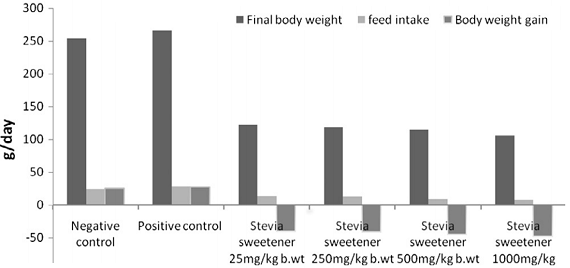
Figure 3: Final body weight, feed intake and body weight gain % in rats treated with administration of stevia sweetener in different dosages (25, 250, 500 and 1000 mg/kg) after 12 weeks on ad-libitum diet (Elnaga. 2016).
In view of the significantly reduced feed intake (>50%) and the even more reduced feed efficiency ratio (FER), of which the scientists say that it was the lowest at a dose 1000 mg/kg b.wt stevia ( -6.14) and increased with decreasing stevia intakes (-5.21, -3.22 FER and -2.91 FER), it would yet be unreasonable to assume that the weight difference was a results of fat loss, alone.
What about human studies? And what's the mechanism? Comparable human studies haven't been done and the fact that a 2005 study by Chang et al. suggests that the body weight loss of rats receiving 5.0 mg/kg stevioside was due to the poor palatability of the food because of the high amount of stevioside. It is thus questionable if stevia would work the same magic in humans. Ok, in the study at hand, the sweetener was gavaged in the drinking water, but the food intake still decreased significantly. Significantly enough to trigger profound weight loss even in the absence of the reduced feed efficacy (see Figure 3); and even the reductions in blood lipids and glucose could eventually be a function of weight loss - even though, studies appear to suggest that stevia has insulinotropic, glucagonostatic, antihyperglycemic, and blood-pressure-lowering effects all of which would suggest that it could be more than a sugar replacement (Gregersen. 2004; Hony. 2006).
Aside from the questionable weight loss, the three groups of rats treated with stevia sweetener showed improvement in lipid profile levels comparing with negative or positive control group. More specifically,
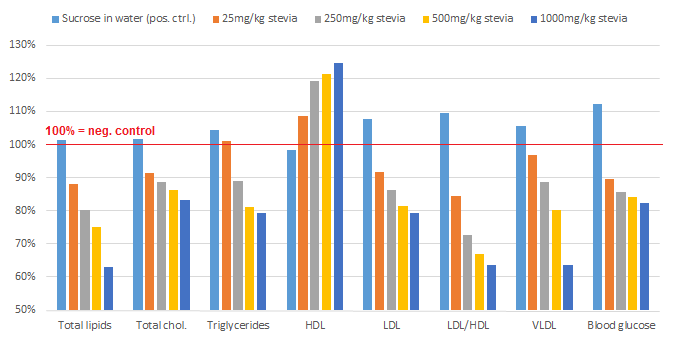
  • ... the total lipid levels of the rodents decreased by 11.96%, 19.89%, 25.03% and 37.07% when rats were given stevia sweetener at doses of 25, 250, 500 and 1000 mg/kg/b. wt, respectively compared to negative control,
  • ... the LDL values in rat serum lipids decreased with increasing the doses of stevia sweetener; rats given stevia sweetener at dose 1000 mg/kg b. wt showed the highest decrease in the LDL (26.50%) followed by those given dose 500 mg/kg (24.36%), dose 250 mg/kg (19.90%) and finally dose 25 mg/kg (15.01%), and 
  • ... the VLDL levels were decreased 3.13%, 11.18%, 19.87% and 26.08% in rats given stevia sweetener at doses of 25, 250, 500 and 1000 mg/kg.
The decreases in total, LDL and VLDL cholesterol stand in contrast to significant increase in HDL and corresponding decreases of the LDL/HDL ratio from 3.43 and 3.76 in the negative and positive control group to 2.90, 2.49, 2.30 and 2.18 in the 25mg/kg, 250mg/kg, 500mg/kg and 1000mg/kg groups, respectively.
Figure 4: Blood lipids and glucose levels after 12 weeks on high sucrose water with different amounts of stevia replacing the sucrose in the water; data expressed relative to negative (=water) control (Elnaga. 2016).
Ill effects on markers of liver health or general blood parameters were not observed and the significant decrease in blood glucose levels, I added to the relative changes in lipid levels in Figure 4, is certainly nothing to be concerned about.
Bottom line: Just as the scientists put it, "the stevia sweetener treated groups showed significantly improvement and ameliorated reduction in bodyweight, BWG % and lesser intake of feed" (Elnaga. 2016). In conjunction with the "decreasing [...] levels of blood glucose, total lipids, total cholesterol, triglycerides and low-density lipoprotein concentrations, and increasing [...] high-density lipoprotein" (ibid.) concentrations the study at hand appears to suggest that stevia was a wonder-drug.

Study indicates stevia kills healthy gut bacteria. So, how bad is it? Are the effects significant, will they have an impact on your overall health and does this mean you must not use stevia any longer? Learn more in this SV Classic
Two things you must not forget, though, are that (a) the health benefits were most pronounced in comparison to the "positive control", i.e. the sucrose guzzling rats that represent the average sugar-sweetened beverage junkie and that (b) the >40% of weight the rodents lost certainly didn't come from body fat, exclusively.

In view of the contemporary lack of data that would confirm the beneficial effects of several grams of stevia (the dose equivalents for an adult are  ~0.2, ~1.6, ~3.2, ~6.5g per day, respectively) on the body composition and lipid levels of human beings, I must caution against being too euphoric about the results of this study, anyways. | Comment!
References:
  • Chang, J. C., et al. "Increase of insulin sensitivity by stevioside in fructose-rich chow-fed rats." Hormone and metabolic research= Hormon-und Stoffwechselforschung= Hormones et metabolisme 37.10 (2005): 610-616.
  • Elnaga, NIE Abo, et al. "Effect of stevia sweetener consumption as non-caloric sweetening on body weight gain and biochemical’s parameters in overweight female rats." Annals of Agricultural Sciences (2016).
  • Gregersen, Søren, et al. "Antihyperglycemic effects of stevioside in type 2 diabetic subjects." Metabolism 53.1 (2004): 73-76.
  • Hong, Jing, et al. "Stevioside counteracts the α-cell hypersecretion caused by long-term palmitate exposure." American Journal of Physiology-Endocrinology and Metabolism 290.3 (2006): E416-E422.