Tampilkan postingan dengan label lipid metabolism. Tampilkan semua postingan

Jumat, 19 Februari 2016

High Dose Stevia Turns Weight Gain into Loss, Lowers Lipid and Glucose Levels not Only When Used to Replace Sugar - Effects are Mediated by Reduced Energy Intake & Utilization

There's very little "natural" about the natural sweetener stevia when it ends up in your food in form of purified and decolorized steviosids.
As a SuppVersity reader you'll know that "natural" does not equate "healthy". This, the proven anti-microbial effects stevia exerts in your gut and the fact that the currently available steviosid-based stevia products undergo more processing steps than than the dreaded aspartame warrant the question whether (a) stevia is safe and (b) as effective as other sweeteners when it comes to weight loss promotion.

Since the optimal dosage of stevia to achieve meaningful effects is also not known, yet, scientists from the Alexandria University in Egypt investigated the safety ad efficacy of different amounts of stevia sweeteners (25, 250, 500 and 1000 mg/kg body weight per day) as a substitute for sucrose on weight gain or the weight loss and weight management of female rats on an ad-libitum diet.
You can learn more about sweeteners at the SuppVersity

Aspartame & Your Microbiome - Not a Problem?

Will Artificial Sweeteners Spike Insulin?

Sweeteners & the Gut Microbiome Each is Diff.

Chronic Sweeten-er Intake Won't Effect Microbiome

Stevia, the Healthy Sweetener?

Sweeteners In- crease Sweet- ness Threshold
Sixty adult female Wistar strain rats (average weight 203 ± 6 g) were used in the present experiment. Animals were obtained from Faculty of Medicine, Alexandria University, Egypt. Animals were caged in groups of 6 and given distilled water and a standard diet that meets their requirements for growing ad libitum. The diet consisted of  44% soybean cake; 12% berseem clover hay, 13.5% fat, 9.8% yellow maize, 13.2% starch, 5% minerals; 2% lime stone and 0.5% vitamins mixture. After two weks of acclimatization, animals were divided into six equal groups:
  • The first group was drank distilled water (Negative control), and positive control was given a dose of sucrose dissolved in drinking water at 500 mg/kg/day. This dose of sucrose used in this experiment was predicted to dose of stevia sweeteners equivalent concentration estimated by JECFA as control. 
  • "On the other hand, groups 3, 4, 5 and 6 were given a different doses of stevia sweeteners which were dissolved in drinking water at a dose level of 25 mg/kg/day (human equivalent dosage, HED = 4 mg/kg/day) according to JECFA (G1), 250 mg/kg/day (G2: HED = 41 mg//kg/day), 500 mg/kg/day (G3: HED = 81 mg/kg/day) and 1000 mg/kg/day (G4: HED = 162 mg/kg/day ), respectively" (Elnaga. 2016)
To assess how much stevia the animals actually consumed, the scientists recorded the animals fluid intake daily. To ensure constant intakes in all groups, they adjusted the solution concentrations weekly based on the average weight of the animals and their current fluid consumption.
At the end of the experimental period (12 weeks), body weights of animals were recorded and calculated of body weights gain (%) and feed efficiency ratio (FER) according to the method of Chapman et al. (1959).
Figure 1: Body weight of rats treated with administration of sucrose (S) and stevia sweetener different dosages (25, 250, 500 and 1000 mg/kg) for 12 weeks compared with control (Elnaga. 2016).
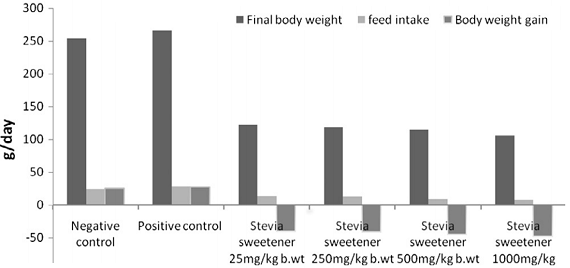
You probably expected that the replacement of sugar with stevia would lead to significant reductions in body weight gain, right? Well, if you scrutinize the data in Figure 1, you will notice that the effect went far beyond a reduction in weight gain. In fact, all stevia supplemented animals lost weight - dose-dependently 40.29%-48.29%.
Figure 2: Organ weights relative to body weight of female rats treated with stevia sweetener at doses of 25, 250, 500 and 1000 mg/kg b. wt and sucrose compared with control (Elnaga. 2016).
This certainly sounds like bad news, but the data in Figure 2 tells you that the weight of all important organs (liver, heart, brain, kidney, lung, pancreas and spleen) remained stable. Unfortunately, the scientists did not measure muscle and fatpad weight.
Figure 3: Final body weight, feed intake and body weight gain % in rats treated with administration of stevia sweetener in different dosages (25, 250, 500 and 1000 mg/kg) after 12 weeks on ad-libitum diet (Elnaga. 2016).
In view of the significantly reduced feed intake (>50%) and the even more reduced feed efficiency ratio (FER), of which the scientists say that it was the lowest at a dose 1000 mg/kg b.wt stevia ( -6.14) and increased with decreasing stevia intakes (-5.21, -3.22 FER and -2.91 FER), it would yet be unreasonable to assume that the weight difference was a results of fat loss, alone.
What about human studies? And what's the mechanism? Comparable human studies haven't been done and the fact that a 2005 study by Chang et al. suggests that the body weight loss of rats receiving 5.0 mg/kg stevioside was due to the poor palatability of the food because of the high amount of stevioside. It is thus questionable if stevia would work the same magic in humans. Ok, in the study at hand, the sweetener was gavaged in the drinking water, but the food intake still decreased significantly. Significantly enough to trigger profound weight loss even in the absence of the reduced feed efficacy (see Figure 3); and even the reductions in blood lipids and glucose could eventually be a function of weight loss - even though, studies appear to suggest that stevia has insulinotropic, glucagonostatic, antihyperglycemic, and blood-pressure-lowering effects all of which would suggest that it could be more than a sugar replacement (Gregersen. 2004; Hony. 2006).
Aside from the questionable weight loss, the three groups of rats treated with stevia sweetener showed improvement in lipid profile levels comparing with negative or positive control group. More specifically,
  • ... the total lipid levels of the rodents decreased by 11.96%, 19.89%, 25.03% and 37.07% when rats were given stevia sweetener at doses of 25, 250, 500 and 1000 mg/kg/b. wt, respectively compared to negative control,
  • ... the LDL values in rat serum lipids decreased with increasing the doses of stevia sweetener; rats given stevia sweetener at dose 1000 mg/kg b. wt showed the highest decrease in the LDL (26.50%) followed by those given dose 500 mg/kg (24.36%), dose 250 mg/kg (19.90%) and finally dose 25 mg/kg (15.01%), and 
  • ... the VLDL levels were decreased 3.13%, 11.18%, 19.87% and 26.08% in rats given stevia sweetener at doses of 25, 250, 500 and 1000 mg/kg.
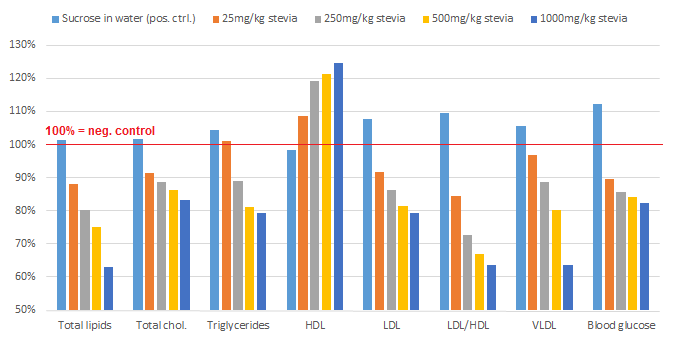
The decreases in total, LDL and VLDL cholesterol stand in contrast to significant increase in HDL and corresponding decreases of the LDL/HDL ratio from 3.43 and 3.76 in the negative and positive control group to 2.90, 2.49, 2.30 and 2.18 in the 25mg/kg, 250mg/kg, 500mg/kg and 1000mg/kg groups, respectively.
Figure 4: Blood lipids and glucose levels after 12 weeks on high sucrose water with different amounts of stevia replacing the sucrose in the water; data expressed relative to negative (=water) control (Elnaga. 2016).
Ill effects on markers of liver health or general blood parameters were not observed and the significant decrease in blood glucose levels, I added to the relative changes in lipid levels in Figure 4, is certainly nothing to be concerned about.
Bottom line: Just as the scientists put it, "the stevia sweetener treated groups showed significantly improvement and ameliorated reduction in bodyweight, BWG % and lesser intake of feed" (Elnaga. 2016). In conjunction with the "decreasing [...] levels of blood glucose, total lipids, total cholesterol, triglycerides and low-density lipoprotein concentrations, and increasing [...] high-density lipoprotein" (ibid.) concentrations the study at hand appears to suggest that stevia was a wonder-drug.

Study indicates stevia kills healthy gut bacteria. So, how bad is it? Are the effects significant, will they have an impact on your overall health and does this mean you must not use stevia any longer? Learn more in this SV Classic
Two things you must not forget, though, are that (a) the health benefits were most pronounced in comparison to the "positive control", i.e. the sucrose guzzling rats that represent the average sugar-sweetened beverage junkie and that (b) the >40% of weight the rodents lost certainly didn't come from body fat, exclusively.

In view of the contemporary lack of data that would confirm the beneficial effects of several grams of stevia (the dose equivalents for an adult are  ~0.2, ~1.6, ~3.2, ~6.5g per day, respectively) on the body composition and lipid levels of human beings, I must caution against being too euphoric about the results of this study, anyways. | Comment!
References:
  • Chang, J. C., et al. "Increase of insulin sensitivity by stevioside in fructose-rich chow-fed rats." Hormone and metabolic research= Hormon-und Stoffwechselforschung= Hormones et metabolisme 37.10 (2005): 610-616.
  • Elnaga, NIE Abo, et al. "Effect of stevia sweetener consumption as non-caloric sweetening on body weight gain and biochemical’s parameters in overweight female rats." Annals of Agricultural Sciences (2016).
  • Gregersen, Søren, et al. "Antihyperglycemic effects of stevioside in type 2 diabetic subjects." Metabolism 53.1 (2004): 73-76.
  • Hong, Jing, et al. "Stevioside counteracts the α-cell hypersecretion caused by long-term palmitate exposure." American Journal of Physiology-Endocrinology and Metabolism 290.3 (2006): E416-E422.

Jumat, 13 November 2015

Health & Weight Loss Start in the Gut: Probiotics Trigger Fat Loss Without Dieting | Casein Improves Lipid Metabolism

Gut health is "all the rage", lately. So even if it's true that this may be one of the most culpably neglected areas of research in the past century, we should still be careful not to hype the effect of the gut on your physique and health too much.
Well, probiotics and the human microbiome (the one in the gut and elsewhere) are all the rage, these days. Against that background, it's not really surprising that a probiotic supplement and thus a human microbiome modulator made it into the SuppVersity news (again). What may be surprising, though, is the fact that casein didn't just do the same, but that its appearance here in the news is not due to its muscle building prowess. Rather than that, casein made the cut, because a recent study by Francois Mariotti, et al. shows that - even in comparison to whey protein - casein attenuates the potentially unhealthy postprandial triglyceride response to a mixed high-fat meal in healthy, overweight men.
You can learn more about the gut & your health at the SuppVersity

Fiber for Female Fat Loss

Sweeteners & Your Gut

Foods, Not Ma- cros for the Gut

Lactulose For Gut & Health

Probiotics Don't Cut Body Fat

Is Gluten Intolerance Real?
  • Cheesy! Casein keeps your trigs in check - Due to the interaction between elevated postprandial triglyceride levels, insulin resistance and cardiovascular disease, the results of the previously mentioned study by Mariotti et al. (2015) may be of interest not just for all of us. After all, the proposed mechanism of which the authors, scientists from the AgroParisTech speculate that it is a direct result of the same
    "solubility of casein and its precipitation that forms a gel in the stomach [which have long been] known to influence its rate of absorption and postprandial protein metabolism in the context of regular, low-energy meals" (Mariotti. 2015),
    as the marked effect on the chylomicron kinetics and decrease in postprandial TGs, a risk factor for cardiovascular disease, the French scientists observed in the study at hand.
    Figure 1: Area under the curve for triglycerides (did respond), amino acids (didn't respond) and glucose (didn't respond) in 10 overweight subjects after consuming isocaloric high-energy meals with 15% of the energy from protein in form of casein (CAS), whey protein (WHE) or alpha-lactalbumin enriched whey (LAC | Mariotti. 2015)
    As you can see in Figure 1, the proteins which made up exactly 15% of the total energy content of the high-fat meal that was fed to 10 healthy overweight men with an elevated waist circumference (>94 cm) did not affect the subjects' postprandial plasma glucose, amino acids, insulin, or nonesterified fatty acid levels (which would, by the way, suggest that ingesting whey or an alpha-lactalbumin enriched whey protein with a meal ruins its amino acid absorption advantage). The study outcome that did differ, though were the postprandial triglycerides (TGs) levels, where the provision of casein lead to a highly significant 22% (+/- 10%) reduction in the 6-h area under the curve.
And I thought casein was bad for the heart? Well, there are in fact concerns that certain forms of casein - more specifically, beta-casein A1 - could be associated with ishaemic heart disease (McLachlan. 2001; Laugesen. 2003). Experimental evidence from humans that would confirm what epidemiologists suggests is yet lacking and the corresponding research happens to be pimped by New Zealand who have the lowest number of A1 cows in their herds | learn more.
  • As the authors point out, similar trends were shown for plasma chylomicrons [apolipoprotein (apo)B-48; P < 0.05], yet not for the postprandial oxidative stress (plasma hydroperoxides and malondialdehyde), endothelial dysfunction (salbutamol-induced changes in pulse contour analysis), or low-grade inflammation. This is also why it is as of yet only a logical, but hitherto unsupported hypothesis that consuming casein (micellar casein, not regular sodium or calcium caseinates) would also reduce one's cardiovascular disease risk. Eventually, it does yet appear to be the more reasonable adjunct to a full meal anyway - the purpose of the latter is after all to keep you satiated for a long time; and that's where casein is unquestionably a better choice than whey.
  • Probiotics - 0.5% body fat reduction, and a 2.68 cm² reduction in subcutaneous fat area are not much, but they occurred in the absence of diet and exercise - If the trend continued and the 120 nondiabetic and overweight subjects Jung et al. divided into two groups: There was the probiotic group with 60 individuals who consumed 2 g of powder of two probiotic strains, L. curvatus HY7601 and L. plantarum KY1032, each at 2.5 × 10⁹ cfu, twice a day. And there was the and a placebo group, likewise 60 individuals, who consumed the same amount of powder that did not contain any probiotics.
    Figure 2: Changes in body composition according to waist measurement and CT scans - All values are relative changes in waist and fat area measure from week 0 to week 12 (Jung. 2015).
    Both groups were advised to take their supplements immediately after breakfast and dinner, but only the probiotic group saw relevant improvements in body fat at slow) pace - albeit a pace at which it would take them "only" 5 years to finally make it into healthy body fat zones.
Probiotics under urgently needed scrutiny: Many Probiotics Contain Antibiotic Resistant Bacteria. Plus: Number of Live Bacteria is up to 95% Below Label Claims | Learn more.
Prebiotic supplements are not created equal! You may remember my recent article on (a) antibiotic resistances in supplemental probiotics and (b) the lack of viable bacteria in the different supplements the researchers analyzed. It should be obvious that these results mean that even though the study at hand appears to suggest that everyone should take probiotics, further research is needed before we can say which of the many pills on the market this should be... ah, and by the way. It is still not clear whether the same bacteria that are benefical for the obese are anywhere close to beneficial for lean athletic individuals. Rather than general recommendations, I expect the future of probiotic supple-ments to be individual (based on diet and metabolic data).
  • Ok, that's painfully slow, but given the fact that the food intake of both groups didn't differ significantly, it is still noteworthy that the 2 g of probiotic powder which contained contained 0.1 g of L. curvatus HY7601, 0.1 g of L. plantarum KY1032, 1.24 g of crystalline cellulose, 0.5 g of lactose, and 0.06 g of blueberry-flavouring agent made the subjects lose significant amounts of body fat, while their peers who received 2 g of a placebo powder that contained 1.34 g of crystalline cellulose, 0.6 g of lactose, and 0.06 g of blueberry-flavouring agent kept gaining.
    Figure 3: The provision of the probiotic supplement did also trigger significant improvements in the above markers of cardiovascular disease risk - if it's not the small fat loss, it would thus be the potential CVD risk reduction that makes the use of probiotic supplements attractive especially for overweight individuals (Jung. 2015).
    In conjunction with the likewise statistically significant beneficial effects on health markers like LDL oxidation and LDL particle size which indicate significant improvements in cardiovascular disease risk, this is still the first non-sponsored study (the study was financed by Korean Ministry of Science) that shows that supplementing with commercially available probiotics in man may actually produce health-relevant beneficial effects.
Probiotics aren't for the overweight and obese, only. A recently discussed study, for example, showed that a patented multi-strain probiotic will reduce the fat gain on a 4-week "bulk" by more than 50% - and that's in twenty young men who consumed an extra 1,000kcal per day | more.
You are kidding me, right? No, I am not. I know that neither casein nor probiotics appear to be game-changers, but eventually you will have to understand that the one trick, supplement or modification of your lifestyle cannot correct the 10,000 mistakes you have or even are still making. Losing fat and getting healthy is about taking one baby step at a time; and the studies by Mariotti et al. and Jung et al. describe two promising ways of taking another of these steps.

In that it would be great if we knew for sure how both of them work on a mechanistic (molecular) level. As of now, the only thing that appears to be certain, though, is that they act at the level of the gut. One by affecting the digestive process, the other by modifying the make-up of the intestinal microbiome of which more and more studies appear to suggest that it may not be triggering, but at least perpetuating the ill health effects of obesity | Comment!
References:
  • Jung, Saem, et al. "Supplementation with two probiotic strains, Lactobacillus curvatus HY7601 and Lactobacillus plantarum KY1032, reduced body adiposity and Lp-PLA 2 activity in overweight subjects." Journal of Functional Foods 19 (2015): 744-752.
  • Laugesen, Murray, and R. B. Elliott. "Ischaemic heart disease, Type 1 diabetes, and cow milk A1 β-casein." (2003).
  • Mariotti, François, et al. "Casein Compared with Whey Proteins Affects the Organization of Dietary Fat during Digestion and Attenuates the Postprandial Triglyceride Response to a Mixed High-Fat Meal in Healthy, Overweight Men." The Journal of nutrition (2015): jn216812.
  • McLachlan, C. N. S. "β-Casein A 1, ischaemic heart disease mortality, and other illnesses." Medical Hypotheses 56.2 (2001): 262-272.