Tampilkan postingan dengan label high fat. Tampilkan semua postingan

Selasa, 26 April 2016

Baking Bread With ~100g Extra-Fat Reduces the Glycemic Response: Coconut Oil Beats Butter, Grapeseed & Olive Oil

No, adding fat to your bread's dough won't make you lose fat magically.
While fat no longer has the bad rep it still had a decade ago, the notion that baking bread with extra fat could have anti-diabetic effects, because it reduces the glucose peaks and the 2h area under the curve (AUC) is unconventional, to say the least; and thus SuppVersity news-worthy, because it is not broscience, but the result of a recent study.

In said study, the scientists tested (a) the effect of different types of fat / oil on the formation of amylose–lipid complexes (ALC) and, more importantly, (b) the effect of the ALCs on the glycemic response to a standardized amount of bread that was baked with the same amount of different fats / oils.
Don't forget that health and looking good naked require eating right and working out!

Exercise Research Uptake Nov '14 1/2

Exercise Research Uptake Nov '14 2/2

Weight Loss Supplements Exposed

Exercise Supplementation Quickie

Squat 4 Min B4 Workout, Chains & Bands + More

Read the Latest Ex. Science Update
The study was an acute, randomised, controlled, single-blinded trial that consisted of five types of bread, each tested on one occasion in a randomised order on separate days, with at least 3 washout days between test visits.
"Participants were recruited through advertisements and personal communications. Inclusion criteria were as follows: (1) males aged between 21 and 50 years, (2) BMI values between 18·0 and 24·9 kg/m2, (3) blood pressure≤120/80 mg/dl and (4) fasting blood glucose≤6·0 mmol/l. People who had metabolic diseases, were on prescribed medication, were smokers, took part in sports at competitive levels or were concurrently participating in other clinical trials were excluded from the study. Females were excluded from the study to prevent differences in menstrual cycles from affecting carbohydrate metabolism" (Lau. 2016).
On the day before a test session, no drinks, caffeine or physical activity were allowed. In addition, a standardised dinner was provided the evening before to reduce potential variations in GR that may arise because of the second meal effect. On the day after, participants had to report to the centre after a 10–12 h fast between 08.00 and 09.00 hours. There, they rested for at least 15 min before starting the test session, before the test meal was consumed "at a comfortable pace within 15 min" (Lau. 2016). Following consumption of test bread, participants were asked to rate their liking of the bread on a 100-mm liking scale. Blood samples (both venous and capillary) were collected at 15, 30, 45, 60, 90, 120, 150 and 180 min after test bread consumption. The same protocol was repeated until the completion of all the five test sessions.
Serving size, energy content and macronutrient composition of the test breads (per serving | Lau. 2016)
How was the bread prepared? This is what the scientists report: "The five types of bread used were as follows: control bread without any added fats (CTR) and breads baked with butter (BTR), coconut oil (COC), grapeseed oil (GRP) or olive oil (OLV). The ingredients used for test breads were as follows: 250 g bread flour (Prima), 125 g potable water, 10 g baker’s yeast (SAF), 40 g sugar (Fairprice) and 6 g salt (Fairprice). These ingredients were mixed at speed 1 for 8 min (Kitchenaid) to form base dough, of which 320 g was weighed and then fat/oil was added.

The fats/oils added were 96 g butter that contained predominantly SFA (Anchor), 87 g coconut oil that was rich in medium-chain TAG (Titi Ecofarm), 80 g grapeseed oil containing predominantly PUFA (Borges) and 76 g olive oil containing predominantly MUFA (Naturel). The amount of fats/oils added was calculated based on the percentage fat as stated on the nutritional panel on the packaging, and was added at 20 %, w/w of dough. Oil was not added into the control bread. The dough mixture was kneaded for a further 12 min, and was then allowed to rest at room temperature for 10 min. Following this, the dough was moulded into serving portions and proofed in the oven (EOB98000; Electrolux) at 40±1°C for 30 min in a fan-assisted mode. Baking was carried out in the same oven at 200°C for 18 min, and bread was allowed to stand for 10 min before being served warm" (Lau. 2016).
The results of the scientists' analysis of the ALC formation in the bread showed that the coconut (COC) and olive oil (OLV) had significantly higher amylose–lipid complex forming ability [reported wrong in the result section of the FT, but correct in the discussion] as compared with butter (BTR) and grapeseed oil (GRP | P<0·05).
Figure 1: Complexing index results for different types of bread. Values are means (n 6), with standard errors represented by vertical bars. a,b Mean values with unlike letters were significantly different (P < 0·05; one-way ANOVA with post hoc Tukey’s test). BTR = butter; COC = coconut oil; GRP = grapeseed oil; OLV = olive oil (Lau. 2016).
Interestingly, the increased ALC levels in the olive oil bread did not produce the same beneficial effects on the glucose response the scientists observed when the subjects consumed the bread that was baked with coconut oil.
Figure 2: (a) Postprandial response curves for change in blood glucose and (b) plasma insulin levels after consumption of 50 g available carbohydrate portion of test bread. Values are means (n 15), with standard errors represented by vertical bars. For glucose response, there were significant time (P < 0·001), bread (P < 0·001) and bread×time interaction effects (P=0·002) when analysed by two-way, repeated-measures ANOVA. For insulin response, two-way, repeated-measures ANOVA showed a significant time effect (P < 0·001) and bread×time interaction effect at near significant levels (P=0·074), but no effect of bread was seen (P=0·195). open circle, Control bread without oil; filled circle, bread with butter; open triangle, bread with coconut oil; filled triangle, bread with grapeseed oil; open square, bread with olive oil (Lau. 2016).
As you can see in Figure 2, all fat-enhanced breads improved the glycemia, but only the grapeseed (closed triangle) and coconut (open triangle) oils also rduced the insulin levels.
Can't I just add the coconut oil on top of the bread? No, you can't, because it has to be in the dough during baking - otherwise the amylose–lipid complexes won't form. What will happen though is that your insulin levels will rise sign. longer (see previous SV article). Edit: Elizabeth Alcott just posted this cool suggestion on Facebook: "Bake low carb coconut flour bread with coconut oil. Reduced calories and glycemic response at the same time." Not a bad idea, for sure.
What is interesting to see, though, is that the glucose AUC, i.e. the total amount of glucose that is released into the blood was still the lowest in those oils / fats with the highest ALC levels: coconut oil and olive oil.
Figure 3: Postprandial glycaemic and insulinaemic responses (AUCs for 180min) after consumption of test bread (Mean values with their standard errors for fifteen healthy young men | Lau. 2016)
As the authors point out in the discussion of the results of their study, their regression analysis "further confirmed that CI [=indicator of ALC formation] was a significant predictor of GR [glucose response], although it only accounted for 13·3 % of the observed variability" (Lau. 2016). Furthermore, the scientists highlight that ...
"[w]hen examined as IAUC, COC showed the greatest attenuation of GR [glucose response] in baked bread. A similar study by Clegg et al. (2012) showed that high-fat pancakes containing MCT had the slowest gastric emptying rate as compared with other fats/oils over a 4-h period. The low GR [glucose response] of COC in this study could be due to a combination of factors. These include delay in gastric emptying rates to MCT having a higher osmolarity (Clegg. 2012) and formation of ALC resulting in resistant starch (Kaur. 2000)" (Lau. 2016).
To assess the physiological significance of these observations, Lau et al. also investigated the surrogate measures of postprandial β-cell function (IGI30 and IGR) and the insulin response which did - in contrast to the glucose response (see Figure 3), not correlate with the ALC content of the breads. Instead, it appeared to be "partially due to rate of appearance of glucose as a result of carbohydrate digestibility" (Lau. 2016).
Will the additional butter on top of the potatoes reduce the insulin response? You can find the answer to this and the other questions in today's episode of "True or False?" | learn more!
So, what's the verdict? Well, adding ~25g of fat to bread increases its energy content significantly. Therefore, it is not clear how advantageous the improvements in glycaemia observed in the study at hand will actually be - after all, calories still count!

With that being said, the scientists' conclusion that "[t]he incorporation of fats during bread baking reduces GR, with the greatest attenuation seen in COC," is a significant result. One that can be partly explained by the reduction in carbohydrate digestibility via ALC formation, but not by any effects on the insulin response to the meal (if you fear insulin, adding fat is thus not going to cut it | learn more).

That the 'coconut advantage' is due to lauric acid and myristic acid in coconut oil is likely, but warrants further investigation; the same goes for the scientists' concluding remark that "[t]he use of simple dietary interventions (addition of functional lipids during cooking of carbohydrate-rich staple foods) may be an effective and practical strategy for improving glycaemic control, and may help in the prevention and management of [...T2DM] and CVD" (Lau. 2016) | Comment!.
References:
  • Clegg, Miriam E., et al. "Addition of different fats to a carbohydrate food: Impact on gastric emptying, glycaemic and satiety responses and comparison with in vitro digestion." Food Research International 48.1 (2012): 91-97.
  • Kaur, Kulwinder, and Narpinder Singh. "Amylose-lipid complex formation during cooking of rice flour." Food Chemistry 71.4 (2000): 511-517.
  • Lau, et al. "Effect of fat type in baked bread on amylose–lipid complex formation and glycaemic response." British Journal of Nutrition, Published online: 22 April 2016.

Jumat, 15 April 2016

Can an Alternate-Day High Fat Diet Turn You into a Fat Burning Machine (Boost Your Muscles' Oxidative Capacity)?

Whether the "alternate-day high fat diet" is in fact an alternative to "training low and competing high", which you can also tweak like this, appears questionable to me, but it is certainly interesting.
If you take a look at the contemporary "low carb"-hype, one of the often-heard arguments in favor of high(er) fat and low carbohydrate intakes is the notion that this would increase your cells' ability to bur fat... or, as some people phrase it: "A high fat diet will turn you into a fat burning machine!"

Believe it or not, this is not totally wrong. What is wrong, though, is that the increase in mitochondrial fatty acid oxidation capacity, which is an adaptive response to the lack of other energy sources, will translate into direct fat loss. Eventually, you will still only lose weight and body fat if you are in a caloric deficit: high carb, low carb or no carb - personal preferences and parameters may determine which one works best for you, but eventually both work.
Until further studies have been done, you better stick to real fasting?

Breakfast and Circadian Rhythm

Does Meal Timing Matter?

Habits Determine Effects of Fasting

Fasting Works - It Does, Right!?

Does the Break- Fast-Myth Break?

Breakfast? (Un?) Biased Review
But I am getting off an a tangent. The actual question in today's SuppVersity article is after all not, whether a high fat diet allows for easier, faster or more reliable fat loss than a balanced or high carb diet. No, the question for today's SuppVersity article is: "Can an Alternate Day High Fat Diet Provide Turn You into a Fat Burning Machine?"

A hilarious idea, right? Well, I would probably have said the same before I had read a recent study from the Waseda University in Japan (Li. 2016). In said study, Li et al. tried to elucidate whether they would be able to get the same improvements in mitochondrial enzyme activity and protein content others have observed in rodents on high fat diets without the concomitant long-term intra-abdominal fat accumulation, and ever-increasing insulin resistance, and obesity. Put simply, Li et al. wanted to know if a small tweak to the diet would be able to "induce increases in mitochondrial oxidative capacities in skeletal muscle without intra-abdominal fat accumulation and body weight gain," as it would "offer many advantages" to endurance athletes (Li. 2016). Their hypothesis was that
  • feeding a high fat diet every other day would trigger the increase in free fatty acids (FFA) that's necessary to produce the desirable increases in mitochondrial capacity, while
  • feeding a regular (low fat) diet on the other day would help to ameliorate (or even better block) the accumulation of intra-abdominal fat mass. 
Accordingly, the scientists conducted a study in which male wistar rats were fed an alternate-day high-fat diet, with a lard, corn oil, sucrose, and casein based HF diet (32%, 18%, 27%, and 23%, respectively, of total calories | 5.1 kcal/g) on one and standard rodent chow (59% carbohydrate, 12% fat, and 29% protein | 3.4 kcal/g) on the other day.
Figure 1: Visceral (epididymal) fat mass, plasma glucose, fatty acid and insulin levels and relative difference to control (above bars); mind the multiplicators that were necessary to plot all data in a single graph (Li. 2016).
As you can see in Figures 1 & 2 the scientists achieved their goal. The visceral fat gain was sign. ameliorated. In spite of identical body weights, the rodents who had been fat high fat diets on alternate days were yet still fatter than their peers on the control diet.
Figure 2: Levels of markers of mitochondrial oxidative capacity after the treatment period (Li. 2016).
To know whether this increase in visceral fat was worth it, one would need to know whether the increases in citric acid synthetase (CS), beta-HAD, PGC-1a and LCAD activity actually pay off in form of increased endurance and/or performance gains due to an increased oxidative capacity.
Figure 3: Effects of alternate‐day high‐fat diet feeding on glycogen concentration (A) and GLUT‐4 protein content (B) in rat skeletal muscle. Values are mean ± SEM of 6 animals per group // If we go by the effects on glycogen, GLUT-4 and insulin (see Figure 1), the ALT diet should not impair the use of CHOs in athletes and would thus allow for CHO fueling during competition, but that's, as much about ALT, in theory!
Bottom line: In view of unaltered glycogen levels and slightly, but non-significantly increased levels of glucose transporter 4 (GLUT-4 | see Figure 3) levels in the muscle tissue of the ALT rats, it is likely that these performance changes would have been observed, but Li et al. don't have the data to prove that they exist.

For the average endurance athlete of whom the scientists rightly write that he does not adopt a high fat diet, even though it may increase the mitochondrial enzyme activities and decrease the utilization of glycogen during endurance exercise, Li's study is thus of very limited value, because future studies are necessary to prove the practical efficacy and relevance of an "alternate-day high fat diet" that has been tested only in rodents and how it compares to "training low and competing high" (Burke. 2010) | Comment!
References:
  • Burke LM. Fueling strategies to optimize performance: training high or training low? Scand J Med Sci Sports. 2010 Oct;20 Suppl 2:48-58. doi: 10.1111/j.1600-0838.2010.01185.x.
  • Li X, Higashida K, Kawamura T, Higuchi M. Alternate-Day High-Fat Diet Induces an Increase in Mitochondrial Enzyme Activities and Protein Content in Rat Skeletal Muscle. Nutrients. 2016 Apr 6;8(4). pii: E203.

Rabu, 06 Januari 2016

Alternate Day Fasting (ADF) Cuts 50% Body Fat and Boosts Lean Mass by 12-13% - In Fat Rodents on Low Fat ADF Diet

When you're alternate day fasting your plate will look as empty or almost as empty as this every other day.
In the scientific literature, the term "intermittent fasting" is used inconsistently. Often, however, it refers to an every-other-day-fasting-regimen, in which you eat on day A and don't eat (or eat almost nothing) on day B. This was also the case of Juliet D. Gotthardt's latest study, where "intermittent fasting" therefore meant eating an ad-libitum diet (eat as much as you want and when you want) on day 1 and starving on day 2 (Gotthardt. 2015). What the scientists from the State University of New Jersey already knew was that this would protect male C57BL/6 from weight gain, what they didn't know and wanted to find out was whether the macronutrient content of the diet would modulate this effect..
Do you have to worry about muscle loss and metabolic damage, when you're fasting?

Breakfast and Circadian Rhythm

Does Meal Timing Matter?

Habits Determine Effects of Fasting

Fasting Works - It Does, Right!?

Does the Break- Fast-Myth Break?

Breakfast? (Un?) Biased Review
Accordingly, 64 mice were purchased from The Jack son Laboratory (Bar Harbor, ME, USA) and fattened up on an ad libitum, high fat diet (HFD; 4.73 kcal/g, 45% fat, 20% protein, 35% carbohydrate; D12451) for 8 weeks (note: this means all mice were already overweight, when the actual "intermittent fasting" began).

Figure 1: Energy content (kcal/100g) of the high and low fat diets the rodents were fed over the course of the 4-week experimental phase either ad-libitum or on an every-other-day-fasting regimen (Gotthardt. 2015).
The mice were then equally divided by bodyweight and transitioned to one of four experimental groups:
  • HFD - an ad libitum high fat diet 
  • IMF-HFD - an every-other-day fasting high fat diet
  • LFD - ad libitum low fat diet
  • IMF-LFD - an every-other-day fasting low fat diet
The mice in the IMF group were food deprived every other 24-hour period beginning at 9:00 AM (fasting day), 2 hours into the light cycle. On fasting days, all animals were weighed, food in take was recorded, cages were changed.
The alternative-day fasting induced a sign. reduction in food intake.
What's the mechanism, here? As the food intake data on the left shows, the effect is at least partly mediated by a significant reduction in food intake. In other words, just as it has been observed in humans, there's no full compensation for the lack of energy intake on the fasting day. This is intriguing, because the increase in norepinephrine (NE | 50-60%) in the hypothalamus and the expression of NPY in the arcuate nucleus ( 65–75%) in both IMF groups would suggest that the rodents were not immune to the regular compensatory stress response to fasting.
After four weeks, the mice on the IMF-HFD ( 13%) and IMF-LFD ( 18%) had significantly lower body weights than those who continued on the HFD.
Figure 2: Body composition as assessed by EchoMRI in all groups at the end of 4 weeks of the diet intervention. Data are represented as means SEM. A: Fat mass (g). B: Lean body mass (g). *** indicates difference from HFD (P .001); * indicates difference (P < .05) from HFD; $ indicates difference (P < .05) from IMF-HFD (Gotthardt. 2015).
As you can see in Figure 2, the body fat of the mice was also significantly reduced - in all four groups by 40–52%. The significant lean mass increases I hinted at in the headline, however, were observed only in the intermediate fasting low fat diet group (IMF-LFD | 12–13%).
Figure 3: Oral glucose tolerance tests in all groups at the end of 4 weeks of the diet intervention. Data are represented as means SEM. A: Blood glucose (mg/dl) response to an oral bolus of glucose (2 g/kg) over 180 minutes. Values for IMF-HFD and LFD overlap. B: Area under the curve (AUC) of glucose tolerance test (Gotthardt. 2015).
As Figure 3 goes to show you, the low fat alternative-day fasting (IMF-LFD) group also had the highest oral glucose tolerance with almost no increase in glucose during the glucose tolerance test. Whether that's due to the increase in lean mass is yet as questionable due to the mere extent of the reduction in glucose AUC. If the latter was simply due to an increase in muscle mass, you'd furthermore expect that the insulin levels of the IMF-LFD rats would have been lower as well. Insulin, as well as leptin, however, decreased to a similar extent in all treatment groups (compared to the high fat diet, obviously).
Figure 4: Cause and consequences of the low-fat exclusive increase in dopamine (DA) in the anterior hypo-thalamus of the fasted rodents are two things researchers don't yet fully understand (Gotthardt. 2015).
What do we make of this study? While I have to admit that the headline suggests that the lean mass increase was a result of the reduced fat intake, a hypothesis that would explain why there should be a mechanistic link between alternate-day-fasting, low fat dieting and increases in lean mass is not in sight. That's disappointing, but with the low-fat exclusive significant increase in anterior hypothalamus dopamine expression (see Figure 4) and the previously mentioned extreme increase in glucose sensitivity (cf. Figure 3), Gotthardt's study provides starting points for future research and it confirms that alternate day fasting does not cost you muscle mass... in this respect previous human trials showed similar results, by the way.

One thing you have to keep in mind is that the high fat diet (HFD) in the study at hand was after high in fat, but it was not low in carbohydrates. Accordingly, it would be really interesting to see, how a true low-carb diet would have affected rodents - and obviously humans, of whom a 2013 human study by Klempel et al. that used a similarly messed up "high fat diet" (45% fat, 40% carbs, 15% protein) shows that they lose the same amount of weight and body fat on "high" and "low fat" diets. Whether that's a species-dependent difference to the study at hand or a result of "too much fat" in Klempel's diet (25% fat is significantly more than in the Gotthardt study) will yet have to be determined in future studies; studies that will hopefully also use an actual high fat alternate-day-fasting regimen instead of the the high fat + high carb Western diet clone that was used in both, the study at hand, and the previously cited human study by Klempel et al. | Comment!
References:
  • Gotthardt, Juliet D., et al. "Intermittent Fasting Promotes Fat Loss with Lean Mass Retention, Increased Hypothalamic Norepinephrine Content, and Increased Neuropeptide Y Gene Expression in Diet-Induced Obese Male Mice." Endocrinology (2015): en-2015.
  • Klempel, Monica C., Cynthia M. Kroeger, and Krista A. Varady. "Alternate day fasting (ADF) with a high-fat diet produces similar weight loss and cardio-protection as ADF with a low-fat diet." Metabolism 62.1 (2013): 137-143.

Kamis, 15 Oktober 2015

52% Reduced Fat Gain Over 4 Weeks of Overfeeding Twenty Young Men W/ 1000 kCal/Day on a High Fat (55%) Diet Due to Double Dose of a Commercial Multistrain Probiotic

Probiotics act on in the digestive tract, but their effects are still systemic.
You've read about the anti-weight gain effects of probiotic supplements in rodents before at the SuppVersity and in the SuppVersity Facebook News. Nice, yes, but will this also work in human beings? If we put faith into the predictive quality of a recent from Virginia Tech, it should.

Before we delve deeper into the study design, results and evaluation in the bottom line, I'd yet like you to know that (a) we don't know if the effects will persist for more than 4-weeks, if they will become stronger or weaker and that (b) the study was funded by VSL Pharmaceuticals (Osterberg. 2015) - both additional reasons not to confuse a single study like this with "proof" that probiotics block fat gain.
You can learn more about the gut & your health at the SuppVersity

Fiber for Female Fat Loss

Sweeteners & Your Gut

Foods, Not Ma- cros for the Gut

Lactulose For Gut & Health

Probiotics Don't Cut Body Fat

Is Gluten Intolerance Real?
The objective of Osterberg's latest study was to "determine the effects of the probiotic, VSL#3, on body and fat mass, insulin sensitivity, and skeletal muscle substrate oxidation following 4 weeks of a high-fat diet" - in humans, and even better in 20 non-obese men (18-30 years) who participated in the study.
Learn everything about overfeeding! How do the effects of high vs. low fat, high vs. low protein and high vs. extra-high energy intake differ, what's the effect on thyroid and other important hormones and more
"All testing took place at the Human Integrative Physiology Laboratory between the hours of 5:00 and 11:00 am. Participants fasted for 12 h, did not consume caffeine or alcohol, performed no vigorous physical activity for the prior 48 h, and were free from acute illness for the prior 2 weeks.

[...]Following a 2-week eucaloric control diet, participants underwent dual X-ray absorptiometry to determine body composition, an intravenous glucose tolerance test to determine insulin sensitivity, and a skeletal muscle biopsy for measurement of in vitro substrate oxidation" (Osterberg. 2015). 
Subsequently, participants were randomized to receive either VSL#3 (2x450 billion bacteria), a dietary probiotic supplement that contains a motley mix of bacteria, i.e. Streptococcus thermophilus DSM24731, Lactobacillus acidophilus DSM24735, Lactobacillus delbrueckii ssp. bulgaricus DSM24734, Lactobacillus paracasei DSM24733, Lactobacillus plantarum DSM24730, Bifidobacterium longum DSM24736, Bifidobacterium infantis DSM24737, and Bifidobacterium breve DSM24732, or placebo daily during 4 weeks.
Figure 1: Composition (in g/day) and energy consumption (kcal/day) of the lead in and high fat diet (Osterberg. 2015).
Both, i.e. the probiotic supplement VSL#3 as well as the placebo supplement, were consumed alongside a high fat milk shake which also served to bring up the total energy intake (+1,000kcal/day) and relative contribution of fat from 8% to 55% compared to the standardized diet that was used in the 2-week lead in. Practically speaking, we are thus looking at a standardized high fat overfeeding study with or without probiotic intervention.
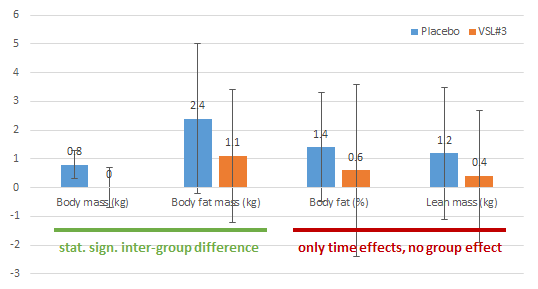
Figure 2: Changes in body composition in response to 4-week high fat overfeeding with or without probiotic supplementation (VSL#3, a 900 billion multi-strain probiotic) in 20 normal-weight young men (Osterberg. 2015).
A study that yielded interesting results, but results that are of questionably practical relevance. Yes, there was a statistical group effect for the changes in total body mass (0 kg vs. 0.8kg) and the total body fat mass (+1.1% vs. +2.4%).

Since there were neither significant differences in body fat% due to the lower lean mass gains in the probiotic group and considering the fact that there were no additional health effects in form improvements in insulin sensitivity or fat oxidation. Since neither of them was affected by the overfeeding, anyways, the significance of the lack of change is questionable.
Bottom line: In spite of the statistically significant weight and fat gain differences, the interpretation of the study at hand is not 100% straight forward. This may be due to the fact that within only 4 weeks other changes (esp. health relevant parameters) did not occur in either group.

While this study shows no immediate health benefits, there's evidence that gluten sensitive individuals may benefit from supplementing /w certain strains.
Furthermore, it must be said that the reduced lean mass gains in the probiotic strain and the subsequent lack of changes in body fat percentages, suggest that the amelioration of the subjects' weight gain is mediated by a mere reduction in energy-availability (this assumes that the intakes in both groups were identical to begin with). If this is the case, the supplement still has its merits: According to the questionable approximation that says that it takes 7,000kcal extra to gain 1kg of body fat, the probiotic supplementation would have compensated for 1.3 kg x 7000 kcal/kg = 9100kcal over 4 weeks and 325 kcal/ day (note this is not a scientifically accurate calculation).

Still, much more research is going to be necessary - not only to elucidate the exact mechanism, but also to find out if the effect might depend on the type of diet: A high fat diet, for example, has been shown to have significant, potentially detrimental effects on the human gut microbiome, which may be meditated by the bile acid resistance of several strains of bacteria, i.e. more fat = exuberant bile production = death to many good bacteria (David. 2014) |  Comment on Facebook!
References:
  • David, Lawrence A., et al. "Diet rapidly and reproducibly alters the human gut microbiome." Nature 505.7484 (2014): 559-563.
  • Osterberg, et al. "Probiotic Supplementation Attenuates Increases in Body Mass and Fat Mass During High-Fat Diet in Healthy Young Adults." Obesity (2015): Ahead of print.