Tampilkan postingan dengan label probiotics. Tampilkan semua postingan

Jumat, 13 November 2015

Health & Weight Loss Start in the Gut: Probiotics Trigger Fat Loss Without Dieting | Casein Improves Lipid Metabolism

Gut health is "all the rage", lately. So even if it's true that this may be one of the most culpably neglected areas of research in the past century, we should still be careful not to hype the effect of the gut on your physique and health too much.
Well, probiotics and the human microbiome (the one in the gut and elsewhere) are all the rage, these days. Against that background, it's not really surprising that a probiotic supplement and thus a human microbiome modulator made it into the SuppVersity news (again). What may be surprising, though, is the fact that casein didn't just do the same, but that its appearance here in the news is not due to its muscle building prowess. Rather than that, casein made the cut, because a recent study by Francois Mariotti, et al. shows that - even in comparison to whey protein - casein attenuates the potentially unhealthy postprandial triglyceride response to a mixed high-fat meal in healthy, overweight men.
You can learn more about the gut & your health at the SuppVersity

Fiber for Female Fat Loss

Sweeteners & Your Gut

Foods, Not Ma- cros for the Gut

Lactulose For Gut & Health

Probiotics Don't Cut Body Fat

Is Gluten Intolerance Real?
  • Cheesy! Casein keeps your trigs in check - Due to the interaction between elevated postprandial triglyceride levels, insulin resistance and cardiovascular disease, the results of the previously mentioned study by Mariotti et al. (2015) may be of interest not just for all of us. After all, the proposed mechanism of which the authors, scientists from the AgroParisTech speculate that it is a direct result of the same
    "solubility of casein and its precipitation that forms a gel in the stomach [which have long been] known to influence its rate of absorption and postprandial protein metabolism in the context of regular, low-energy meals" (Mariotti. 2015),
    as the marked effect on the chylomicron kinetics and decrease in postprandial TGs, a risk factor for cardiovascular disease, the French scientists observed in the study at hand.
    Figure 1: Area under the curve for triglycerides (did respond), amino acids (didn't respond) and glucose (didn't respond) in 10 overweight subjects after consuming isocaloric high-energy meals with 15% of the energy from protein in form of casein (CAS), whey protein (WHE) or alpha-lactalbumin enriched whey (LAC | Mariotti. 2015)
    As you can see in Figure 1, the proteins which made up exactly 15% of the total energy content of the high-fat meal that was fed to 10 healthy overweight men with an elevated waist circumference (>94 cm) did not affect the subjects' postprandial plasma glucose, amino acids, insulin, or nonesterified fatty acid levels (which would, by the way, suggest that ingesting whey or an alpha-lactalbumin enriched whey protein with a meal ruins its amino acid absorption advantage). The study outcome that did differ, though were the postprandial triglycerides (TGs) levels, where the provision of casein lead to a highly significant 22% (+/- 10%) reduction in the 6-h area under the curve.
And I thought casein was bad for the heart? Well, there are in fact concerns that certain forms of casein - more specifically, beta-casein A1 - could be associated with ishaemic heart disease (McLachlan. 2001; Laugesen. 2003). Experimental evidence from humans that would confirm what epidemiologists suggests is yet lacking and the corresponding research happens to be pimped by New Zealand who have the lowest number of A1 cows in their herds | learn more.
  • As the authors point out, similar trends were shown for plasma chylomicrons [apolipoprotein (apo)B-48; P < 0.05], yet not for the postprandial oxidative stress (plasma hydroperoxides and malondialdehyde), endothelial dysfunction (salbutamol-induced changes in pulse contour analysis), or low-grade inflammation. This is also why it is as of yet only a logical, but hitherto unsupported hypothesis that consuming casein (micellar casein, not regular sodium or calcium caseinates) would also reduce one's cardiovascular disease risk. Eventually, it does yet appear to be the more reasonable adjunct to a full meal anyway - the purpose of the latter is after all to keep you satiated for a long time; and that's where casein is unquestionably a better choice than whey.
  • Probiotics - 0.5% body fat reduction, and a 2.68 cm² reduction in subcutaneous fat area are not much, but they occurred in the absence of diet and exercise - If the trend continued and the 120 nondiabetic and overweight subjects Jung et al. divided into two groups: There was the probiotic group with 60 individuals who consumed 2 g of powder of two probiotic strains, L. curvatus HY7601 and L. plantarum KY1032, each at 2.5 × 10⁹ cfu, twice a day. And there was the and a placebo group, likewise 60 individuals, who consumed the same amount of powder that did not contain any probiotics.
    Figure 2: Changes in body composition according to waist measurement and CT scans - All values are relative changes in waist and fat area measure from week 0 to week 12 (Jung. 2015).
    Both groups were advised to take their supplements immediately after breakfast and dinner, but only the probiotic group saw relevant improvements in body fat at slow) pace - albeit a pace at which it would take them "only" 5 years to finally make it into healthy body fat zones.
Probiotics under urgently needed scrutiny: Many Probiotics Contain Antibiotic Resistant Bacteria. Plus: Number of Live Bacteria is up to 95% Below Label Claims | Learn more.
Prebiotic supplements are not created equal! You may remember my recent article on (a) antibiotic resistances in supplemental probiotics and (b) the lack of viable bacteria in the different supplements the researchers analyzed. It should be obvious that these results mean that even though the study at hand appears to suggest that everyone should take probiotics, further research is needed before we can say which of the many pills on the market this should be... ah, and by the way. It is still not clear whether the same bacteria that are benefical for the obese are anywhere close to beneficial for lean athletic individuals. Rather than general recommendations, I expect the future of probiotic supple-ments to be individual (based on diet and metabolic data).
  • Ok, that's painfully slow, but given the fact that the food intake of both groups didn't differ significantly, it is still noteworthy that the 2 g of probiotic powder which contained contained 0.1 g of L. curvatus HY7601, 0.1 g of L. plantarum KY1032, 1.24 g of crystalline cellulose, 0.5 g of lactose, and 0.06 g of blueberry-flavouring agent made the subjects lose significant amounts of body fat, while their peers who received 2 g of a placebo powder that contained 1.34 g of crystalline cellulose, 0.6 g of lactose, and 0.06 g of blueberry-flavouring agent kept gaining.
    Figure 3: The provision of the probiotic supplement did also trigger significant improvements in the above markers of cardiovascular disease risk - if it's not the small fat loss, it would thus be the potential CVD risk reduction that makes the use of probiotic supplements attractive especially for overweight individuals (Jung. 2015).
    In conjunction with the likewise statistically significant beneficial effects on health markers like LDL oxidation and LDL particle size which indicate significant improvements in cardiovascular disease risk, this is still the first non-sponsored study (the study was financed by Korean Ministry of Science) that shows that supplementing with commercially available probiotics in man may actually produce health-relevant beneficial effects.
Probiotics aren't for the overweight and obese, only. A recently discussed study, for example, showed that a patented multi-strain probiotic will reduce the fat gain on a 4-week "bulk" by more than 50% - and that's in twenty young men who consumed an extra 1,000kcal per day | more.
You are kidding me, right? No, I am not. I know that neither casein nor probiotics appear to be game-changers, but eventually you will have to understand that the one trick, supplement or modification of your lifestyle cannot correct the 10,000 mistakes you have or even are still making. Losing fat and getting healthy is about taking one baby step at a time; and the studies by Mariotti et al. and Jung et al. describe two promising ways of taking another of these steps.

In that it would be great if we knew for sure how both of them work on a mechanistic (molecular) level. As of now, the only thing that appears to be certain, though, is that they act at the level of the gut. One by affecting the digestive process, the other by modifying the make-up of the intestinal microbiome of which more and more studies appear to suggest that it may not be triggering, but at least perpetuating the ill health effects of obesity | Comment!
References:
  • Jung, Saem, et al. "Supplementation with two probiotic strains, Lactobacillus curvatus HY7601 and Lactobacillus plantarum KY1032, reduced body adiposity and Lp-PLA 2 activity in overweight subjects." Journal of Functional Foods 19 (2015): 744-752.
  • Laugesen, Murray, and R. B. Elliott. "Ischaemic heart disease, Type 1 diabetes, and cow milk A1 β-casein." (2003).
  • Mariotti, François, et al. "Casein Compared with Whey Proteins Affects the Organization of Dietary Fat during Digestion and Attenuates the Postprandial Triglyceride Response to a Mixed High-Fat Meal in Healthy, Overweight Men." The Journal of nutrition (2015): jn216812.
  • McLachlan, C. N. S. "β-Casein A 1, ischaemic heart disease mortality, and other illnesses." Medical Hypotheses 56.2 (2001): 262-272.

Kamis, 05 November 2015

Many Probiotics Contain Antibiotic Resistant Bacteria. Plus: Number of Live Bacteria is up to 95% Below Label Claims

Probiotics under urgently needed scrutiny - This is the first study to test for antibiotic resistances and to highlight the discrepan- cy between label claims and the actual number of live bacteria in supplements.
There have been plenty of good news about probiotic supplements in the news (including the SuppVersity News), lately. One thing that is often forgotten, though, is that the effect of the supplements depends on (a) the exact type of bacteria that are in the pills, (b) the ratio of the different strains and (c) the number of bacteria that are still alive.

Unfortunately, this important truth is rarely mentioned in the edutainment articles on probiotics in the laypress and sales pitches you will find all over the Internet.

Another thing, even you may not have thought about yet is however the potential occurrence of antibiotic resistances among the bazillions of bacteria in your allegedly healthy probiotic supplements.
You can learn more about the gut & your health at the SuppVersity

Fiber for Female Fat Loss

Sweeteners & Your Gut

Foods, Not Ma- cros for the Gut

Lactulose For Gut & Health

Probiotics Don't Cut Body Fat

Is Gluten Intolerance Real?
A group of people who thought of this hitherto overlooked problem are researchers from the  King Abdullah University of Science and Technology in Saudi Arabia and the UCSI University in Malaysia (Wong. 2015). In their recent paper in the scientific journal Nutrition Journal, the international group of researchers are the first to highlight a previously ignored problem i.e. the possibility that certain genes that make bacteria resistant to antibiotics "could transfer to pathogens sharing the same intestinal habitat" - an event that is, as the scientists rightly point out, "conceivable considering the fact that dietary supplements contain high amounts of often heterogeneous populations of probiotics" and could thus "confer pathogens protection against commonly-used drugs" (Wong. 2015).

MRSA in your probiotic supplements? 

Against that background and in view of the numerous reports of antibiotic resistant probiotics in food and biological sources, the antibiogram of probiotics from dietary supplements remains elusive.
Figure 1: Petri dishes from the antibiotic test (top). If the antibiotics still worked on the bacteria in the probiotics, they all should be dead. As you can see (in the graph, as well), that's by no means the case (Wong. 2015).
In fact, Wong et al. are apparently the first researchers to screen five commercially available dietary supplements (the full names were not disclosed) for resistance towards antibiotics of different classes - with somewhat disconcerting results, namely:
  • Even probiotics that help weight loss, could transfer antibiotic resistances.
    Probiotics of all batches of products were resistant towards vancomycin.
  • Several batches of probiotics from four different brands were also resistant towards streptomycin, aztreonam, gentamycin and / or ciprofloxacin antibiotics (this includes the US and Austrian products, i.e. Cn and Bn, respectively)
  • The fifth brand showed a unique resistance towards gentamycin, strepto- mycin and ciprofloxacin antibiotics. 
Now, as previously pointed out, this does not mean that "bad" bacteria which will always be present in your gut, will automatically acquire the same resistances, but the mere fact that it is possible should tell you that the current hype over probiotics as the "go-to supplement" everyone should take is unwarranted, or at least premature.

You're not getting what you're paying for!

The problem with antibiotic resistances is yet not the only intriguing result of Wang's study. The researchers analyses also revealed that you're not just getting more (albeit unwanted) ingredients that you're paying for, they also found a significant discrepancy between the enumerated viable bacteria amounts and the claims of the manufacturers.
Figure 2: Non-strain specific essay that evaluated the number of live bacteria in the products. The products from producers Bi, Bg, and L didn't just contain significantly less living bacteria than the manufacturers claim, the number is even so low that it is absolutely certain that they are 100% useless. The good news may be that the low dose supplements from the Austria(BN) and USA (CN) contained either more or at least roughly the amount of bacteria on the label (Wong. 2015).
In other words, while the scientists claim that you would get more than enough viable bacteria from their product to have a significant impact on your intestinal microbiome, the reality is that many of the good bacteria are dead before you even open the package.
The "live bacteria"-problem can be solved by eating probiotic foods like yogurt. The problem with potential antibiotic resistances, on the other hand, is rampant with foods, too. Even meat (especially chicken) and allegedly extra-healthy products like veggies from the farmers market may be tainted (the latter due to natural fertilizers of animal origin aka slurry).
Bottom line: The transfer of genes that could make bad gut bugs resistant to antibiotic is only a possibility, but it's one with literally fatal consequences. If bacterial strains in your gut have become resistant to antibiotics and you end up - for whatever reason - with an infection, i.e. a rapid multiplication of these bacteria, you could probably find yourself in the emergency room ... or worse.

In conjunction with the proven lack of viable bacteria in the five products from the US, Malaysia and Austria this study casts a shadow on a class of supplements with rapidly increasing sales - a shadow that becomes even darker if you remember my previous warning that we know literally nothing about the far-reaching interactions between the billion of different bacteria in our gut to even know the "good" from the "bad" guys | Comment on Facebook!
References:
  • Wong, Aloysius, et al. "Detection of antibiotic resistance in probiotics of dietary supplements." Nutrition journal 14.1 (2015): 1-6.

Kamis, 15 Oktober 2015

52% Reduced Fat Gain Over 4 Weeks of Overfeeding Twenty Young Men W/ 1000 kCal/Day on a High Fat (55%) Diet Due to Double Dose of a Commercial Multistrain Probiotic

Probiotics act on in the digestive tract, but their effects are still systemic.
You've read about the anti-weight gain effects of probiotic supplements in rodents before at the SuppVersity and in the SuppVersity Facebook News. Nice, yes, but will this also work in human beings? If we put faith into the predictive quality of a recent from Virginia Tech, it should.

Before we delve deeper into the study design, results and evaluation in the bottom line, I'd yet like you to know that (a) we don't know if the effects will persist for more than 4-weeks, if they will become stronger or weaker and that (b) the study was funded by VSL Pharmaceuticals (Osterberg. 2015) - both additional reasons not to confuse a single study like this with "proof" that probiotics block fat gain.
You can learn more about the gut & your health at the SuppVersity

Fiber for Female Fat Loss

Sweeteners & Your Gut

Foods, Not Ma- cros for the Gut

Lactulose For Gut & Health

Probiotics Don't Cut Body Fat

Is Gluten Intolerance Real?
The objective of Osterberg's latest study was to "determine the effects of the probiotic, VSL#3, on body and fat mass, insulin sensitivity, and skeletal muscle substrate oxidation following 4 weeks of a high-fat diet" - in humans, and even better in 20 non-obese men (18-30 years) who participated in the study.
Learn everything about overfeeding! How do the effects of high vs. low fat, high vs. low protein and high vs. extra-high energy intake differ, what's the effect on thyroid and other important hormones and more
"All testing took place at the Human Integrative Physiology Laboratory between the hours of 5:00 and 11:00 am. Participants fasted for 12 h, did not consume caffeine or alcohol, performed no vigorous physical activity for the prior 48 h, and were free from acute illness for the prior 2 weeks.

[...]Following a 2-week eucaloric control diet, participants underwent dual X-ray absorptiometry to determine body composition, an intravenous glucose tolerance test to determine insulin sensitivity, and a skeletal muscle biopsy for measurement of in vitro substrate oxidation" (Osterberg. 2015). 
Subsequently, participants were randomized to receive either VSL#3 (2x450 billion bacteria), a dietary probiotic supplement that contains a motley mix of bacteria, i.e. Streptococcus thermophilus DSM24731, Lactobacillus acidophilus DSM24735, Lactobacillus delbrueckii ssp. bulgaricus DSM24734, Lactobacillus paracasei DSM24733, Lactobacillus plantarum DSM24730, Bifidobacterium longum DSM24736, Bifidobacterium infantis DSM24737, and Bifidobacterium breve DSM24732, or placebo daily during 4 weeks.
Figure 1: Composition (in g/day) and energy consumption (kcal/day) of the lead in and high fat diet (Osterberg. 2015).
Both, i.e. the probiotic supplement VSL#3 as well as the placebo supplement, were consumed alongside a high fat milk shake which also served to bring up the total energy intake (+1,000kcal/day) and relative contribution of fat from 8% to 55% compared to the standardized diet that was used in the 2-week lead in. Practically speaking, we are thus looking at a standardized high fat overfeeding study with or without probiotic intervention.
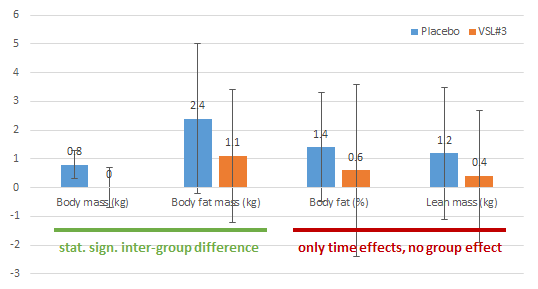
Figure 2: Changes in body composition in response to 4-week high fat overfeeding with or without probiotic supplementation (VSL#3, a 900 billion multi-strain probiotic) in 20 normal-weight young men (Osterberg. 2015).
A study that yielded interesting results, but results that are of questionably practical relevance. Yes, there was a statistical group effect for the changes in total body mass (0 kg vs. 0.8kg) and the total body fat mass (+1.1% vs. +2.4%).

Since there were neither significant differences in body fat% due to the lower lean mass gains in the probiotic group and considering the fact that there were no additional health effects in form improvements in insulin sensitivity or fat oxidation. Since neither of them was affected by the overfeeding, anyways, the significance of the lack of change is questionable.
Bottom line: In spite of the statistically significant weight and fat gain differences, the interpretation of the study at hand is not 100% straight forward. This may be due to the fact that within only 4 weeks other changes (esp. health relevant parameters) did not occur in either group.

While this study shows no immediate health benefits, there's evidence that gluten sensitive individuals may benefit from supplementing /w certain strains.
Furthermore, it must be said that the reduced lean mass gains in the probiotic strain and the subsequent lack of changes in body fat percentages, suggest that the amelioration of the subjects' weight gain is mediated by a mere reduction in energy-availability (this assumes that the intakes in both groups were identical to begin with). If this is the case, the supplement still has its merits: According to the questionable approximation that says that it takes 7,000kcal extra to gain 1kg of body fat, the probiotic supplementation would have compensated for 1.3 kg x 7000 kcal/kg = 9100kcal over 4 weeks and 325 kcal/ day (note this is not a scientifically accurate calculation).

Still, much more research is going to be necessary - not only to elucidate the exact mechanism, but also to find out if the effect might depend on the type of diet: A high fat diet, for example, has been shown to have significant, potentially detrimental effects on the human gut microbiome, which may be meditated by the bile acid resistance of several strains of bacteria, i.e. more fat = exuberant bile production = death to many good bacteria (David. 2014) |  Comment on Facebook!
References:
  • David, Lawrence A., et al. "Diet rapidly and reproducibly alters the human gut microbiome." Nature 505.7484 (2014): 559-563.
  • Osterberg, et al. "Probiotic Supplementation Attenuates Increases in Body Mass and Fat Mass During High-Fat Diet in Healthy Young Adults." Obesity (2015): Ahead of print.

Selasa, 06 Oktober 2015

High Dose BCAAs for Cyclists | Cholostrum Peptides for Bulking | Intermittent Fasting for Cutting | Probiotics for Muscle Protection -- ISSN'15 Research Review Issue #6

Are you trying to build a body like this? Maybe one of the supplements discussed in this article can help.
To make sure that I am not missing other relevant / interesting new research spending time with the ISSN'15 poster presentations, this is going to be the last installment of the ISSN'15 Research Review. With six different studies in one installment of the series it is obviously difficult to find a common theme. With studies on the ergogenic and pro-anabolic effects of various supplements, I am yet sure that there's (at least) one interesting study for everyone. So what's your favorite? The study on the immune effects of BCAAs, the one investigating the differential effects of coffee and caffeine, or the experiment that probes the safety and effects of bioactive peptides, the one that tests the nootropic effects of alpha-glycerylphosphorylcholine, caffeine or placebo or the new study on intermittent fasting?
Read more about ISSN and other studies at the SuppVersity

Vitargo, Red Bull, Creatine & More | ISSN'15 #1

Pump Supps & Synephrine & X | ISSN'15 #2

High Protein, Body Comp & X | ISSN'15 #3

Keto Diet Re- search Update | ISSN'15 #4

The Misquantified Self & More | ISSN'15 #5

BCAA, Cholos-trum, Probiotics & Co | ISSN'15 #6
  • Ten weeks of branched chain amino acid supplementation improves select performance and immunological variables in trained cyclists -- Unlike previous studies which used either relatively low amounts of BCAAs or investigated only the acute effects of BCAA supplementation on performance and immune markers in athletes, the latest study from the Auburn University used a total of 12g BCAAs per day (6g/d L-Leucine, 2g/d L-Isoleucine and 4g/d L-Valine) or a maltodextrin placebo that was consumed by the N=18 trained cyclists (32 ± 2 yr, 77.8 ± 2.6 kg, and 7.4 ± 1.2 yr training) who participated in the study for 10-weeks.

    Before and after the 10-week study, the following was assessed: a) 4-h fasting blood draws; b) dual X-ray absorptiometry body composition; c) Wingate peak power tests; and d) 4km time-trials.
    Figure 1: While there were no improvements in body composition, the scientists observed sign. increases in selected performance markers in response to 10-weeks on high dose BCAA (Kephart. 2015).
    The analysis of the data shows no group*time interactions existed for total lean mass (p = 0.27) or dual-leg lean mass (p = 0.96). A significant interaction existed for body mass-normalized relative peak power (19% increase in the BCAA group pre- to post-study, p = 0.01), and relative mean power (4% increase in the BCAA group pre- to post-study, p = 0.01), however.

    Non-significant, but still noteworthy were the improvements in 4km time-trial performance which shows a borderline significant interaction (p = 0.08) - with the BCAA group improving their TT performance by a non-significant +11% from pre- to post-study. To which extent this improvement was mediated by the increase in serum BCAA: L-Tryptophan ratio would have to be investigated separately, though (l-tryptophan is still suspected to mediate the exercise induced increase in central fatigue | Fernstrom. 2006).

    Of similarly unclear practical significance are the interactions the scientists observed for neutrophil numbers (p = 0.04), which increased only in the placebo (+18%), yet not in the BCAA group. In view of the association of increased neutrophil levels and the exercise-induced suppression of immunity, it is yet logical to follow the scientists' conclustion that "BCAAs may benefit immune function during a prolonged cycling season" (Kephart. 2015).
  • Caffeine and coffee don't differ in their effects on exercise performance -- As Trexler et al. point out, coffee (COF) and caffeine (CAF) "have not yet been directly compared in the context of strength and sprint performance" (Trexler. 2015). To fill this gap in the available research Trexler et al. conducted a randomized, double-blind study that was to compare the effects of acute COF and CAF intake on strength and sprint performance.

    In the study, fifty-four resistance-trained male participants (mean ± SD; age = 20.1 ± 2.1 yrs; height = 177.3 ± 5.6cm; weight = 78.8 ± 8.8 kg; habitual caffeine intake = 32.9 ± 59.6mg/day) completed a baseline test that consisted of both one-rep max (1RM) and repetitions to fatigue (RTF) for leg press (LP) and bench press (BP).
    "Following strength testing, a friction-loaded cycle ergometer was loaded with a resistance of 95g/kg of bodyweight and participants completed a repeated sprint protocol consisting of five, ten-second sprints separated by one minute of passive rest. Peak power (PP) and total work (TW) were recorded for each sprint, along with average PP and TW values for the entire protocol (all five sprints). At least 48 hours later, participants returned for post-testing and ingested a beverage containing either CAF (300mg), a caffeine-matched dose of instant COF (8.9g, yielding 303mg of caffeine), or a flavored placebo (PLA) 30 minutes prior to exercise. Prior to each visit, participants were instructed to maintain similar dietary habits, abstain from strenuous exercise for at least 24 hours, and avoid caffeine intake for at least 48 hours. Change scores were compared using one-way ANOVAs, and 95% confidence intervals (mean ± 1.96 × SEM) were constructed for each dependent variable" (Trexler. 2015).
    The analysis of the data the experiment generated yielded significant performance increases on the on the leg press where the 1RM was improved more by COF compared to CAF (Δ = 32.2 ± 18.6 vs 15.3 ± 16.9lb, p = 0.04), but not to PLA (p = 0.99).
    Figure 2: At least in comparison to the placebo treatment, the improvements in exercise performance are not debatable. Whether caffeine or coffee is the better ergogenic is albeit still not 100% clear (Trexler. 2015)
    No significant interactions were not observed for bench press (BP) 1RM, BP RTF, or leg press (LP) RTF (p > 0.05). The total work during the spring, however was increased for CAF [81.4, 623.9J], but not COF [-121.0, 376.2J] or PLA [-239.9, 180.1J]. In addition, both caffeine and coffee blunted the significant reductions in peak power and total work during the latter sets of the spring training. In spite of the lack of general improvements of strength outcomes, the improvements that were observed during the repeated sprint test support the notion that both caffeine and coffee have practically relevant ergogenic effects.
  • Bio-Gro™, a commercial food-based bio-active peptide product, may augment your gains and enhance your recovery -- I guess the question that's preying on your mind at the moment is "Bio-Gro? Wtf..." Well, I wish I could answer this question precisely, but all I can tell you is that it's a peptide-based powder (serving size 1.5g) of which the manufacturer, Isatori, says that it is extracted from bovine colostrums and contains ...
    "an exact concentration of bioactive:  Proline-Rich Peptides (PRP's), Growth Factors (IgF, TGF beta-2, EGF, PDGF), Immunoglobulins (IgG, IgA), Lactoferrin and Fibroblast-GF." (manufacturer website)
    Against that background it is not really surprising that Patrick Jacobs' study on the safety of the product did not find unwanted side effects in twenty recreationally resistance trained men who consumed the supplement that is available both in powder- and capsule-form.

    What is surprising, though, is that the provision of the supplement over 8-weeks also yielded significant enhancements in the rate of body mass and lean body mass gains with supplementation of a bio-active peptide in conjunction with eight weeks of resistance training. To be precise, Jacobs' analyses of the data revealed that ...
    "Bio-Gro™ produced significantly greater (p < 0.05) changes in total body mass as assessed with BodPod (+6.3 pounds) than the placebo condition (+2.8 pounds). [In addition, l]ean body mass changes were also significantly greater with Bio-Gro™ (+5.8 pounds) compared with placebo (+3.7 pounds) (p < 0.05)" (Jacobs. 2015).
    Similar benefits were observed for the subjects sleeve sized of which mid-arm flexed measurements (+0.74 inches) indicate that they increased more than 2x more in the treatmet vs. placebo condition (+0.31 inches) (p < 0.05).
    Figure 3: Pre- / post changes in body composition and mid-arm flexed circumference (Jacobs. 2015).
    In view of the lack of differences in other circumferential change scores, and the lack of statistical significance of the lean mass when the latter were assessed by skinfold measurements, I would still like to see an independent confirmation of the results (also a comparison to whey protein / the use of Bio-Gro™ alongside whey protein) before I invest 52.5 cents per serving. This is particularly true in view of the fact that the supplement appears to have boosted the subjects' fat gains, too (see Figure 3 where the difference between total mass and lean mass increases is probably fat, not organ or bone weight ;-).
  • Caloric restriction is easy on "intermittent fasting", but fat loss does not ensue -- Bad news for intermittent fasting enthusiasts comes from the Baylor University, where Grant M Tinsley investigated the effects of intermittent fasting combined with resistance training on body composition, muscular performance, and dietary intake.

    For the course of the 8-week study, 18 adult men were randomly assigned to do either resistance training alone (RT) or resistance training plus IF, in the form of termed time-restricted feeding (RT+TRF). Both groups followed a 3-days-per-week resistance training program for 8 weeks.
    "The TRF program was implemented on non-workout days (i.e. 4 days per week) and consisted of consuming all calories within any 4-hour period between 4 PM and midnight. Both groups were allowed unrestricted food intake during feeding periods. Research visits were conducted at baseline, 4 weeks, and 8 weeks after beginning the study and consisted of body composition assessment via dual-energy x-ray absorptiometry (DXA), 1-repetition maximum (1-RM) strength testing and muscular endurance testing on bench press and leg press exercises, and subjective measures of program difficulty. Diet records, workout logs, and compliance forms were used to track and encourage program adherence, as well as examine dietary differences. One-way and factorial ANOVAs were conducted using R (version 3.1.1)" (my emphasis in Tinsley. 2015).
    For intermittent fasting enthusiasts, the results were - as previously said - disappointing: No group*time interactions were found for any measures of body composition (lean mass, fat mass, and body fat percentage), muscular performance, or dietary intake.

    Interestingly, the intermittent fasting group did still display a slightly higher leg press 1-RM as well as an increased bench press endurance compared to the resistance training only (RT) group. That this occurred in the presence of a significantly reduced energy and fat intake in the RT+TRF group on the fasting days, but in the absence of significant differences on the non-fasting days is surprising. It does after all suggest that the subjects in the intermittent fasting (RT+TRF) group must have consumed significantly less energy. Now, it's up to you to decide what you find more surprising:
    • Intermittent fasting can make you fat | learn why!
      The fact that the subjects in the intermittent fasting group consumed significantly less energy without losing body weight or fat?
    • Or the fact that the subjects in the intermittent fasting group saw greater performance increases despite consuming significantly less energy and dietary fat?
    Whatever your personal answer to this question may be, the most significant results of the study is probably that there were "[n]oticeable differences in individual responses to the programs" (Tinsley. 2015) - an observation that should remind you of the conclusions to previous articles on Intermittent Fasting, here at the SuppVersity: Eventually, you will have to try it to find out if IF works for you.
  • Probiotic muscle protectors -- Muscle protecting probiotics? I have to admit: That sounds awkward. Nobody would doubt that GanedenBC30 a probiotic supplement that contains Bacillus coagulans GBI-30, 6086, supports healthy digestive and immune function. I am even willing to believe that supplement-induced changes in the make-up of its users gut microbiome can increase the absorption of protein, but I would not have expected that it can actively promote muscle recovery through gut microbial modulation.

    Just that is yet what a recent study from the University of Tampa suggests. In said study, 30 healthy recreationally-trained males (mean+/-SD; age: 21.5 ± 2.8 years; height: 177.4 ± 8.0 cm; weight: 89.7 ± 28.2 kg) were randomly assigned to consume either 20 g of casein (Control = CON) or 20 g of casein plus probiotic (500M CFU GanedenBC30, = BC30) twice daily in a crossover, diet-controlled design for a two-week time period.
    "Subjects performed a damaging exercise bout consisting of 10 sets × 10 repetitions unilateral leg press at 70% 1 RM with 1 minute rest, one legged - leg extension (5 sets × 12 reps), and rear foot elevated split squat 5 sets × 12 reps with one minute rest at baseline and after two weeks of supplementation. Athletic performance consisting of peak power (Wingate 10 sec Peak Power Assessment at 7.5% BW at 175RPM threshold loaded drop), vertical jump power (Tendo unit, single-leg jump), and 1-RM single-leg press; and muscle damage was analyzed by muscle swelling (ultrasonography) and blood draws (creatine kinase (CK), blood urea nitrogen (BUN)) were taken at baseline (pre-supplementation) and 48 hours after damaging exercise bout. Perceptual measures (perceived recovery, soreness) were taken before, 24, 48 and 72 hours after exercise" (Jäger. 2015).
    The analysis of the data the tests generated shows that the damaging exercise bout significantly increased muscle soreness (p < 0.001), reduced perceived recovery (p < 0.001) in both groups. Compared to the control group, however, the subjects in the casein + BC30 group show a significantly increased rate of recovery at 24 and 72 hours, and decreased soreness at 72 hours post exercise.
    Figure 4: Changes in CK and Wingate peak power in the control and treatment group (Jäger. 2015).
    The perceptual measures were confirmed by increases in CK (CON: +266.8%, p = 0.0002; BC30: +137.7%, p = 0.01), with BC30 showing a trend towards reduced indices of muscle damage (p = 0.08). It is thus only logical that the significant reduction in athletic performance in the control group (Wingate Peak Power; CON: (-39.8 watts, - 5.3%, p = 0.03)), was ameliorated, yes even blocked, in the BC30 group (+10.1 watts, +1.7%).

    Whether similar effects can be seen with non-patented strains of probiotic bacteria warrants further investigation. What I can tell you already, though, is that even regular yogurt has immuno-supportive effects (Lollo. 2013). Previous studies also indicate that more commonly used lactobacillus strains have similar anti-oxidant effects in athletes (Martarelli. 2011). Whether their effects are more or less pronounced than those of the Bacillus coagulans strain in BC30 will now have to be elucidated in future studies.
Nootropics for the bottom line: In view of the inconclusive results of Parker et al.'s study on the effects of alpha-glycerylphosphorylcholine, caffeine or placebo on markers of mood, cognitive function, power, speed, and agility, I have "banned" it into the bottom line, where I'd like to cite the scientists's conclusion that "future research should focus on dosage of [alpha GPC for certain physical and mental performance tasks], timing of consumption before testing measurement, bioavailability, longer term supplementation, and subject selection, in order to reduce individual variability" (Parker. 2015) and add that you may want to memorize that the provision of 200mg of caffeine did not improve the 10 male and 10 female participants' performance on subsequent (30 min) tests for reaction time, hand-eye coordination, power, speed, and agility.

You have to adjust volume, intensity and frequency of your workouts according to your goals | learn how!
At first sight, the lack of efficacy of caffeine appears to stand in contrast to the results Trexler et al. present in their study. Eventually, however, it could well be nothing but the test that makes all the difference. After all, acute performance benefits were observed by Trexler et al. only in the total work during a sprint test - the total work, however, wasn't even assessed by Parker et al. So, if there's one important take-away it's that supplements must always be chosen according to one's personal goals...

Now, this which brings me back to the increased sleeve sizes in the Jacobs study. You will be happy about these inches only if you don't care about the purported fat gain Jacobs doesn't address in the abstracts to his 8-week study on cholostrum peptide supplementation | Comment on Facebook!
References:
  • Fernstrom, John D., and Madelyn H. Fernstrom. "Exercise, serum free tryptophan, and central fatigue." The Journal of nutrition 136.2 (2006): 553S-559S.
  • Jacobs, Patrick L. "Safety and organ health with 8 weeks use of commercially available bio-active peptide supplement: A prospective, double-blind, placebo controlled randomized trial." Journal of the International Society of Sports Nutrition 12.Suppl 1 (2015): P46.
  • Jacobs, Patrick L. "Significant enhancement in the rate of body mass and lean body mass gains with supplementation of a bio-active peptide in conjunction with eight weeks of resistance training: a prospective, double-blind, placebo controlled randomized trial." Journal of the International Society of Sports Nutrition 12.Suppl 1 (2015): P47.
  • Jäger, Ralf, et al. "Effects of probiotic supplementation on markers of skeletal muscle damage, perceived recovery and athletic performance after an intense single leg training bout." Journal of the International Society of Sports Nutrition 12.Suppl 1 (2015): P36.
  • Lollo, Pablo Christiano B., et al. "Probiotic yogurt offers higher immune-protection than probiotic whey beverage." Food Research International 54.1 (2013): 118-124.
  • Martarelli, Daniele, et al. "Effect of a probiotic intake on oxidant and antioxidant parameters in plasma of athletes during intense exercise training." Current microbiology 62.6 (2011): 1689-1696.
  • Kephart, Wesley C., et al. "Ten weeks of branched chain amino acid supplementation improves select performance and immunological variables in trained cyclists." Journal of the International Society of Sports Nutrition 12.Suppl 1 (2015): P20.
  • Parker, Adam G., et al. "The effects of alpha-glycerylphosphorylcholine, caffeine or placebo on markers of mood, cognitive function, power, speed, and agility." Journal of the International Society of Sports Nutrition 12.Suppl 1 (2015): P41.
  • Tinsley, Grant M., et al. "Intermittent fasting combined with resistance training: effects on body composition, muscular performance, and dietary intake." Journal of the International Society of Sports Nutrition 12.Suppl 1 (2015): P38.
  • Trexler, Eric T., et al. "Effects of coffee and caffeine anhydrous on strength and sprint performance." European journal of sport science (2015): 1-9.