Jumat, 19 Februari 2016

High Dose Stevia Turns Weight Gain into Loss, Lowers Lipid and Glucose Levels not Only When Used to Replace Sugar - Effects are Mediated by Reduced Energy Intake & Utilization

There's very little "natural" about the natural sweetener stevia when it ends up in your food in form of purified and decolorized steviosids.
As a SuppVersity reader you'll know that "natural" does not equate "healthy". This, the proven anti-microbial effects stevia exerts in your gut and the fact that the currently available steviosid-based stevia products undergo more processing steps than than the dreaded aspartame warrant the question whether (a) stevia is safe and (b) as effective as other sweeteners when it comes to weight loss promotion.

Since the optimal dosage of stevia to achieve meaningful effects is also not known, yet, scientists from the Alexandria University in Egypt investigated the safety ad efficacy of different amounts of stevia sweeteners (25, 250, 500 and 1000 mg/kg body weight per day) as a substitute for sucrose on weight gain or the weight loss and weight management of female rats on an ad-libitum diet.
You can learn more about sweeteners at the SuppVersity

Aspartame & Your Microbiome - Not a Problem?

Will Artificial Sweeteners Spike Insulin?

Sweeteners & the Gut Microbiome Each is Diff.

Chronic Sweeten-er Intake Won't Effect Microbiome

Stevia, the Healthy Sweetener?

Sweeteners In- crease Sweet- ness Threshold
Sixty adult female Wistar strain rats (average weight 203 ± 6 g) were used in the present experiment. Animals were obtained from Faculty of Medicine, Alexandria University, Egypt. Animals were caged in groups of 6 and given distilled water and a standard diet that meets their requirements for growing ad libitum. The diet consisted of  44% soybean cake; 12% berseem clover hay, 13.5% fat, 9.8% yellow maize, 13.2% starch, 5% minerals; 2% lime stone and 0.5% vitamins mixture. After two weks of acclimatization, animals were divided into six equal groups:
  • The first group was drank distilled water (Negative control), and positive control was given a dose of sucrose dissolved in drinking water at 500 mg/kg/day. This dose of sucrose used in this experiment was predicted to dose of stevia sweeteners equivalent concentration estimated by JECFA as control. 
  • "On the other hand, groups 3, 4, 5 and 6 were given a different doses of stevia sweeteners which were dissolved in drinking water at a dose level of 25 mg/kg/day (human equivalent dosage, HED = 4 mg/kg/day) according to JECFA (G1), 250 mg/kg/day (G2: HED = 41 mg//kg/day), 500 mg/kg/day (G3: HED = 81 mg/kg/day) and 1000 mg/kg/day (G4: HED = 162 mg/kg/day ), respectively" (Elnaga. 2016)
To assess how much stevia the animals actually consumed, the scientists recorded the animals fluid intake daily. To ensure constant intakes in all groups, they adjusted the solution concentrations weekly based on the average weight of the animals and their current fluid consumption.
At the end of the experimental period (12 weeks), body weights of animals were recorded and calculated of body weights gain (%) and feed efficiency ratio (FER) according to the method of Chapman et al. (1959).
Figure 1: Body weight of rats treated with administration of sucrose (S) and stevia sweetener different dosages (25, 250, 500 and 1000 mg/kg) for 12 weeks compared with control (Elnaga. 2016).
You probably expected that the replacement of sugar with stevia would lead to significant reductions in body weight gain, right? Well, if you scrutinize the data in Figure 1, you will notice that the effect went far beyond a reduction in weight gain. In fact, all stevia supplemented animals lost weight - dose-dependently 40.29%-48.29%.
Figure 2: Organ weights relative to body weight of female rats treated with stevia sweetener at doses of 25, 250, 500 and 1000 mg/kg b. wt and sucrose compared with control (Elnaga. 2016).
This certainly sounds like bad news, but the data in Figure 2 tells you that the weight of all important organs (liver, heart, brain, kidney, lung, pancreas and spleen) remained stable. Unfortunately, the scientists did not measure muscle and fatpad weight.
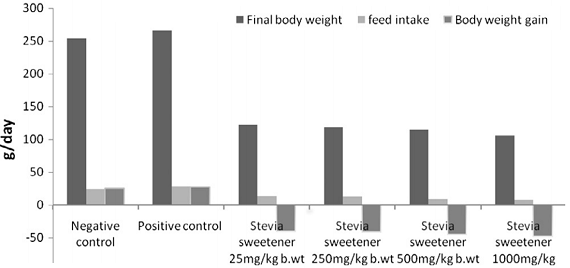
Figure 3: Final body weight, feed intake and body weight gain % in rats treated with administration of stevia sweetener in different dosages (25, 250, 500 and 1000 mg/kg) after 12 weeks on ad-libitum diet (Elnaga. 2016).
In view of the significantly reduced feed intake (>50%) and the even more reduced feed efficiency ratio (FER), of which the scientists say that it was the lowest at a dose 1000 mg/kg b.wt stevia ( -6.14) and increased with decreasing stevia intakes (-5.21, -3.22 FER and -2.91 FER), it would yet be unreasonable to assume that the weight difference was a results of fat loss, alone.
What about human studies? And what's the mechanism? Comparable human studies haven't been done and the fact that a 2005 study by Chang et al. suggests that the body weight loss of rats receiving 5.0 mg/kg stevioside was due to the poor palatability of the food because of the high amount of stevioside. It is thus questionable if stevia would work the same magic in humans. Ok, in the study at hand, the sweetener was gavaged in the drinking water, but the food intake still decreased significantly. Significantly enough to trigger profound weight loss even in the absence of the reduced feed efficacy (see Figure 3); and even the reductions in blood lipids and glucose could eventually be a function of weight loss - even though, studies appear to suggest that stevia has insulinotropic, glucagonostatic, antihyperglycemic, and blood-pressure-lowering effects all of which would suggest that it could be more than a sugar replacement (Gregersen. 2004; Hony. 2006).
Aside from the questionable weight loss, the three groups of rats treated with stevia sweetener showed improvement in lipid profile levels comparing with negative or positive control group. More specifically,
  • ... the total lipid levels of the rodents decreased by 11.96%, 19.89%, 25.03% and 37.07% when rats were given stevia sweetener at doses of 25, 250, 500 and 1000 mg/kg/b. wt, respectively compared to negative control,
  • ... the LDL values in rat serum lipids decreased with increasing the doses of stevia sweetener; rats given stevia sweetener at dose 1000 mg/kg b. wt showed the highest decrease in the LDL (26.50%) followed by those given dose 500 mg/kg (24.36%), dose 250 mg/kg (19.90%) and finally dose 25 mg/kg (15.01%), and 
  • ... the VLDL levels were decreased 3.13%, 11.18%, 19.87% and 26.08% in rats given stevia sweetener at doses of 25, 250, 500 and 1000 mg/kg.
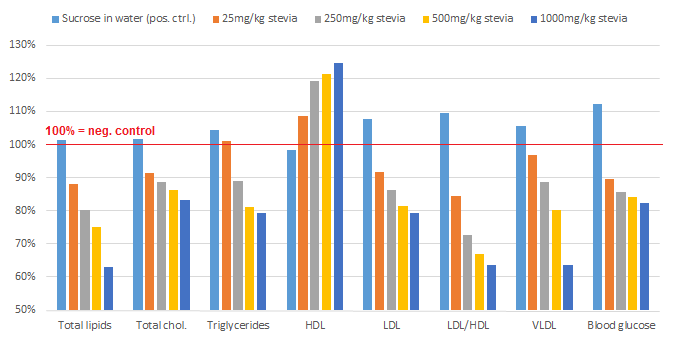
The decreases in total, LDL and VLDL cholesterol stand in contrast to significant increase in HDL and corresponding decreases of the LDL/HDL ratio from 3.43 and 3.76 in the negative and positive control group to 2.90, 2.49, 2.30 and 2.18 in the 25mg/kg, 250mg/kg, 500mg/kg and 1000mg/kg groups, respectively.
Figure 4: Blood lipids and glucose levels after 12 weeks on high sucrose water with different amounts of stevia replacing the sucrose in the water; data expressed relative to negative (=water) control (Elnaga. 2016).
Ill effects on markers of liver health or general blood parameters were not observed and the significant decrease in blood glucose levels, I added to the relative changes in lipid levels in Figure 4, is certainly nothing to be concerned about.
Bottom line: Just as the scientists put it, "the stevia sweetener treated groups showed significantly improvement and ameliorated reduction in bodyweight, BWG % and lesser intake of feed" (Elnaga. 2016). In conjunction with the "decreasing [...] levels of blood glucose, total lipids, total cholesterol, triglycerides and low-density lipoprotein concentrations, and increasing [...] high-density lipoprotein" (ibid.) concentrations the study at hand appears to suggest that stevia was a wonder-drug.

Study indicates stevia kills healthy gut bacteria. So, how bad is it? Are the effects significant, will they have an impact on your overall health and does this mean you must not use stevia any longer? Learn more in this SV Classic
Two things you must not forget, though, are that (a) the health benefits were most pronounced in comparison to the "positive control", i.e. the sucrose guzzling rats that represent the average sugar-sweetened beverage junkie and that (b) the >40% of weight the rodents lost certainly didn't come from body fat, exclusively.

In view of the contemporary lack of data that would confirm the beneficial effects of several grams of stevia (the dose equivalents for an adult are  ~0.2, ~1.6, ~3.2, ~6.5g per day, respectively) on the body composition and lipid levels of human beings, I must caution against being too euphoric about the results of this study, anyways. | Comment!
References:
  • Chang, J. C., et al. "Increase of insulin sensitivity by stevioside in fructose-rich chow-fed rats." Hormone and metabolic research= Hormon-und Stoffwechselforschung= Hormones et metabolisme 37.10 (2005): 610-616.
  • Elnaga, NIE Abo, et al. "Effect of stevia sweetener consumption as non-caloric sweetening on body weight gain and biochemical’s parameters in overweight female rats." Annals of Agricultural Sciences (2016).
  • Gregersen, Søren, et al. "Antihyperglycemic effects of stevioside in type 2 diabetic subjects." Metabolism 53.1 (2004): 73-76.
  • Hong, Jing, et al. "Stevioside counteracts the α-cell hypersecretion caused by long-term palmitate exposure." American Journal of Physiology-Endocrinology and Metabolism 290.3 (2006): E416-E422.

Rabu, 17 Februari 2016

Research Update: 5000 IU/day Vitamin D, 12g/day Citrulline Malate or Barefoot Running What's the Most Ergogenic?

Who would have thought that barefoot running triggers instant improvements in running economy?
With the release of ahead of print articles for the next issue of the Journal of Strength and Conditioning Research, it is high time for yet another research update; an update with research on the effect of vitamin d supplementation on training adaptation in well trained soccer players, acute citrullin malate supplementation (10 grams 60 minutes before a workout) and high-intensity cycling performance, as well as information about the ability of barefoot running to reduce oxygen cost and improve running economy in female distance runners who have never run barefoot before.
Read more about exercise-related studies at the SuppVersity

Tri- or Multi-Set Training for Body Recomp.?

Aug '15 Ex.Res. Upd.: Nitrate, Glycogen, and ...

Pre-Exhaustion Exhausts Your Growth Potential

Full ROM ➯ Full Gains - Form Counts!

BFR-Preconditio- ning Useless for Weights?

Study Indicates Cut the Volume Make the Gains!
  • The effect of vitamin d supplementation on training adaptation in well trained soccer players (Jastrzebska. 2016) - In view of the fact everybody appears to believe that the currently available evidence would imply that vitamin D supplements could enhance athletic performance, it is hardly surprising that the next issue of the Journal of Strength and Conditioning Research will contain yet another study investigating the effects of vitamin D supplements on athletic performance.

    What distinguishes the study at hand from the rest of the pack is that it was conducted in high-level, well trained athletes, who received either a placebo (PG) or 5000IU of vitamin D per day (SG). Both groups were subjected to the same "High Intensity Interval Training Program".
    Figure 1: Overview of he training regimen, the subjects were subjected to.
    The selection to the groups was based on peak power results attained before the experiment and position on the field. Blood samples for vitamin D level were taken from the players. In addition, total work, 5-10-20-30 m running speed, squat jump, and countermovement jump height were determined.

    Much to the disappointment of the average vitamin D enthusiast, there were no significant differences between SG and PG groups for any power-related characteristics at baseline. What did work, though, was the training: All power-related variables, except the 30 m sprint running time, improved significantly in response to interval training. However, the mean change scores (the differences between post- and pre-supplementation values) did not differ significantly between SG and PG groups. Thus, the authors of the study conclude that...
    Remember the differential effect of Vitamin D on breast cancer risk in lean vs. obese women?
    "[...] an 8-week vitamin D supplementation in highly trained football players was not beneficial in terms of response to high intensity interval training [and that, g]iven the current level of evidence, the recommendation to use vitamin D supplements in all athletes to improve performance or training gains would be premature" (Jastrzebska. 2016).
    What may make sense, however, is to avoid a seasonal decrease in 25(OH)D level or to obtain optimal vitamin D levels via higher dietary intakes and, optionally, vitamin D supplementation. Why that? Well, in vitamin D deficient athletes, there's at least some evidence that supplementing, or rather increasing the 25OHD levels help.
  • Acute Citrulline-Malate supplementation and high-intensity cycling performance (Cunniffe. 2016) - Unlike the results of a previously discussed study on the effects of citrulline supplementation during an intense leg workout, in which 8g/day triggered significant performance increases, the recent double-blind, placebo-controlled, crossover study by Cunniffe et al. found no benefits of 12g of citrulline malate (in 400ml) compared to lemon sugar-free cordial (Placebo [PL]) when the 10 subjects consumed it 60 min prior to completion of two exercise trials... or, to be precise, only the heart rate differed significantly.
    Figure 2: Mean performance in the two groups; # sign. inter-group difference (p < 0.05 | Cunniffe. 2016)
    They consumed it 60 minutes before the workouts? Right, this happens to be the same protocol, Wax et al. used 2014 in 12 advanced resistance trained male subjects. What was different, however, is the type of exercise. While Wax et al. had their subjects squat and leg press, Cunniffe investigated the effects in a trial that consisted of ten (x 15 s) maximal cycle sprints (with 30 s rest intervals) followed by 5 min recovery before completing a cycle time-to-exhaustion test (TTE) at 100% of individual peak power (PP). I guess that explains the difference and suggest that the performance enhancing effects of citrulline are exercise dependent - obviously, this has to be investigated in future studies ;-)
  • Barefoot running reduces the submaximal oxygen cost in female distance runners (Berrones. 2016) - The two most important ways to increase your running performance are (a) improving your VO2max, (b) improving your running economy aka the "O2 costs of running". That this can be achieved as easily as by dropping your shoes is thus a quite important result, Berrones et al. observed in during three 5-minute submaximal running trials representing 65, 75, and 85% of VO2max in fourteen recreationally active, trained distance female runners (age = 27.6 +/- 1.6 yrs; height = 163.3 +/- 1.7 cm; weight = 57.8 +/- 1.9 kg) who were completely inexperienced with unshod running.

    Following initial testing, each subject was randomized to either unshod or shod for days 2 and 3. Berrones et al. analyzed the data with a 2-way (condition by intensity) repeated measures ANOVA. The results of this analysis shows that the runners' submaximal oxygen consumption was significantly reduced at 85% of VO2max (P = 0.018), but not during the 65% or 75% trials (P > 0.05, both).
    The improvement in VO2 consumption during barefoot running was sign. only for 85% VO2max (Berrones. 2016).
    No other dependent measure, i.e. respiratory exchange ratio (RER), lactate, heart rate (HR), and ratings of perceived exertion (RPE), was different between unshod and shod conditions; and still, the scientists' conclusion that "training or competing while barefoot may be a useful strategy to improve endurance performance" (Berrones. 2016) may be useful for recreational or competitive distance runners.
You want more short exercise news? Well, this is not exactly a short one, but still: "GYM-Science Update: Bands Aid W/ Deadlifts? 16x1 or 4x4 for HIIT? Kettlebell HIIT Workout Better Than HIIT-Cycling?" | more
Bottom line? Well, I guess I should answer the question in the headline even if it is obvious, right? The answer is: "barefoot running". What we should not forget, though is the fact that previous research suggests that having normal (not extra-high) vitamin D levels is as important for athletes as 8g of citrulline are useful for strength trainees.

Against that background I wouldn't be surprised if the next SuppVersity Research Update featured studies showing beneficial effects of vitamin D and citrulline malate supplements and no or even ill effects of barefoot running... but hey, the results of the Berrones study are still impressive, right? Don't forget: the subjects had never run barefoot before | Comment on Facebook!
References:
  • Berrones, Adam J.; Kurti, Stephanie; Kilsdonk, Korey; Cortez, Delonyx; Melo, Flavia; Whitehurst, Michael. "Barefoot running reduces the submaximal oxygen cost in female distance runners." Journal of Strength & Conditioning Research: Post Acceptance: January 19, 2016. doi: 10.1519/JSC.0000000000001330. 
  • Cunniffe, Brian; Papageorgiou, Maria; O’Brien, Barbara; Davies, Nathan A; Grimble, George K; Cardinale, Marco. "Acute Citrulline-Malate supplementation and high-intensity cycling performance." Journal of Strength & Conditioning Research: Post Acceptance: January 19, 2016. doi: 10.1519/JSC.0000000000001338.
  • Jastrzebska, Maria; Kaczmarczyk, Mariusz; Jastrzebski, Zbigniew. "The effect of vitamin d supplementation on training adaptation in well trained soccer players." Journal of Strength & Conditioning Research: Post Acceptance: January 20, 2016. doi: 10.1519/JSC.0000000000001337
  • Wax, Benjamin, et al. "Effects of Supplemental Citrulline Malate Ingestion During Repeated Bouts of Lower-body Exercise in Advanced Weight Lifters." The Journal of Strength & Conditioning Research (2014).

Minggu, 14 Februari 2016

Normal-Weight Women Lose >6kg Fat Mass in 6 Weeks With Three 15x60s HIIT Workouts/Week - Without Dieting

I am still waiting for a study using only body weight exercises like squats, push ups, burpees and co as a HIIT regimen for weight or rather fat loss.
While HIIT is gaining ground especially in male muscle heads, women like the twenty-three previously untrained women (28.43 ± 12.53 years), who participated in a recent study from the Department of Sport at the School of Physical Education and Sport of the University of Sao Paulo in Brazil (Panissa. 2016), are gravitating rather towards training in the alleged (but non-existing) "fat burning" zone at an intensity of 70% of their individual HRmax.

I guess, Panissa et al. knew that, because in their latest study they compared the effects of 6 weeks of high-intensity intermittent training (HIIT) to those of moderate intensity continuous exercise (MICT-control group) on body composition (skinfold measures), hunger and food intake.
Read more about exercise-related studies at the SuppVersity

Tri- or Multi-Set Training for Body Recomp.?

Aug '15 Ex.Res. Upd.: Nitrate, Glycogen, and ...

Pre-Exhaustion Exhausts Your Growth Potential

Full ROM ➯ Full Gains - Form Counts!

BFR-Preconditio- ning Useless for Weights?

Study Indicates Cut the Volume Make the Gains!
As previously highlighted, the subjects were twenty-three previously untrained women (28.43 ± 12.53 years) who were randomly assigned to a HIIT (n = 11) or MICT group (n = 12).
  • The HIIT group performed 15 1-min bouts at 90 % of maximum heart rate (HRmax) interspersed by 30-s active recovery (60 % HRmax). 
  • The MICT group performed a continuous exercise at 70 % HRmax equalizing the training load method proposed by Edwards (1993) to a similar value achieved by the HIIT group. 
Training for both groups was performed on regular cycling ergometers three times per week for 6 weeks. More specifically, both groups performed the same warm up and cool down, composed by 3 min at 60 % of maximum heart rate, MICT sessions consisted of moderate intensity aerobic exercise, i.e., after warm up the subjects performed 29 min at 70 % of maximum heart rate. HIIT group performed 22 min of HIIE using a 2:1 effort–pause ratio, where the effort was 1 min at 90 % of maximum heart rate and recovery was a 30s exercise at the same load as warm up (60 % HRmax).Each training session was closely supervised, and load was adjusted according to individual HR prescription. During this period subjects were asked to avoid any supervised exercise and strenuous efforts during their daily routine.
Was the training load standardized? To equalize training load between groups, the scientists used a method proposed by Edwards (1993). He proposed a zone based method for the calculation of training load. According to Edwards model, the time spent in five pre-defined arbitrary zones is multiplied by arbitrary coefficients to quantify training load. You can read up on the method here.
The performance effects were assessed by the means of Astrand cycloergometer that were used to estimate maximal oxygen consumption (VO2max) 1 week before and after the training period.
"Feeding behavior was assessed by two methods: (1) a 3 days daily food recordatory, including 1 weekend day before the protocols at baseline and after the last session. A detailed explanation for filling the food diary was held at the end of the evaluation, to be returned completed during the first week of training. The analysis of food diaries was made from the application to FatSecret [Subar. 2010]; (2) Immediately after each training session, participants answered a Visual Analog Scale (VAS) of Hunger ranging from 1 to 10, where 1 corresponded to no sensation of hunger and the 10 maximum feeling of hunger" (Panissa. 2016).
The subjects body composition was calculated based on detailed measures of skinfold thickness (triceps, subscapular, chest, supra iliac, abdominal, thigh and leg and the circumference of waist, hip, arm, chest, thigh) and legs - a method that is, assuming it is done correctly, as accurate as an expensive DXA-scan (Eston. 2005; Steinberger. 2005).
Figure 1: Relative changes in BMI, fat free mass (FFM), fat mass (FM) and waist circumference over the 6 week study; absolute changes in kg/m², kg and cm are displayed as first number below the bars (Panissa. 2016).
As you can see in Figure 1, both interval and steady state training induced significant pre- to post-decreases for fat mass, fat percentage, waist circumference and sum of seven skinfolds.
This is no "HIIT is better than LISS / MICT study! Theoretically, the study at hand "proves" that HIIT is more effective than LISS, but let's be honest: if you volume-equate HIIT and light / medium intensity training you end up at durations for the LISS / MICT of which no one would be surprised that they don't trigger fat loss. Plus: Facebook Fans know: HIIT decreases MICT / LISS increases appetite when all things are considered (more). Furthermore, the women were untrained and didn't do extra resistance training which would add additional load on the sympathetic nervous system and may thus (if done 3+ times per week) better be combined with LISS or MICT which would provide a parasympathetic stimulus that could ideally complement your resistance training training.
With a 2:1 fat to muscle ratio, the HIIT regimen was yet significantly more successful in improving the subjects' body composition (which obviously depends on the relative, not the total amount of fat) and that despite the fact that the energy intake didn't change significantly in either of the groups.
Figure 2: Daily energy intake in kcal before and during / after the exercise intervention (Panissa. 2016).
Another parameter that showed a measurable, albeit not significant inter-group difference is the effect of the exercise intervention on the subjects' fitness, as it can be predicted based on the subjects VO2max, a value that increased by a whopping 31.12% in the HIIT group, and only 16.70% in the MICT group - a difference that can hardly surprise the average SuppVersity reader.
Isn't HIIT for everyone? Study suggests: Effective- and usefulness of high intensity interval training depend on age and fitness level | learn more
Bottom line: HIIT wins, but not with a statistically significant advantage. As the authors point out, "the main result of the present study was that although the HIIT was able to promote a higher decrease in body fat mass" (Panissa. 2016). Furthermore, the observed benefits of HIIT were not, as previous studies had suggested, due to changes in hunger and energy intake. This important observation leads the authors to conclude that "the hypothesis that changes in hunger (measured by analogical visual scale in all training sessions) and in energy intake (measured by food diaries preand post-training) would contribute to a higher efficiency of HIIT to decrease body fat was not confirmed by our results" (Panissa. 2014).

What the scientists forget to mention in said conclusion, however, is that the lack of statistical significant differences may be a consequence of the "short term" nature of their study, they emphasized in the title "Can short-term high-intensity intermittent training reduce adiposity?" (Panissa. 2016). I bet: In a longer term and/or better powered follow up study, the already visible changes will achieve statistical significance | Comment!
References:
  • Edwards S. "High performance training and racing." In: Edwards S (ed) High performance training and racing. Feet Fleet Press (2013), Sacramento, pp 113–12.
  • Eston, R. G., et al. "Prediction of DXA-determined whole body fat from skinfolds: importance of including skinfolds from the thigh and calf in young, healthy men and women." European journal of clinical nutrition 59.5 (2005): 695-702.
  • Panissa, Valéria Leme Gonçalves, et al. "Can short-term high-intensity intermittent training reduce adiposity?." Sport Sciences for Health (2016): 1-6.
  • Steinberger, J., et al. "Comparison of body fatness measurements by BMI and skinfolds vs dual energy X-ray absorptiometry and their relation to cardiovascular risk factors in adolescents." International journal of obesity 29.11 (2005): 1346-1352.
  • Subar, Amy F., et al. "Assessment of the accuracy of portion size reports using computer-based food photographs aids in the development of an automated self-administered 24-hour recall." Journal of the American Dietetic Association 110.1 (2010): 55-64.

Jumat, 12 Februari 2016

HMB for Every, Not Just Strength Athletes? Lower Body Fat, Improved VO2, Muscle, Testosterone in 2x12 Week Study

Lean muscle for athletes? HMB could help, irrespective of exercise type - by increasing strength, lean mass and VO2. In the study at hand, all three increased and that is / was in highly trained athletes.
You've read all articles about HMB at the SuppVersity? In that case you will be aware that HMB has hitherto been perceived rather as a strength / bodybuilding than an endurance supplement. Against that background it may come as a surprise that researchers from the Poznán University of Life Sciences in Poland chose to study the effects of HMB on the aerobic capacity (Burkalec-Michalski. 2016), instead of the usual study outcome, the subjects' strength. Is that a bad thing? Not at all!

After all, there are  more sports that require optimal aerobic performance than sports that require (only) optimal strength performance. It thus makes perfect sense that Krzysztof Durkalec-Michalski and Jan Jeszka chose aerobic performance as their primary, but not only study outcome.
Learn more about the potential beneficial effects of HMB at the SuppVersity:

HMB For Fat Loss?

Hica & HMB in Yogurt

More on HMB Free Acid

Breakthrough HMB Science

HMB + Whey = Useless?!

HMB Hampers Fat Loss?
Don't worry, though! With the body composition (unfortunately only BIA data) as second outcome measure, the results the scientists derived in an experiment that involved 58 male athletes aged 22 ± 6 years, with body weight of 82.9 ± 12.3 kg and height of 181 ± 7 cm, practicing wrestling (n = 12), judo (n = 10), Brazilian jiu-jitsu (n = 14), karate (n = 6), and rowing (n = 16) are still interesting and relevant for those of you who don't care that their aerobic conditioning forces them to take the elevator.

The subjects were asked to complete dietary records every second week to ensure that they did not change their dietary habits during the two 12-week supplementation periods during which the subjects alternately consumed HMB or a placebo supplement (for 12 weeks each with 10 days wash-out inbetween).
"The experiments were conducted using a preparation of calcium salt of β-hydroxy-β- methylbutyric acid, produced by Olimp Laboratories. A single capsule contained 1250 mg Ca-HMB, which corresponds to 1000 mg β-hydroxy-β-methylbutyrate. The producer also prepared a placebo preparation containing maltodextrin. The tested group of athletes was administered 3 capsules of the assigned preparation a day, in 3 doses as follows: upon waking, immediately after training, and before sleep. On nontraining days, the participants were instructed to consume one serving with each of three separate meals throughout the day" (Burkalec-Michalski. 2016 | my emphasis).
As you will remember based on previous SuppVersity articles, the HMB dose of 3g per day (in 3x1g doses) is what previous studies have shown to trigger significant improvements in performance and body composition in even shorter times-spans (Nissen. 1996; Lamboley. 2007; Wilson. 2008; Portal. 2011; Zanchi. 2011).
Ca-HMB or free acid? There is no doubt that this is another study to put a questionmark behind the necessity of buying the expensive free acid gel of HMB. More than 90% of the previous (mostly promising) HMB studies have been conducted with calcium HMB consumed either once or, as in this case, thrice a day. In contrast to the functionality of Ca-HMB, however, the increased speed of absorption scientists have observed for the free acid form of HMB has yet to be proven to have practical relevance.
In conjunction with the previously not mentioned blood draws, the weighing and BIA measurements, as well as the ergometer tests that were performed at the beginning and end each of the 12-week study periods clearly support the scientists conclusion that...
"[t]he results indicate that supplying HMB promotes advantageous changes in body composition and stimulates an increase in aerobic capacity, while seeming not to significantly affect the levels of the analyzed blood markers" (Burkalec-Michalski. 2016).
Here, the scientists refer to the observed beneficial effects on fat-free mass (+0.2 kg HMB vs. -1.0 kg PLA, P = 0.021), with a simultaneous reduction of fat mass (-0.8 kg HMB vs. +0.8 kg PLA, P < 0.001), as well as the augmented increases in maximal oxygen uptake (VO2max: +0.102 L·min-1 HMB vs. -0.063 L·min-1 PLA, P = 0.013), time to reach ventilatory threshold (TVT: +1.0 min HMB vs. -0.4 min PLA, P < 0.0001), and the threshold load and heart rate at ventilatory threshold (WVT: +20 WHMB vs. -7 WPLA, P = 0.001 // HRVT: +8 bpm HMB vs. -1 bpm PLA, P < 0.0001).
Figure 1: HMB supplementation lead to sign. improvements in body composition (BIA | Burkalec-Michalski. 2016)
If and to which extent these effects were related to statistically significant increase in testosterone levels (P = 0.047), which, in contrast to the increase in cortisol, occurred only in the HMB group, is difficult to say (see Figure 1).
Figure 2: Changes in testosterone and cortisol during the treatment phase; * p < 0.05 (Burkalec-Michalski. 2016).
In view of the fact that the testosterone to cortisol ratio did not differ significantly in the two groups, it is yet very unlikely that the hormonal changes played a decisive role in terms of the previously discussed study outcomes.
As you can see, the study at hand confirmed that HMB is not a "strength supplement"; increases in VO2max, the ventilatory threshold and even the maximal wattage in trained athletes are an argument in favor of Ca-HMB for every, not just endurance athletes. I mean, who wouldn't want to get faster, stronger, and in better shape.
Bottom line: Even though the supplement company that produced the HMB product that was used in the study is explicitly mentioned in the methodology section of the paper, the authors report "no conflicts of interest with this work". It does therefore appear unwarranted to question the results based on potential bias. What you should question, though, is your own interpretation of the results. The use of HMB did, after all, not provide a steroid-like advantage to the athletes.

What's even more relevant than the effect sizes, though, is the fact that the benefits occurred in the absence of protein supplementation. If we assume that the differences persist and that similar effects would be observed if HMB is consumed on top of three whey protein shakes per day, though, the study at hand provides one of the most convincing arguments in favor of a supplement that is close to being unpalatable (buy caps, boys & girls ;-) | Comment!
References:
  • Durkalec-Michalski, Krzysztof, and Jan Jeszka. "The Effect Of Hmb On Aerobic Capacity And Body Composition In Trained Athletes." The Journal of Strength & Conditioning Research (2016).
  • Lamboley, Cédric RH, Donald Royer, and Isabelle J. Dionne. "Effects of beta-hydroxy-beta-methylbutyrate on aerobic-performance components and body composition in college students." International journal of sport nutrition and exercise metabolism 17.1 (2007): 56.
  • Nissen, S., et al. "Effect of leucine metabolite β-hydroxy-β-methylbutyrate on muscle metabolism during resistance-exercise training." Journal of Applied Physiology 81.5 (1996): 2095-2104.
  • Portal, Shawn, et al. "The effect of HMB supplementation on body composition, fitness, hormonal and inflammatory mediators in elite adolescent volleyball players: a prospective randomized, double-blind, placebo-controlled study." European journal of applied physiology 111.9 (2011): 2261-2269.
  • Wilson, Gabriel J., Jacob M. Wilson, and Anssi H. Manninen. "Effects of beta-hydroxy-beta-methylbutyrate (HMB) on exercise performance and body composition across varying levels of age, sex, and training experience: A review." Nutrition & metabolism 5.1 (2008): 1.
  • Zanchi, Nelo Eidy, et al. "HMB supplementation: clinical and athletic performance-related effects and mechanisms of action." Amino acids 40.4 (2011): 1015-1025.

Rabu, 10 Februari 2016

Want to Home-Brew Your Own 15x More Bioavailable Super-Curcumin? Buy Buttermilk and a Yogurt Starter Culture

No one says you cannot add other ingredients to the yogurt to make it more tasty if you add the curcumin before fermenting the buttermilk.
If you're a regular at the SuppVersity you will know that curcuminoids, the polyphenols found in turmeric roots (Curcuma longa), have health effects that are similar, in some cases even superior to several anti-inflammatory, anti-diabetic and lipid-lowering drugs. Yes, their consumption has even been linked to significant reductions in cancer risk. Unfortunately, there's a problem with these powerful polyphenols: they are hydrophopbic (Tønnesen. 2002) and prone to degradation in an aqueous environment at neutral and alkaline pH (Tønnesen. 1985; Wang. 1997) - two properties of which Gupta and others (2013) believe that they are responsible their poor oral bioavailability.
Unlike other supps and practices curcumin has not been shown to interfere with hormesis

Is Vitamin E Good for the Sedentary Slob, Only?

Even Ice-Baths Impair the Adapt. Process

Vit C+E Impair Muscle Gains in Older Men

C+E Useless or Detrimental for Healthy People

Vitamin C and Glucose Management?

Antiox. & Health Benefits Don't Correlate
Low bioavailability or not, Shishan Fu and rightly highlight in the introduction of their latest paper, even the hardly absorbed "regular" curcuminoids have been reported to offer many health-promoting properties (Gupta and others 2013), it is thus only logical that there's an "interest in the development of functional foods containing these compounds is increasing" (Fu. 2016).
Figure 1: Even dispersing them in buttermilk will increase the bioavailability by decreasing the breakdown of curcuminoids during digestion - that's at least what a 2014 study by Fu et al. shows. 
Hitherto scientists have (more or less successfully) tried to increase the solubility and stability of curcuminoids by dispersing them in matrices such as lipid-based emulsions (Ahmed. 2012; Yu and Huang. 2012), modified starch (Yu and Huang 2010), hydroxypropyl methyl cellulose (Chuah. 2014), milk proteins (Yazdi and Corredig. 2012), and buttermilk (Fu. 2014). As Fu et al. point out, ...
"[...t]he bioavailability may also be increased when formulated in appropriate delivery systems. For example, lecithin–piperine formulations containing curcuminoids and curcuminoids encapsulated in cellulose have been reported to have enhanced bioavailability after oral administration in humans (Antony and others 2008; Vitaglione and others 2012)" (Fu. 2014).
Based on their own previous study with regular buttermilk and evidence that yogurt can significantly increase the stability and bioavailability of bioactives, like green tea polyphenols (Lamothe and others 2014), Fu et al. speculated that dispersing curcuminoids in buttermilk prior to yogurt manufacture would exert even more powerful effects than simply mixing them with buttermilk (see Figure 1). To test this hypothesis, the scientists did something anyone of you can do at home (see Figure 2 for information on how the control samples were prepared, too):
Figure 2: Preparation of yogurts (Fu. 2016).
"A buttermilk dispersion (14% total solids, w/w) was prepared by reconstituting 142.3 g of buttermilk powder in MilliQ-water which was made up to 1000 g. The powder was dispersed in the water at 45 °C with stirring using an overhead stirrer (Heidolph RZR 2051 control, Germany) at 1000 rpm for 30 min. The dispersion was then stored at 4 °C overnight for more complete hydration. The chosen fortification level of curcuminoids in yogurt was 300 mg/ 100 g yogurt (0.3% w/w)

An ABT-5 culture was prepared by mixing 0.2 g of culture granules in 10 mL of buttermilk dispersion (14% total solids, w/w) and stirring for 15 min in an ice bath. This culture solution was prepared freshly prior to fermentation. The ABT-5 culture was added at a level of 0.2 g/L of yogurt buttermilk. The buttermilk was subsampled (50 mL) into separate plastic containers and incubated at 43 °C until pH reached 4.6. These set yogurts were put into the ice water bath for 30 min, stirred at 200 rpm for 20 s using a mixer (Heidolph RZR 2050, Germany) and then stirred manually (approximately 20 times) to obtain a uniform product. The stirred yogurts were stored in a cool room (4 °C) overnight. All analysis was completed within 2 d of yogurt manufacture. The total solids of the yogurts were estimated using a moisture analyser (Sartorius AG, Germany)." (Fu. 2016).
To be able to tightly control the experiment, the curcumin enhanced yogurt and the other samples were exposed to in vitro digestion. During this procedure, the sample (5 g) was mixed with 15 mL of simulated gastric fluid (SGF) containing 2 g NaCl and 7 mL 37% w/v HCl per liter (pH 1.23) and 3.2 mg/mL pepsin, and incubated in a water bath with 100 rpm at 37 °C for 2 h (United States Pharmacopeia Convention 2009).
"After exposure to SGF, the mixture was adjusted to pH 6.5 using 1 M NaOH and mixed with 9.6 mL of simulated intestinal fluid (SIF) containing 3 mL of 2 M NaCl, 0.3 mL of 0.075 M CaCl2, and 6.3 mL of 36.5 mg/mL bile extract in 5 mM phosphate buffer. The pH was adjusted to 6.8 and then 5.4 mL of 10 mg/mL pancreatin in phosphate buffered saline was added. Samples were incubated at 37 °C, 100 rpm for 3 h and then placed in an ice bath to arrest the enzyme activity. At the end of the in vitro digestion period curcuminoids were extracted from the whole digested mixture with acetone and quantified using HPLC-DAD" (Fu. 2016). 
The in-vitro digestion, which is described in a previous paper by Fu et al. (2015), provided the scientists with an estimate of the amount of undegraded curcuminoids - it is yet not a 100% reliable method to determine the real world biological effects in humans, which would have to be tested in future studies. In view of the fact that the scientists calculations show that the resistance of the curcuminoids to degradation after sequential exposure to SGF and SIF improved more than just statistically significantly (see Figure 3), it is logical to assume that benefits would be observed in vivo, too.
Figure 3: Bioaccessibility of curcuminoids after sequential exposure of samples to SGF and SIF (Fu. 2016).
The difference pre-processing, i.e. the prior dissolution in ethanol (which wouldn't make you drunk, anyway, because the total ethanol content of the yogurt would be marginal), the dissolution of curcuminoids in buttermilk and its fermentation to "curcumin enhanced" buttermilk yogurt with a standard ATB yogurt starter culture, made in terms of the bioavailability is after all huge.

In fact, the bioavailability of the curcuminoids increased to an extent that easily surpasses the hyped BCM-95®, a combination of curcumin and bioperin, which has been shown to exhibit a 6.93-fold higher bioavailability. In all fairness, we shouldn't forget, though, that, unlike the yogurt trick described here, Biocurcumax™ has already been studies in humans (Antony. 2008).
Curcumin has cancer protective effects, too | learn more
The total bioavailability is still low, but... As, Fu et al. point out in the conclusion of their soon-to-be-published paper, "[t]he most important and practical finding from the bioaccessibility data is that the incorporation of powdered curcuminoids into buttermilk prior to yogurt manufacture results in a 15-fold increase in bioaccessibility of curcuminoids compared to that of neat curcuminoids dispersed in aqueous buffer" (Fu. 2016).

The scientists are yet also right to point out that even with the enhanced bioaccessibility of curcuminoids the total bioavailability was still low (approximately 6%) when they were delivered in yogurt.

In view of the fact that the polyphenols which are transferred into the colon are degraded by gut microflora and the degradation products contribute to the bioactivity of these compounds in the body, the real-world relevance of this astonishing increase in bioavailability will have to be tested in in vivo, before we can have a final say on the practical significance of these findings | Comment!
References:
  • Ahmed, Kashif, et al. "Nanoemulsion-and emulsion-based delivery systems for curcumin: encapsulation and release properties." Food Chemistry 132.2 (2012): 799-807.
  • Antony, B., et al. "A pilot cross-over study to evaluate human oral bioavailability of BCM-95® CG (Biocurcumax™), a novel bioenhanced preparation of curcumin." Indian journal of pharmaceutical sciences 70.4 (2008): 445.
  • Chuah, Ai Mey, et al. "Enhanced bioavailability and bioefficacy of an amorphous solid dispersion of curcumin." Food chemistry 156 (2014): 227-233.
  • Fu, Shishan, et al. "Bioaccessibility of curcuminoids in buttermilk in simulated gastrointestinal digestion models." Food chemistry 179 (2015): 52-59.
  • Fu, Shishan, e al. "Enhanced Bioaccessibility of Curcuminoids in Buttermilk Yogurt in Comparison to Curcuminoids in Aqueous Dispersions." Journal of Food Science (2016): Ahead of print. doi: 10.1111/1750-3841.13235
  • Yazdi, S. Rahimi, and M. Corredig. "Heating of milk alters the binding of curcumin to casein micelles. A fluorescence spectroscopy study." Food Chemistry 132.3 (2012): 1143-1149.
  • Yu, Hailong, and Qingrong Huang. "Enhanced in vitro anti-cancer activity of curcumin encapsulated in hydrophobically modified starch." Food Chemistry 119.2 (2010): 669-674.
  • Yu, Hailong, and Qingrong Huang. "Improving the oral bioavailability of curcumin using novel organogel-based nanoemulsions." Journal of agricultural and food chemistry 60.21 (2012): 5373-5379.