Selasa, 24 Mei 2016

Sick of Being Sick? 30 High Flavenoid Foods to Reduce the Incidence, Length & Severity of Infections by 40% (Avg.)

If "that's you" and "that's you" more than four times a year, you better read today's SuppVersity article and learn which Flavenoids may reduce your number of upper respiratory tract infections into the normal range of 2-4 per year.
The number of purported anti-URTI (=anti Upper Respiratory Tract Infection) agents is unquestionable higher than the average number of yearly upper respiratory infections of the average US citizen, which is 2-4. Which of these usually natural agents actually have the ability to protect you from at least one of the previously cited 2-4 infections, however, is far from being obvious.

The scientific evidence is ambiguous and confusing and therefore I am happy that researchers from the University of Auckland and colleagues from the College of Sport and Exercise Science at the Victoria University have recently conducted a large-scale meta-analysis of no less than 387 studies - ok, that's the number they began with, obviously ;-)
Learn more about the effects of your diet on your health at the SuppVersity

Whey, Not Soy for 'Wheytloss'

Taste Receptors, Appetite & More
Frozen Foods & Veggies = Super?!

CHO & Fat Don't go Together?

5 Ways to Impro-ve Insulin Sens.

CHOs & Paleo - How Many?
Since the aim of the meta-analysis was not to investigate all possible remedies, but only those that are based on naturally occurring flavenoids and their effects on the immune function in healthy adults, it should not surprise you that not all of those ~400 studies made it into the analysis. After the returned studies were initially screened, and 2 reviewers independently assessed the remaining studies for eligibility against prespecified criteria, only fourteen studies, of 387 initially identified, were included in this review.
Figure 1: Preferred Reporting Items for Systematic Reviews and Meta-Analyses flowchart. Pop, population; RCT, randomized controlled trial (Somerville. 2016)
The primary outcome measure was the effect of flavonoids on URTI incidence, duration, and severity - outcomes of which not all were measured and every study. This and the differences in dosing, which ranged from 0.2 to 1.2 g/d reduce the significance of the authors' comparison, without making the meaningless, though.

With that being said, the scientists most general finding, i.e. that "[o]verall, flavonoid supplementation decreased URTI incidence by 33% (95% CI: 31%, 36%) compared with control, with no apparent adverse effects" (Somerville. 2016) may give hope to those of you who are way above the initially stated average of 2-4 infections per year.
Eat colorful! I know this advice doesn't sound exactly sexy, but it is - after all, flavenols are the molecules that give our foods (among other things) color... at least the natural foods, obviously not the artificially colored junk from the convenient area in the supermarket. The best way to get a full spectrum of "anti-infectious" flavenols would thus be to always combine differently colored fruits, vegetables, potatoes and grains (if you eat them) in your meals. A 2006 study by Thompson et al. even goes so far to suggest (and prove experimentally) that only a botanical diverse high fruit and vegetable intake will significantly affects reduce oxidative biomarkers in women.
Now, this wouldn't be the SuppVersity if I simply copy and pasted the tabular overviews from the meta-analysis. The latter are nice, but make it difficult for you to grasp which agents actually work and how well they reduced the incidence of URTI. Therefore I decided to take a different approach and to synthesize the most relevant data in a single figure (Figure 2).
Figure 2: Relative risk reduction due to supplementation of the given agents (see bulletpoints below for more legible information) and exemplary data from Niemann et al. (2007).
In that, I dropped all studies with "non-realworld" outcomes and stuck to those that actually measured the incidence of upper respiratory tract infections (URTIs) or rather the URTI risk reduction and supplement the data with some basic information on the individual studies, plus the results of the study with the most significant results (Niemann. 2007 | -91% risk!). Since I couldn't put all that info in the figure, here are the basics:
  • Figure 3: Effects of 1g of quercitin on URTI incidence in participants of 160km race in Western States (Hesnon. 2008)
    Henson et al. (2008) conducted a study in 9 healthy participants of the Western States Endurance Run (WSER / 160 km run); a double-blind parallel RCT, with 21-d supplementation of 1000 mg/day quercetin or placebo before the WSER and compared URTI occurrence vs. placebo (Figure 3); a comparison that yielded that had visible, but non-significant effects on the illness rate of the subjects (I would still consider this a success).
  • Nantz et al. (2012 & 2013) tested 2.56 g/d aged garlic extract (likewise a major source of quercitin) vs. placebo in 120 healthy subjects (60 per group) for 45 days in 2012 and a low calorie cranberry beverage (450 ml) made with a juice-derived, powdered cranberry fraction (n = 22) or a placebo beverage (n = 23) that was consumed for 10 weeks by 54 healthy subjects (17 men and 37 women), ranging in age from 21 to 50 years in 2013 and found that "aged garlic extract may enhance immune cell function and that this may be responsible, in part, for reduced severity of colds and flu" in Nantz et al. (2012 | -10% URTI risk).
    Table 1: Chemical characterization of the cranberry treatment and placebo beverages in the 2013 study by Nantz et al. that found a highly sign. 44% reduction in URTI symptoms / risk.
    A sign. more impressive reduction of -44% in URTI symptoms / risk, however, was observed one year later in Nantz et al. (2013) in their study with a cranberry beverage the composition of which you can find in Table 1.
  • You're missing the vitamins and aminos? Check out this older SV article and learn if vitamin C, D, E, glutamine, arginine & co promote or hamper immune health!
    Niemann, et al. (2007) investigate the effects of quercetin supplementation on incidence of upper respiratory tract infections (URTI) and exercise-induced changes in immune function in trained male cyclists (N = 40) who were randomized to quercetin (N = 20) or placebo (N = 20) groups and, under double-blind procedures. More specifically, the subjects received 3 wk quercetin (1000 mgIdj1) or placebo before, during, and for 2 wk after a 3-d period in which subjects cycled for 3 h/d at approximately 57% of their maximal wattage. You've seen the results of the study in Figure 2, already - quite impressive with quercetin protecting yielding URTI rates of 1/20 vs placebo = 9/20 (Kaplan–Meier analysis statistic = 8.31).
  • Riede et al. (2013) and Rowe et al. (2007) didn't use powders or drinks, but rather commercial immune boosters. Both, RestAid® and ImmuneGuard® worked, but contained very different ingredients.
    Table 2: Monthly illnesses and symptoms for subjects (healthy, 18-70 years) taking ImmuneGuard®, a combination of EGCG and theanine for three months (Rowe. 2007).
    While the former, i.e. RestAid® as it was used by Riede et al., contains an extract from the larch tree of which the scientists say that its arabinogalactan (a soluble fiber) and bioactive flavonoids are the active ingredients that produced a sign. reduction in common colds (p < 0.040) and the number of participants affected by the infection (p ¼ 0.033), the latter, i.e. ImmuneGuard® (see Table 2) which was used by Rowe et al. in 2007, contains a proprietary Camellia sinensis formulation (CSF) with EGCG standardized decaffeinated green tea and extra L-theanine (Suntheanine®), of which Rowe et al. were able to show that it had 32.1% fewer subjects come down with URTI symptoms (P < 0.035), reduced the number of overall illnesses (not just URTI) of at least 2 days duration by 22.9% (P < 0.092), and the number of days with symptoms by 35.6% (P < 0.002).
If we simply assume that you react similarly to the subjects in said studies, candidate supplements to get you through phases of increased infection risk are:
  • quercitin or high quercitin foods like citrus fruits, apples, onions, parsley, sage, tea, and red wine; olive oil, grapes, dark cherries, and dark berries such as blueberries, blackberries, and bilberries,
  • cranberry extracts or juices with and/or supplements or other foods containing proanthocyanidins and anthocyanins, like purple corn or sweet potatoes, black rice, aubergines, red cabbage, red onions, radishes or black beans, and - the obvious - red, blue and purple fruits (like cranberry, obviously),
  • larch extracts and/or dietary or supplemental arabinogalactan which can be found in very small quantities in a wide variety of foods including carrots, radishes, pears, corn, wheat and tomatoes, as well as
  • green tea and/or supplements containing EGCG and theanine, of which you already know that they have various benefits, such as increased fat oxidation with GTE or improved attention and reaction speed(s) with theanine.
So, eventually, the use of the the "right" flavenols (see list above) year-round may thus reduce the number of sick-days significantly. If we go by the numbers Somerville et al. calculated in their meta-analysis by as much as quite impressive 40%! - a reduction of which the meta-analysis suggests that it was not mediated by significant changes in bioimmune markers (e.g., interleukin-6, tumor necrosis factor-a, interferon-g, neutrophils), because those were "trivial between the intervention and control groups during the intervention and after exercise when a postintervention exercise bout was included" (Somerville. 2016).
Don't forget: Cholesterol may also help you recover faster from infections!
Bottom line: Even though the actual mechanism behind the anti-URTI effects of the previously listed flavenoids and the corresponding foods and herbs may not be clear, Somerville et al.'s findings "suggest that flavonoids are a viable supplement to decrease URTI incidence in an otherwise healthy population" (Somerville. 2016), or - in other words - they confirm that at least some of the often well-known remedies actually do what they are supposed to: reduce the risk, number and length of upper respiratory tract aka URTIs (and other infections), significantly.

What would be interesting, now, are head to head comparisons of the agents in the list I've compiled for you, as well as studies that investigate possible synergies and (even if those are unlikely) incompatibilities of  the agents in the list right above this conclusion | Comment!
References:
  • Henson, D., et al. "Post-160-km race illness rates and decreases in granulocyte respiratory burst and salivary IgA output are not countered by quercetin ingestion." International journal of sports medicine 29.10 (2008): 856.
  • Nantz, Meri P., et al. "Supplementation with aged garlic extract improves both NK and γδ-T cell function and reduces the severity of cold and flu symptoms: a randomized, double-blind, placebo-controlled nutrition intervention." Clinical Nutrition 31.3 (2012): 337-344.
  • Nantz, Meri P., et al. "Consumption of cranberry polyphenols enhances human γδ-T cell proliferation and reduces the number of symptoms associated with colds and influenza: a randomized, placebo-controlled intervention study." Nutrition journal 12.1 (2013): 1.
  • Nieman, David C., et al. "Quercetin reduces illness but not immune perturbations after intensive exercise." Medicine and science in sports and exercise 39.9 (2007): 1561.
  • Riede, L., B. Grube, and J. Gruenwald. "Larch arabinogalactan effects on reducing incidence of upper respiratory infections." Current medical research and opinion 29.3 (2013): 251-258.
  • Rowe, Cheryl A., et al. "Specific formulation of Camellia sinensis prevents cold and flu symptoms and enhances γδ T cell function: a randomized, double-blind, placebo-controlled study." Journal of the American College of Nutrition 26.5 (2007): 445-452.
  • Somerville, Vaughan S., Andrea J. Braakhuis, and Will G. Hopkins. "Effect of Flavonoids on Upper Respiratory Tract Infections and Immune Function: A Systematic Review and Meta-Analysis." Advances in Nutrition: An International Review Journal 7.3 (2016): 488-497.
  • Thompson, Henry J., et al. "Dietary botanical diversity affects the reduction of oxidative biomarkers in women due to high vegetable and fruit intake." The Journal of nutrition 136.8 (2006): 2207-2212.

Minggu, 22 Mei 2016

Food Proteins Have Same Muscle Building + Fat Shredding Effects as Whey Protein Shakes, and Reduces Desire to Eat

What's more muscle ana & fat catabolic?
It is not too long ago that I've written about the results of the first PRISE study (Arciero. 2014) on Facebook. In said study, the subjects, your average overweight to obese individuals, had been advised to use a protein-pacing strategy (P; six meals/day @ 1.4 g/kg body weight (BW), three of which included whey protein (WP) supplementation) combined with a sane multi-mode fitness program consisting of resistance, interval sprint, stretching, and endurance exercise training (RISE) to improve their composition - with quite astonishing results, by the way (Arciero. 2014).

More specifically, the subjects in the PRISE (vs. RISE = only exercise) arm of the study lost more more body weight (3.3 ± 0.7 vs. 1.1 ± 0.7 kg, P + RT) and fat mass  (2.8 ± 0.7 vs. 0.9 ± 0.5 kg, P + RT) and gained (P < 0.05) a greater percentage of lean body mass (2 ± 0.5 vs. 0.9 ± 0.3 and 0.6 ± 0.4%, P + RT and P, respectively | read old FT).
Yes, the high protein intake clogged the liver during overfeeding

Are You Protein Wheysting?

5x More Than the FDA Allows!

More Protein ≠ More Satiety

Protein Oxidation = Health Threat

Protein Timing DOES Matter!

More Protein = More Liver Fat?
The purpose of Arciero's newest study was now to "extend these findings and determine whether protein-pacing with only food protein (FP) is comparable to WP [whey protein] supplementation during RISE training on physical performance outcomes in overweight/obese individuals" (Arciero. 2016). To this ends, the scientists recruited thirty weight-matched volunteers who were prescribed either RISE training and a P diet derived from whey protein supplementation (WP, n = 15) or RISE training a P diet  with food protein being the major protein sources (FP, n = 15) for 16 weeks. Both interventions involved the previously discussed ingestion of six small meals, each day containing ~20–25 g of a high quality protein source.
Table 1: Sample Menus from the FP and WP nutritional intervention diet plans during the 16 week PRISE intervention. Menus were similar in macronutrient distribution (Arciero. 2016).
As you can see in Table 1, the sources of said 20-25g of protein differed significantly between groups; with eggs, greek yogurt, fish, poultry, beef, cottage cheese and other natural and rather slow- digesting protein sources replacing the fast-digesting whey protein (Classic Whey; Optimum Nutrition) from the previous study / in the current whey protein arm of the study.
"For all meals, participants were provided with a menu of foods from which to choose. Examples included milk, Greek yogurt, eggs, lean meats, fish, poultry, and specific plant sources, including legumes, nuts, and seeds. The number of recommended daily calories to consume was estimated to match the caloric requirements of each individual as measured by resting metabolic rate and measured/estimated physical activity level but was ad libitum, and not energy-restricted. Both groups followed the same protocol in terms of the timing of meals: all meals were evenly spaced throughout the day and one meal was consumed within one hour of waking in the morning and another two hours prior to bed. On exercise days, both groups consumed a protein meal (20–25 g) within 60 min [PWO, as bros'd call it ;-] after completion of exercise. For WP, they were required to consume this meal as 20–25 g of whey protein giving them a total of three servings of whey on exercise days. For FP, this required a protein-rich food meal of 20–25 g. On non-exercise days, both groups consumed similar amounts of total protein at each of their six meals per day" (my emphasis in Arciero. 2016).
Needless to say that all subjects in both groups participated in the same multiple exercise training regimen as described previously (Arciero. 2014). Briefly:
  • Figure 1: CONSORT (Consolidated Standards of Reporting Trials) flow chart of participants during the study intervention (Arciero. 2016).
    The training program consisted of four specific types of exercise: (1) resistance training; (2) interval sprints; (3) stretching/yoga/pilates; and (4) endurance exercise (RISE training; Supplementary Materials Table S2). 
  • Subjects underwent four exercise sessions / week, and the sessions rotated through the four types of exercise, such that each of the four exercises was performed one day/week. 
  • The resistance (R) training sessions were completed within 60 min and consisted of a dynamic warm-up, footwork and agility, lower and upper body resistance, and core exercises performed at a resistance to induce muscular fatigue in 10–15 repetitions and for two to three sets (in other words: they trained to failure). 
  • A 30 s recovery was provided between sets and a 60 s recovery was allowed between different exercises (and they still grew | cf recent post on short rest). 
  • The sprint interval (I) training sessions were completed within 40 min and consisted of 5–10 sets of 30–60 s of all-out exercise (remember "all-out" for an overweight untrained individual is miles away from "all-out" for an athlete, though) interspersed with 2–4 min of rest after each exercise. Participants were allowed to perform the sprints using any mode of exercise (treadmill, elliptical machine, stationary bikes, swimming, snowshoeing, cycling, rollerblading, etc.). 
  • The stretching/yoga/pilates regimen was based on traditional yoga poses with modern elements of pilates training for a total body stretching, flexibility, and strengthening workout. All sessions were completed within 60 min and were led by a certified yoga instructor (PJA). It should be pointed out that it is not clear how important this part of the regimen was, but previous research indicates that yoga can actively reduce the ill effects of chronically elevated cortisol down (Kamei. 2000) and may thus help restore the natural "downs", which are required for the fat burning (yes, you read me right!) cortisol spikes. 
  • Finally, endurance exercise training was performed for 60 min or longer at a moderate pace (60% of maximal effort). Participants were allowed to choose from a variety of aerobic activities, including walking, jogging, cycling, rowing, swimming, etc. 
To make it easier to grasp, I've included a tabular overview of the workout in Table 2 of this article. Here, RPE is, as usually the rating of perceived effort; C the choice of exercise modality; WB whole body exercises; S is stretching exercise; and the Xs, are exercise days. Ah, and not to forget, the  Exercise modalities available for C aka cardio were running, cycling, swimming, elliptical, rowing, cross-country skiing, etc.
Table 2: Overview of the subjects' workout schedule (Arciero. 2016).
While the subjects' body weight was obtained during each visit with a standard digital scale (Befour Inc., Cedarburg, WI, USA), their body composition was assessed by Dual Energy X-ray Absorptiometry (iDXA; Lunar iDXA; GE Healthcare, Madison, WI, USA; analyzed using Encore software version 13.6; GE Healthcare). For the twenty-one participants who completed the intervention (WP, n = 9; FP, n = 12), the measures of body composition I plotted for you in Figure 2 can thus be considered highly reliable:
Figure 2: Changes in body composition fro pre- to post-study (Arciero. 2016)
As you can see, the body composition and the physical performance (Figure 3) significantly improved in both groups, regardless of whether the protein came from fast digesting leucine-packed whey protein or common (albeit high essential amino acid aka EAA food sources | p < 0.05 for the effect on performance and body comp, not the inter-group difference!).
Is this for athletes, too? The scientists think so, read their 2015 review of the literature discussing why "PRISE" may benefit not just the biggest loser, here - for FREE (Arciero. 2015)!
Now, this is not exactly surprising, what may come as an unwanted surprise for the protein supplement industry, though, is the fact that there was no effect of protein source on either the changes in body composition - including the reduction in visceral fat, where the "whey advantage" does yet point to a potential benefit of increased GLP-1 levels in response to fast(er) digesting proteins (read further to learn more reasons).
Figure 3: Pre-/post values of the most relevant performance markers assessed in the study (Arciero. 2016)
As the authors point out, there were likewise no significant differences in the performance markers (see Figure 3) or the health-relevant markers of cardiometabolic disease risk (e.g., LDL (low-density lipoprotein) cholesterol, glucose, insulin, adiponectin, systolic blood pressure), which significantly improved (p < 0.05) to a similar extent in both groups.

The reason it is still worth taking a closer look at the latter is that the higher baseline insulin and triglyceride levels in the whey protein group (171.8 ± 29.8 vs. 94.2 ± 8.5 mg/dL and 21.7 ± 10.5 vs. 9.6 ± 2.3 μg/dL, respectively) could explain the higher visceral fat loss despite identical food and protein (1.6-1.7g/kg) intakes in the whey protein group (see Figure 2) - at least some of the subjects who had been randomly assigned to the were simply significantly more metabolically deranged.
Compared to whey protein, food proteins suppress hunger more effectively (Arciero. 2016).
So what? Well, there's little doubt that the scientists' conclusion that their "results demonstrate that both whey protein and food protein sources combined with multimodal RISE training are equally effective at improving physical performance and cardiometabolic health in obese individuals" (Arciero. 2016) is accurate and not debatable.

That obviously does not mean that you cannot or should no longer use your protein powders (whey studies). What the results do indicate, though, is that previously untrained individuals (confirmation in athletes is warranted) are not missing out on performance gains or improvements in body composition if they cover their protein needs with regular high protein foods instead of supplemental whey protein - regardless of its faster digestion and higher leucine levels.

There's yet more: A brief glance at the figure to the right suggests that some people may even benefit from ditching the fast digesting, insulin spiking whey protein, due to the superior effect of "real" (= food) protein on hunger / your desire to eat, which was not sign., but measurably higher wit whey compared to "real" food protein in the study at hand | Comment!
References:
  • Arciero, Paul J., et al. "Timed-daily ingestion of whey protein and exercise training reduces visceral adipose tissue mass and improves insulin resistance: the PRISE study." Journal of Applied Physiology 117.1 (2014): 1-10.
  • Arciero, Paul J., Vincent J. Miller, and Emery Ward. "Performance Enhancing Diets and the PRISE Protocol to Optimize Athletic Performance." Journal of nutrition and metabolism 2015 (2015).
  • Arciero, Paul J., et al. "Protein-Pacing from Food or Supplementation Improves Physical Performance in Overweight Men and Women: The PRISE 2 Study." Nutrients 8.5 (2016): 288.
  • Kamei, Tsutomu, et al. "Decrease in serum cortisol during yoga exercise is correlated with alpha wave activation." Perceptual and motor skills 90.3 (2000): 1027-1032.

Jumat, 20 Mei 2016

Polarized Concomitant Training - Will it Help You Make Max. Gains & Improvements in Body Comp. W/ Strength+Cardio?

Polarized training? Find out more...
Does concurrent / concomitant training intensity distribution matter? Unless you're a first timer at the SuppVersity you will have read at least two or three previous articles of mine about studies investigating the effects of concurrent training, i.e. the combination of strength and cardio training, (i.e. concomitant training) here.

If you recall the results, you will know that previous research has demonstrated the influence of intensity distribution on strength endurance training adaptations.
You can learn more about the optimal exercise order at the SuppVersity

What's the Right Training 4 You?

Hypertrophy Blueprints

Fat Loss Support Blueprint

Strength Training Blueprints

Study: Over-training Exists

Recovering from the Athlete's Triad
You may also remember that no previous study has addressed the influence of "intensity distribution", i.e. the way intensity and volume are distributed across the training sessions, on the effectiveness of concurrent training (CT | see Figure 1). The goal was to prevent interference of the two types of training:
Figure 1: Training design of the experimental groups during the 8-week training period. Continuous-line and dotted-line circles represent the different training session modalities for the PT and TT groups, respectively. PT: polarized training group; TT: Traditional-based training group; BW: brisk walking; RM: repetition maximum; RNG: running; IST: intermittent sprint training (Varela-Sanz. 2016).
"Another problem which must be solved is the comparison of external training loads. Thus, our independent variable and focus was training intensity distribution with an equivalent total external load [...] of both training programs. A training group performed a combination of strength and endurance training aligned with the current ACSM recommendations of intensity distribution, while another group performed the same amount of external workload but with a polarized intensity distribution. Both ex. groups were evaluated before and after an 8-week training period (weekly training frequency of 3 days), and compared to a control group. To examine the effectiveness of the [...] training regimes, [...] physical (jump capacity, upper- and lower-body strength, running performance, and body composition), physiological (heart rate variability), and perceptual variables (rate of perceived exertion, training impulse, and feeling scale) were examined as dependent variables" (Varela-Sanz. 2016)
Thirty-one healthy sport science students (30 men, 5 women; all moderately active, but training less than 2 days per week apart from their academic activities which included a variable amount of PA on a daily basis) volunteered and were, after a 2-week familiarization phase (training thrice a week for two weeks), evaluated for resting heart rate variability (HRV), countermovement jump, bench press, half squat, and maximum aerobic speed (MAS).
I don't get it. How exactly did this "polarized training" work? Yes, the protocol was different from the one you may remember from Seiler et al. (2006) who tried to quantify training intensity distribution in elite endurance athletes. More specifically, subjects trained thrice a week (i.e. Monday, Wednesday, and Friday) for ~120 min each on Monday and Friday, and ~60 min on Wednesday. The training sessions on Mondays and Fridays consisted of cardiorespiratory exercise training (i.e. brisk walking or running) followed by resistance exercise training; meanwhile on Wednesdays participants only performed cardiorespiratory exercise training.

Each training session started with a standardized warm-up that consisted of 5 min of calisthenics followed by 5 min of brisk walking at 30% of the MAS. Before resistance exercises, participants also performed a specific warm-up that consisted of 2 sets of 8 repetitions of the resistance circuit they performed during the familiarization period with a OMNI-Scale perception of effort of 2-3. Cooling down exercises consisted of 2-3 sets of 15 s of stretching exercises of the muscle groups involved during the session. The exercises during the actual workout were bench press and half squat. Based on the conclusions of Simão et al., whose study had revealed that you will see greater gains on those exercises you do first in your workout, the order of resistance exercises was alternated each week. In that, the TT group performed 3-5 sets of 10-12 RM with 3 min of rest between sets. The PT group performed 3-5 sets of 5 RM on Mondays, and 2-4 sets of 15 RM on Fridays. The rest between sets was always 3 min. Resistance exercise workloads were equated.
All were then randomly distributed into either a traditional-based training group (TT; n=11; 65-75% of MAS, combined with 10-12RM), polarized training group (PT; n=10; 35-40% and 120% of MAS, combined with 5RM and 15RM), or control group (CG; n=10).
Figure 2: Relative changes in heart rate, jump height, peak power, bench press (1RM) and half squat (1RM) after 8 weeks of traditional (TT), polarized (PT) training or control (Varela-Sanz. 2016).
After 8 weeks of training (3 days.week-1), TT and PT exhibited similar improvements in MAS, bench press and half squat performances. No differences were observed between TT and PT groups for perceived loads. There were no changes in heart rate variability (HRV) for any group although TT exhibited a reduction in resting HR.
Figure 3: Effect sizes corresponding to the relative values in Figure 1 (Varela-Sanz. 2016).
What is worth mentioning, though, is that, compared to other groups, the PT group maintained jump capacity with an increment in body weight and BMI without changes in body fatness, in other words: they gained muscle, but also fat (see Figure in Bottom Line | body fat measured by skinfold "only").

There's one thing we didn't discuss yet: Was the polarized training maybe less taxing or more fun? The findings of the study at hand suggest that this was the case: TT and PT reported similar perceptions of effort, sensations, and internal load levels over the 8-week training period. Briefly, RPE and TRIMPS increased progressively along the 8-week training period. These perceptual levels demonstrated an increase in external load during the 3rd microcycle compared to the 1st and 2nd microcycles of each mesocycle. Thus, "the current findings suggest that different concurrent training regimes of equated loads could be similarly perceived by participants" (Varela-Sanz. 2016).
Effects on body composition; effect sizes and rel. (%) changes (Varela-Sanz. 2016).
Bottom line: The previously outlined observations lead the scientists to conclude that their funky polarization approach to concurrent training "induced similar improvements in physical fitness of physically-active individuals", but that "PT produced a lower interference for jumping capacity despite an increment in body weight, whereas TT induced greater bradycardia" (Varela-Sanz. 2016).

The fact that there were further benefits in terms of peak power, squat and bench press performance, but that those were not statistically significant (see Figure 2), however, is something the scientists don't mention in the abstract, even though these differences could become significant in the longer (>8 weeks) term.

A mistake? No, in view of the conflicting evidence from the calculated effect sizes (see Figure 3), it is absolutely correct to say that there were no meaningful inter-group differences in the most important parameters for most trainees, i.e. the bench press, half squat and the effects on body comp (see Figure on the right) | Comment!
References:
  • Seiler, K. Stephen, and Glenn Øvrevik Kjerland. "Quantifying training intensity distribution in elite endurance athletes: is there evidence for an “optimal” distribution?." Scandinavian journal of medicine & science in sports 16.1 (2006): 49-56.
  • Simao, Roberto, et al. "Exercise order in resistance training." Sports Medicine 42.3 (2012): 251-265.
  • Varela-Sanz, Adrián; Tuimil, José L.; Abreu, Laurinda; Boullosa, Daniel A. "Does concurrent training intensity distribution matter?" Journal of Strength & Conditioning Research: Post Acceptance: May 09, 2016 doi: 10.1519/JSC.0000000000001474.

Rabu, 18 Mei 2016

Can Oxidized Proteins Kill You? PROTOX Links Processed High Protein Foods to IBS, Diabetes, Cancer, NAFLD & Co.

Dietary protein sources: You better eat them before they're rancid.
There's such a thing as "protein oxidation"? If you are asking yourself this question, you will probably have missed the 20th century studies by Henry D. Dakin (*1880–†1952). Dakin originally reported the oxidative degradation of particular amino acids during digestion and introduced the potential biological consequences of such biochemical reactions.

The impact of PROTOX, as this form oxidation is called to distinguish it from the way better known LOX (lipid oxidation) on human health was, at that moment, wholly unknown.

As Estévez and Luna point out in a recent paper in the peer-reviewed scientific journal "Critical Reviews in Food Science and Nutrition", PROTOX has been in the focus during the succeeding decades, though, "owing to the association between the oxidative damage to proteins and aging and age-related diseases (Berlett & Stadtman, 1997)" (Estévez. 2016).
Learn more about meat at the SuppVersity

You May Eat Pork, too!

You Eat What You Feed!

Meat & Prostate Cancer?

Meat - Is cooking the problem

Meat Packaging = Problem?

Grass-Fed Pork? Is it Worth it?
Earl R. Stadtman (*1919–†2008), a renowned biochemist of the 20th century and mentor of various Novel-prized scientists, was one of the pioneers in unveiling the chemistry and biological consequences of PROTOX. From the elucidation of mechanisms whereby the rates of metabolic reactions match to the necessities of the living cell, he identified the connection between unbalanced oxidative metabolism (≈ oxidative stress) and impaired physiological processes (Stadtman, 1990).
Figure 1: Oxidative damage to poultry: Sources of oxidative stress, impact of oxidation, and antioxidant strategies (Estévez. 2015).
"While some of the underlying mechanisms of the connection between in vivo PROTOX and disease are still to be clarified, it is accepted that PROTOX plays a role in aging and age related diseases such as Alzheimer’s, Parkinson’s, inflammatory Bowel’s (IBD), rheumatoid arthritis, diabetes, muscular dystrophy, and cataractogenesis, among others (Berlett & Stadtman, 1997). 
On account of the effort of brilliant scientists, the ‘poor cousin’ of lipid oxidation is now extolled as a topic of the utmost scientific interest" (Estévez. 2016).
Now that you know all that, I suspect that you are asking yourself what this "protein oxidation" has to do with "Food Science and Nutrition". Well, the answer is actually pretty simple: While PROTOX has been for decades disregarded as a major cause of food deterioration, it does play a major role in foods from nutritional, sensory and technological points of view.
Note: There will be a follow up to this article, next week with answers to your questions, such as (1) How can I avoid protein oxidation when preparing protein containing meals? (2) Which foods are the most susceptible? (3) If processing is an issue won't protein powders be the worst offenders? Not your question? Feel free to post additional questions you may have here.
In the early years of the 21st century, numerous subsequent studies shed light on the oxidative modifications undergone by muscle proteins during handling, processing and storage of muscle foods; and among of the better known results of these studies are...
Figure 2: Hypothesis of the influence of dietary protein oxidation on in vivo oxidative stress and pathological conditions. "It is actually well-established that the composition of food and the dietary habits have physiopathological consequences" (Estévez. 2016).
  • that the formation of PROTOX will impair the functionality and digestibility of meat and dairy proteins (Santé-Lhoutellier et al., 2007; Feng et al., 2015),
  • that the presence of PROTOX will impair the nutritional value and sensory attributes of muscle foods such as tenderness (Bao & Ertbjerg, 2015) and flavor (Villaverde et al., 2014), and the chemistry behind food PROTOX, the occurrence and consequences of PROTOX during food
  • that PROTOX will almost inevitably occur during storage and processing, but can be reduced by applying certain strategies (Bekhit et al., 2013; Estévez, 2015; Soladoye et al., 2015).
As Estévez and Luna point out, the investigation of postprandial events, which has started, only recently, "enables a more realistic approach to investigate the impact of food intake on nutrition and health as food components are severely modified during the digestion phases" (Estévez. 2016). Unfortunately, many of the currently existing studies investigated events in-vitro. The important (and certainly most relevant) question, whether the consumption of oxidized proteins from food can actually harm you, however, has been addressed by a limited number of studies, only.
How to prevent protein oxidation? There's no way you prevent the oxidation of proteins in food completely, but packaging in light-blocking low-oxygen containers and not processing foods like crazy (exerting force on it in a grinder, for example | see Figure, right. Bao. 2015) could reduce the oxidation process just as significantly as not heating / burning meat will (Villaverde. 2013).
There's, nevertheless, "evidence that in vivo oxidation is a source of aging and disease calls to elucidate to which extent dietary oxidative stress contributes to aggravating in vivo oxidative stress and its harmful consequences" (Estéves. 2015); and these "harmful consequences" have been traced back to particular dietary oxidation products, of which researchers believe that they are able to induce or contribute to some pathological process in targeted cells or tissues through the induction of specific molecular responses (i.e. gene expression regulation).
  • Figure 2: Proposed mechanisms of pathogenesis exerted by dietary protein oxidation products. It was not until recently that the fact that dietary oxidized proteins would, themselves, be active executors of specific pathological processes was discovered (Estévez. 2016).
    the intake of foods high in PROTOX products, raises general oxidation markers, leads to cell damage and increases the risk of suffering health disorders such as coronary-heart diseases, neurodegenerative disorders and certain types of cancer (Esterbauer et al., 1992, 1993; Sies et al., 2005; Awada et al., 2012), 
  • interestingly, these processes have been linked to LOX products, as well, which turn out to be cross-linked to the cytotoxicity and mutagenicity potential of PROTOX species on the gastrointestinal tract or in internal organs upon absorption (Esterbauer et al., 1993), 
  • proteins are regarded as targets for post-translational changes, unlike LOX of which we believe that they have a direct damaging effect
  • the molecular basis of these processes commonly involves the interaction of primary and secondary LOX products (i.e. alkyl radicals, peroxides, hexanal, 4-HNE, MDA) with proteins of biological significance (formation of adducts) and other biomolecules such as DNA (Esterbauer et al., 1991; Awada et al., 2012).
  • cellular responses to these molecular changes usually imply the activation of particular signalling pathways that involves gene expression and/or suppression (Figure 2), 
Now, while all of this has been known for years, it was not until recently that the fact that dietary oxidized proteins and PROTOX products would, themselves, be active executors of specific pathological processes was discovered.
"The oxidation of food proteins during processing and storage leads to the inexorable accumulation of oxidation products that will be primary exposed to the gastrointestinal tract. As aforementioned, food PROTOX also occurs during consumption and gastrointestinal digestion increasing the concentration of oxidation products in the lumen. Scientific evidences support the impact of dietary oxidized proteins on intestinal flora disturbance, the redox state of intestinal tissues and the onset of local pathological conditions (Keshavarzian et al., 2003; Fang et al., 2012; Xie et al., 2014). 
Pierre et al. (2004), among others, already provided reasonable arguments to support the impact of luminal oxidative stress on cytotoxicity, genotoxicity and apoptosis in cells from colonic mucosa. More specifically, oxidative stress has been found to play a relevant role in the onset of carcinogenic processes, including CRC (Polyak et al., 1997; Valko et al., 2006). Interestingly, some clinical studies emphasize the extent of plasma protein carbonylation as a reliable marker of the risk of suffering CRC (Yeh et al., 2010; Chang et al., 2008). Chang et al. (2008) in particular, found altered protein carbonyl levels in CRC patients while LOX products remained at low levels. Others implicate the oxidative damage to proteins in the pathogenesis of CRC. This is the case of Nedic et al. (2013) who indicated the potential role of the carbonylation of insulin-like growth factor-binding proteins in CRC growth" (Estévez. 2016).
While the formerly cited evidence is mostly from in vitro studies, more recent data from rodents shows that intraperitoneal administration (= injection that is equivalent to oral consumption) of oxidized proteins to rats raised the level of advanced oxidation protein products )AOPPs) in the local intestine tissue and in blood inducing intestine epithelial death through a redox-dependent
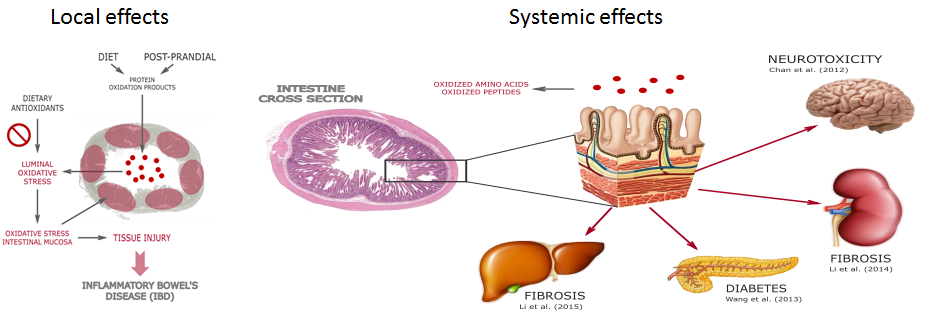
pathway. As Estévez and Luna rightly point out, "[t]hese results proven that PROTOX products may be implicated in the transfer of oxidative stress from the luminal phase to the lamina propia of the intestinal mucosa facilitating the process of IBD" (Estézes. 2016 |see Figure 4, left).
Figure 4: LEFT - Pathogenesis of dietary protein oxidation products in the GIT: transfer of oxidative stress from lumen to intestinal mucosa, tissue injury and inflammatory disease.f, RIGHT - Absorption and subsequent pathological effects of dietary protein oxidation products in targeted tissues (Estévez. 2016).
The molecular mechanisms of this pathological effect involved is, according to the authors of this most recent review a NADPH oxidase-mediated ROS generation, JNK phosphorylation, and poly (ADP-ribose) polymerase-1 (PARP-1) activation. Consequences of which studies show that their effects are not limited to the gut.
Protein oxidation during refrigerated storage of liver pâtés with added BHT sage or rosemary essential oils (p < 0.05, between antioxidant groups within a day of storage denoted by letters | Estévez. 2006)
Vitamin E doesn't work, vitamin C only increases the formation of PROTOX! Studies suggest that adding known anti-oxidant to your foods may both promote and inhibit the formation of PROTOX or Pox, as they are also called. The usual suspects, such as tocopherols, however, will be failing you, here. Some phenolic-rich plant and fruit extracts have been shown to exert anti-oxidative protection of proteins in cooked pork patties, porcine liver pâté (see figure on the left) and chicken, but the pro-/anti-oxidative effect depends on the structure and the concentration of the respective phenolic compound.

In beef patties, a rosemary extract was found to have no protective effect against Pox and a mixture of ascorbate and citrate promoted Pox, while both anti-oxidant systems protected lipids from oxidation. Furthermore, addition of rosemary oil to frankfurters has been shown to inhibit Pox while addition of higher levels of the rosemary oil resulted in a prooxidative effect when the frankfurters were prepared with meat from white pigs showing that the anti-oxidative effect was dependent on concentration and product characteristics. Lastly, it should be mentioned that the synthetic hydrophilic anti-oxidant Trolox (a vitamin E analogue) was found to prevent oxidation of both protein and lipid fractions (Lund. 2011).
As such, diets rich in readily oxidized components (polyunsaturared fatty acids) and meat proteins are believed have long been linked to a increased risk of suffering various forms of IBD such as Crohn's disease and ulcerative colitis (Hou et al., 2011), but it is also, as Estévez and Luna point out, also reasonable to hypothesize that such diets may contribute considerable oxidized proteins given the close association between LOX and PROTOX in food systems and in the gastrointestinal tract (Soladoye et al., 2015; Van-Hecke et al., 2015).
"Gurer-Orhan et al. (2006) already hypothesized that oxidized amino acids may be misincorporated into proteins such as enzymes and structural element in cells, potentially contributing to malfunction, cell apoptosis and disease. These authors emphasized that post-translational oxidative modification of proteins may not be the only factor that contributes to in vivo PROTOX suggesting that external (dietary) sources of oxidized amino acids may cause direct toxic effects by being used for de novo synthesis of proteins. To similar conclusions came succeeding studies carried out by Dunlop et al. (2008; 2011). The absorption and subsequent deleterious effects of unnatural oxidized amino acids such as meta-tyrosine and 3,4-dihydroxyphenylalanine (L-DOPA) are known to occur in animals and humans leading to dysfunctional proteins and toxicity (Dunlop et al., 2015). These species may not only be formed in foods as a result of tyrosine oxidation, they are also natural components of edible plants and beans (Siddhuraju & Becker, 2001; Davies, 2003; Dunlop et al., 2015). Chan et al. (2012) demonstrated that substitution of L-tyrosine residues in proteins with L-DOPA causes protein misfolding, promotes protein aggregation and stimulates the formation of autophagic vacuoles in SH-SY5Y neuroblastoma cells. Other oxidized forms of tyrosine, such as the ortho-tyrosine, contribute to the impairment of the insulin-induced arterial relaxation through the attenuation of endothelial nitric oxide synthase (eNOS) phosphorylation (Szijártó et al., 2014)" (Estévez. 2016).
Similar effects as they are described for oxidized tyrosine have been observed for oxidized tryptophan and lysine, which are present in significant amount in a plethora of processed foods including, but not restricted to meat and dairy.
Table 1: Relation of 2-AAA (oxidized lysine) levels to the risk of future diabetes in the whole sample and subgroups of 188 individuals who developed diabetes and 188 propensity-matched controls from 2,422 normoglycemic participants followed for 12 years in the Framingham Heart Study (Wang. 2013).
With respect to the latter, i.e. oxidized lysine, it is certainly worth poining out that 12-years long metabolomic study with human patients found this compound to be the most reliable indicator of diabetes risk - plus: Wang et al. were able to demonstrate that its oral ingestion increased the levels of the oxidized amino acid particularly in the pancreas, the same organ that is failing in diabetes (Wang et al., 2013). Other oxidized amino acids have been linked to
  • cell death in the intestine, colon and small intestine and subsequent irritable bowel disease (various) AOPPs; Xie et al (2014), Fang et al. (2012), Keshavarzian et al. (2003), Wu et al. (2015)
  • intestinal flora & redox state disturbance and liver & kidney stress, oxidized casein; Fang et al. (2012), Li et al. (2013), and Li et al. (2014)
With oxidized proteins and amino acids, there's thus yet another, often overlooked parameter of our food intake and dietary habits with "straightforward impact on health status" (Estevéz. 2016).
Bottom line: As premature as our understanding of the biology that governs the beneficial/detrimental effects of certain dietary components still is, there is ample evidence that not just the consumption of oxidized dietary fats, but also that of proteins, the major components of most foods (particularly animal-source), could harm us.

Fresh (!) Red Meat Acquitted - Overgeneralized Accusations that Red Meat Consumption Triggers Cancer Overlooks Influence of Processing & Other Confounding Factors | more
This does not mean that proteins (animal or plant proteins) are still a vital part of a healthy diet - that's indisputable. As Estevez and Luna point, out, "the discussion about dietary proteins [wich] is typically centered in the quantity, quality (≈ amino acid profile; biological value) and bioavailability upon digestibility," future recommendations for protein intake will have to consider the differential impact of foods with different PROTOX levels, as well. In this context, it should be obvious why "the current increase of the intake by population of highly processed animal-based foods with high protein content and presumably high oxidation rates" has been found to predict the raise of health disorders already associated to in vivo or dietary oxidative stress, in dozens if not hundreds of epidemiological studies | Comment!
References:
  • Awada, Manar, et al. "Dietary oxidized n-3 PUFA induce oxidative stress and inflammation: role of intestinal absorption of 4-HHE and reactivity in intestinal cells." Journal of lipid research 53.10 (2012): 2069-2080.
  • Bao, Yulong, and Per Ertbjerg. "Relationship between oxygen concentration, shear force and protein oxidation in modified atmosphere packaged pork." Meat science 110 (2015): 174-179.
  • Berlett, Barbara S., and Earl R. Stadtman. "Protein oxidation in aging, disease, and oxidative stress." Journal of Biological Chemistry 272.33 (1997): 20313-20316.
  • Chan, Sandra W., et al. "L-DOPA is incorporated into brain proteins of patients treated for Parkinson's disease, inducing toxicity in human neuroblastoma cells in vitro." Experimental neurology 238.1 (2012): 29-37.
  • Chang, Dong, et al. "Evaluation of oxidative stress in colorectal cancer patients." Biomedical and Environmental Sciences 21.4 (2008): 286-289.
  • Davies, Michael J. "Singlet oxygen-mediated damage to proteins and its consequences." Biochemical and biophysical research communications 305.3 (2003): 761-770.
  • Davies, Michael J. "The oxidative environment and protein damage." Biochimica et Biophysica Acta (BBA)-Proteins and Proteomics 1703.2 (2005): 93-109.
  • Dunlop, Rachael A., Roger T. Dean, and Kenneth J. Rodgers. "The impact of specific oxidized amino acids on protein turnover in J774 cells." Biochemical Journal 410.1 (2008): 131-140.
  • Dunlop, Rachael A., Ulf T. Brunk, and Kenneth J. Rodgers. "Proteins containing oxidized amino acids induce apoptosis in human monocytes." Biochemical Journal 435.1 (2011): 207-216.
  • Estévez, Mario, Sonia Ventanas, and Ramón Cava. "Effect of natural and synthetic antioxidants on protein oxidation and colour and texture changes in refrigerated stored porcine liver pâté." Meat science 74.2 (2006): 396-403.
  • Estévez, M. "Oxidative damage to poultry: from farm to fork." Poultry science 94.6 (2015): 1368-1378.
  • Estévez, M., and C. Luna. "Dietary Protein Oxidation: A Silent Threat to Human Health?." Critical Reviews in Food Science and Nutrition just-accepted (2016): 00-00.
  • Esterbauer, Hermann, et al. "The role of lipid peroxidation and antioxidants in oxidative modification of LDL." Free Radical Biology and Medicine 13.4 (1992): 341-390.
  • Esterbauer, Hermann. "Cytotoxicity and genotoxicity of lipid-oxidation products." The American journal of clinical nutrition 57.5 (1993): 779S-785S.
  • Fang, W., et al. "Effect of oxidated food protein on mice gut floraand redox state." Chinese Journal of Microecology 24 (2012): 193-196.
  • Gurer-Orhan, Hande, et al. "Misincorporation of free m-tyrosine into cellular proteins: a potential cytotoxic mechanism for oxidized amino acids." Biochemical Journal 395.2 (2006): 277-284.
  • Hou, Jason K., Bincy Abraham, and Hashem El-Serag. "Dietary intake and risk of developing inflammatory bowel disease: a systematic review of the literature." The American journal of gastroenterology 106.4 (2011): 563-573.
  • Keshavarzian, A., et al. "Role of reactive oxygen metabolites in experimental colitis." Gut 31.7 (1990): 786-790.
  • Keshavarzian, A., et al. "Increases in free radicals and cytoskeletal protein oxidation and nitration in the colon of patients with inflammatory bowel disease." Gut 52.5 (2003): 720-728.
  • Li, Zhuqing Leslie, et al. "Effect of oxidized casein on the oxidative damage of blood and digestive organs in mice." Acta Nutrimenta Sinica 35.1 (2013): 39-43.
  • Li, Zhuqing Leslie, et al. "Oxidized casein impairs antioxidant defense system and induces hepatic and renal injury in mice." Food and Chemical Toxicology 64 (2014): 86-93.
  • Li, Zhuqing Leslie, et al. "24-Week Exposure to Oxidized Tyrosine Induces Hepatic Fibrosis Involving Activation of the MAPK/TGF-β1 Signaling Pathway in Sprague-Dawley Rats Model." Oxidative medicine and cellular longevity 2016 (2015).
  • Lund, Marianne N., et al. "Protein oxidation in muscle foods: A review." Molecular nutrition & food research 55.1 (2011): 83-95.
  • Sante-Lhoutellier, Veronique, Laurent Aubry, and Philippe Gatellier. "Effect of oxidation on in vitro digestibility of skeletal muscle myofibrillar proteins." Journal of Agricultural and Food Chemistry 55.13 (2007): 5343-5348.
  • Siddhuraju, Perumal, and Klaus Becker. "Rapid reversed-phase high performance liquid chromatographic method for the quantification of L-Dopa (L-3, 4-dihydroxyphenylalanine), non-methylated and methylated tetrahydroisoquinoline compounds from Mucuna beans." Food chemistry 72.3 (2001): 389-394.
  • Sies, Helmut, Wilhelm Stahl, and Alex Sevanian. "Nutritional, dietary and postprandial oxidative stress." The Journal of nutrition 135.5 (2005): 969-972.
  • Soladoye, O. P., et al. "Protein oxidation in processed meat: Mechanisms and potential implications on human health." Comprehensive Reviews in Food Science and Food Safety 14.2 (2015): 106-122.
  • Stadtman, Earl R. "Metal ion-catalyzed oxidation of proteins: biochemical mechanism and biological consequences." Free Radical Biology and Medicine 9.4 (1990): 315-325.
  • Stadtman, E. R. "Oxidation of free amino acids and amino acid residues in proteins by radiolysis and by metal-catalyzed reactions." Annual review of biochemistry 62.1 (1993): 797-821.
  • Szijártó, Andras István, et al. "Elevated vascular level of ortho-tyrosine contributes to the impairment of insulin-induced arterial relaxation." (2014).
  • Villaverde, Adriana, and Mario Estévez. "Carbonylation of myofibrillar proteins through the Maillard pathway: Effect of reducing sugars and reaction temperature." Journal of agricultural and food chemistry 61.12 (2013): 3140-3147.
  • Wang, Thomas J., et al. "2-Aminoadipic acid is a biomarker for diabetes risk." The Journal of clinical investigation 123.10 (2013): 4309-4317.
  • Wu, Peiqun, et al. "Advanced oxidation protein products decrease the expression of calcium transport channels in small intestinal epithelium via the p44/42 MAPK signaling pathway." European journal of cell biology 94.5 (2015): 190-203.
  • Xie, F., et al. "Advanced oxidation protein products induce intestine epithelial cell death through a redox-dependent, c-jun N-terminal kinase and poly (ADP-ribose) polymerase-1-mediated pathway." Cell death & disease 5.1 (2014): e1006.